



Dr. Zabeer Ahmed:
For years, agriculture in large parts of the Himalayan region followed a familiar cycle—small landholdings, low-value crops, uncertain returns and seasonal migration. Across many hilly districts of Jammu and Kashmir, and increasingly in neighbouring Himalayan states, farming remained tied to conventional crops that offered limited income and few opportunities for local value creation. That pattern began changing when aromatic crops cultivation moved from scientific laboratories into village fields.
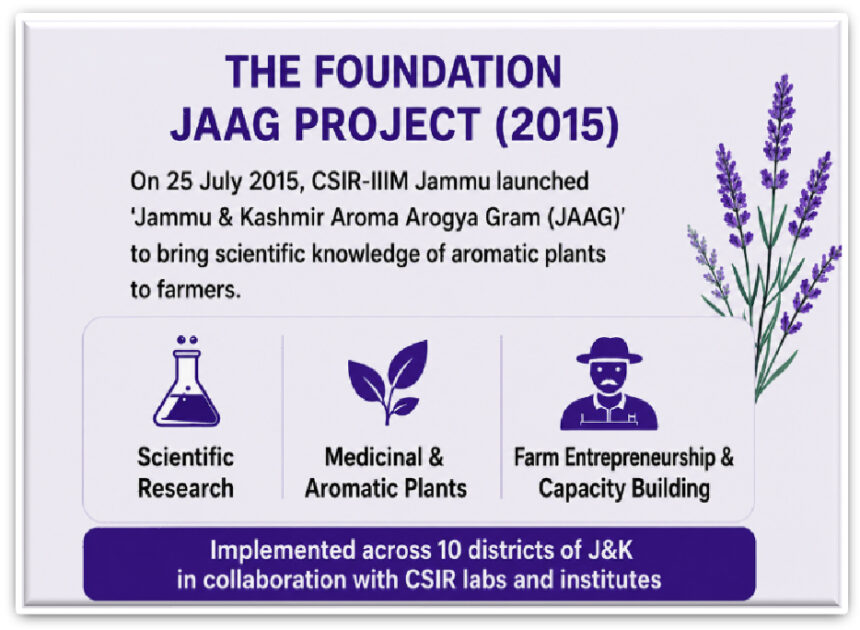
The transformation, however, did not happen overnight. It was the result of years of scientific research, field demonstrations and sustained efforts to bridge the gap between laboratory innovations and rural livelihoods. Before the Aroma Mission emerged as a nationwide programme, its foundation was laid through the Jammu and Kashmir Aroma Arogya Gram (JAAG) initiative.
Launched by Hon’ble Union Minister of Science & Technology and Vice President, CSIR, Dr. Jitendra Singh, on 19 October 2014 under the aegis of CSIR–Indian Institute of Integrative Medicine (CSIR-IIIM), Jammu, JAAG marked the first organised effort to introduce medicinal and aromatic plant cultivation as a viable livelihood option for farmers in Jammu and Kashmir.
Through this initiative, CSIR-IIIM supplied quality planting material, provided scientific training, demonstrated improved cultivation practices and encouraged value addition, enabling farmers to diversify from traditional crops to high-value aromatic plants.
Implemented across ten districts of Jammu and Kashmir, with particular focus on areas possessing favourable agro-climatic conditions, the project promoted the cultivation of industrially important aromatic crops alongside conventional farming while bringing underutilised land into productive use. Working in collaboration with CSIR-Central Institute of Medicinal and Aromatic Plants (CIMAP), Lucknow, CSIR-Institute of Himalayan Bioresource Technology (IHBT), Palampur, CSIR-National Botanical Research Institute (NBRI), Lucknow and CSIR-North East Institute of Science and Technology (NEIST), Johrat, the CSIR-IIIM demonstrated that agriculture could generate higher incomes not only through cultivation but also through processing, value addition and rural entrepreneurship.
The success of JAAG established a scalable model for science-led agricultural transformation and laid the foundation for the CSIR Aroma Mission, which was launched in 2016 as a flagship programme of the Council of Scientific and Industrial Research (CSIR), with CSIR-CIMAP, Lucknow, serving as the nodal institute.
Conceived to enhance farmers’ incomes through the cultivation of high-value aromatic crops while reducing India’s dependence on imported essential oils, the mission expanded the JAAG model from Jammu and Kashmir to suitable agro-climatic regions across the country.
The initiative has since received sustained policy support from the Government of India and aligns closely with Prime Minister Narendra Modi’s vision of transforming Indian agriculture through science, innovation and value addition while promoting the principles of “Vocal for Local,” “Local to Global” and Atmanirbhar Bharat.
The Hon’ble Prime Minister has also highlighted the Purple Revolution and the cultivation of lavender in his Mann Ki Baat addressed as, “There is a town ‘Bhadarwah’ in the Doda district of Jammu and Kashmir. Here, the farmers had been engaged in traditional maize cultivation for decades, but some farmers thought of doing something different. They turned to floriculture, that is, the cultivation of flowers. Today, around two and a half thousand farmers are cultivating lavender here. They have also been handheld through the Aroma Mission of the Central Government. This new cultivation has greatly increased the income of the farmers, and today, along with the lavender, the fragrance of their success is spreading far and wide. ” which exemplifies how scientific innovation can enhance farmers’ incomes, generate rural entrepreneurship and create sustainable livelihood opportunities in remote regions.
The mission has also received consistent support from Hon’ble Union Minister of Science & Technology and Vice President, CSIR, Dr. Jitendra Singh, whose mentorship has played a pivotal role in strengthening CSIR-led innovation, technology transfer and science-based rural entrepreneurship, particularly across the Himalayan region.

Photo : Union Minister, Dr. Jitendra Singh in the purple field of Lavender at Bhaderwah, Doda during Lavender Festival -2026
Scientific leadership from CSIR, under Director General Dr N. Kalaiselvi, has further guided its national expansion and implementation framework. Over time, however, the programme expanded beyond agriculture and developed into something larger—an ecosystem connecting cultivation, processing, entrepreneurship, branding, tourism and rural enterprise.
The story is most visible in Jammu and Kashmir, where lavender cultivation has become synonymous with what is now widely referred to as the Purple Revolution.
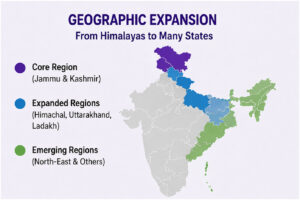
Lavender, traditionally associated with colder regions and niche cultivation, gradually entered new geographies through scientific support, free planting material, training and processing infrastructure. Under the Aroma Mission, cultivation extended across Jammu division districts including Doda, Jammu, Kathua, Kishtwar, Rajouri, Poonch, Ramban, Reasi, Samba and Udhampur; Kashmir division districts including Bandipora, Baramulla, Budgam, Ganderbal, Kulgam, Kupwara and Pulwama; and later into Leh and Kargil in Ladakh.
Aromatic crop interventions also reached neighbouring Himalayan states including Himachal Pradesh and Uttarakhand before extending to additional regions under successive phases of implementation.
CSIR data shows that the growth of lavender cultivation unfolded in phases and reflected how a scientific intervention gradually evolved into a rural economic model. During the initial phase, lavender cultivation covered around 164.92 hectares, with nearly 600 farmers adopting cultivation practices.
Early revenues reached approximately ₹8.6 lakh, demonstrating commercial potential even at limited scale. Nursery systems developed alongside cultivation and generated nearly 50 lakh rooted cuttings, creating the planting base for future expansion.
The second phase marked the decisive expansion period. Cultivation increased to approximately 910.71 hectares, and more than 2,500 farmers became associated with lavender farming.
Oil extraction crossed 3,000 kilograms, while revenues expanded sharply to nearly ₹8.09 crore. Nursery infrastructure strengthened further with production exceeding 1.10 crore rooted cuttings.
Expansion continued in later phases with an additional 552 hectares brought under cultivation and more than 1,500 additional farmers associated with lavender farming. Oil extraction added another 1,097 kilograms, while revenues crossed ₹10 crore, reflecting the transition from cultivation to a broader rural economy.
During Phase I (April 2016–March 2019), CSIR-IIIM brought more than 1,800 hectares under 15 aromatic crops across 12 states and directly connected over 2,100 farmers with aromatic cultivation.
To strengthen value retention at village level, 55 distillation units were installed and more than 120 training and awareness programmes introduced farmers and rural youth to oil extraction, processing and value addition practices. Bhaderwah emerged as one of the strongest examples during this period, producing nearly 1,600 litres of lavender oil and generating revenues exceeding ₹1.5 crore.
Phase II (April 2020–March 2023) marked the turning point that transformed lavender into a flagship crop. The Mission expanded to over 9,000 hectares across 15 states and strengthened adoption through free distribution of quality planting material worth nearly ₹2 crore. Farmers collectively produced more than 5,000 kilograms of essential oil while generating additional income through nursery development and sale of planting material.
The phase III (April 2023–March 2026) moved beyond cultivation expansion and focused increasingly on value addition and enterprise development. Mission interventions extended across 13 states and two Union Territories covering more than 2,400 hectares under crops including Lavender, Lemongrass, Mint, Rosemary, Ocimum, Rosagrass and wild Marigold.
Jammu and Kashmir became the mission’s strongest demonstration ground. Initial implementation covered around 165 hectares with nearly 600 farmers adopting lavender cultivation. Subsequent expansion brought hundreds of additional hectares under cultivation and drew thousands more farmers into the programme.
Recent assessments indicate that more than 1,200 hectares are now under aroma cultivation in Jammu and Kashmir, supported by an expanding nursery and processing network.
Expansion of nursery infrastructure enabled large-scale production of rooted planting material and supported future cultivation growth. Yet the significance of the intervention lies less in acreage than in changing the economics of agriculture.
The central idea was that farmers should not remain suppliers of raw agricultural produce. Instead of harvesting and selling directly at commodity prices, the model introduced processing and market participation at the village level.
To make cultivation commercially viable, dozens of distillation units were installed across cultivation clusters. Farmers could process harvested flowers locally and convert them into essential oils and related products with significantly higher market value. Across Jammu and Kashmir, fixed and mobile distillation units were installed to reduce post-harvest loss and improve price realisation.
This altered the economics of farming — a change reflected most clearly in farmers’ own experiences.
Bharat Bhushan said, “I am from Bhaderwah district. Earlier, we used to depend on traditional farming and the income was limited. Through the CSIR Aroma Mission, we started cultivating lavender and our earnings improved significantly. The support we received in training and cultivation encouraged us to continue. Today, we see farming not just as agriculture but as an opportunity for better livelihoods.”
Before adopting aromatic crops, many growers depended on maize and other conventional crops that generated modest annual returns. IIIM assessments recorded a substantial jump in earnings after shifting to lavender. Net annual income that earlier ranged between roughly ₹40,000 and ₹60,000 per hectare increased to between ₹3.5 lakh and ₹5.0 lakh per hectare.
In several areas of Doda district, farmers who once viewed agriculture as subsistence activity began treating it as an enterprise.
Local processing encouraged a second layer of economic activity. Entrepreneurs entered packaging, oil extraction, wellness products, fragrances, dried flower products and small-scale manufacturing. Under the later phases of the Mission, farmers were increasingly encouraged to move beyond cultivation and become rural entrepreneurs.
Another young entrepreneur said, “Earlier we practiced traditional farming, but after starting lavender cultivation we saw better returns. Compared to conventional crops, lavender gave us stronger market value and better profits. Exposure through industry interactions and festivals also helped us understand opportunities beyond cultivation.”
Training programmes introduced production of perfumes, aromatic candles, agarbatti, car diffusers and dried flower products using essential oils sourced from local farms. These interventions contributed to the emergence of more than 24 agri-startups and rural enterprises.
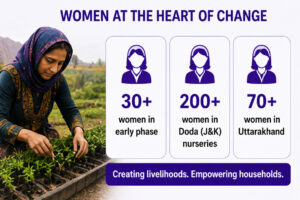
Women’s participation increased in nursery work, harvesting and post-harvest handling, creating supplementary household income streams. Early interventions recorded more than 30 women involved in nursery development, while later expansion saw over 200 women engaged in nursery generation activities in Doda district alone. In Uttarakhand, more than 70 women became associated with lavender cultivation.
Reports from the mission indicate that thousands of farmers and young entrepreneurs received training in cultivation, processing, value addition and marketing.
Bhaderwah and surrounding regions increasingly began attracting visitors during flowering seasons. What started as agricultural activity gradually created local spending through transport, food services, hospitality and visitor experiences. Lavender festivals and destination branding introduced a tourism layer that supported businesses beyond farming.
Annual Lavender Festivals became an important public expression of the Mission’s growth. The first festival held on 25–26 May 2022 highlighted early success stories and the emergence of lavender as a flagship crop. The second edition on 4–5 June 2023 reflected rapid expansion in cultivation and value addition, while the third festival held on 1–2 June 2025 showcased agri-startups, value-added products and the wider economic ecosystem emerging around the Purple Revolution.
This year, the 4th Lavender Festival under the theme, “Lavender Goes Global” marked then enthusiastic participation of Indian Aroma Industries Leaders, Farmers, Startup, Scientists, policy makers and national media. As prelude to the event, CSIR-IIIM Jammu also organised Stakeholders meet at Jammu, and Buyer-Seller meet at CSIR Innovation Complex, Mumbai which helped the farmers to build direct connect with the industries and market.
An Agri-businessman Touqeer Bagban sharing his success story said, “This year’s Lavender Festival, organised around the theme ‘Lavender Goes Global’, encouraged us a lot. Harvesting has already started and the event gave us exposure through technical sessions and buyer–seller interactions.”
These events gradually positioned Bhaderwah as a centre of agri-innovation and rural tourism while creating direct interaction between farmers, scientists, entrepreneurs and policymakers.
The wider impact of the programme also gained national recognition. The Prime Minister highlighted the Aroma Mission during the 99th edition of Mann Ki Baat, recognising its contribution to farmer empowerment and indigenous essential oil production. The Purple Revolution Tableau later featured during the Republic Day Parade in 2024. In recognition of its scientific and societal contribution, the CSIR-led Aroma Mission received the Rashtriya Vigyan Puraskar 2025 (Vigyan Team Award).
There are still figures that require consolidation—updated farmer counts, current business turnover, startup numbers, tourism revenue, import substitution data and independent evaluation outcomes. Those numbers will determine whether the mission’s long-term success matches its early promise.
Aroma Mission changed the conversation from how much land was cultivated to how much value remained with the people cultivating it.
[The author is Director of CSIR-Indian Institute of Integrative Medicine]

