



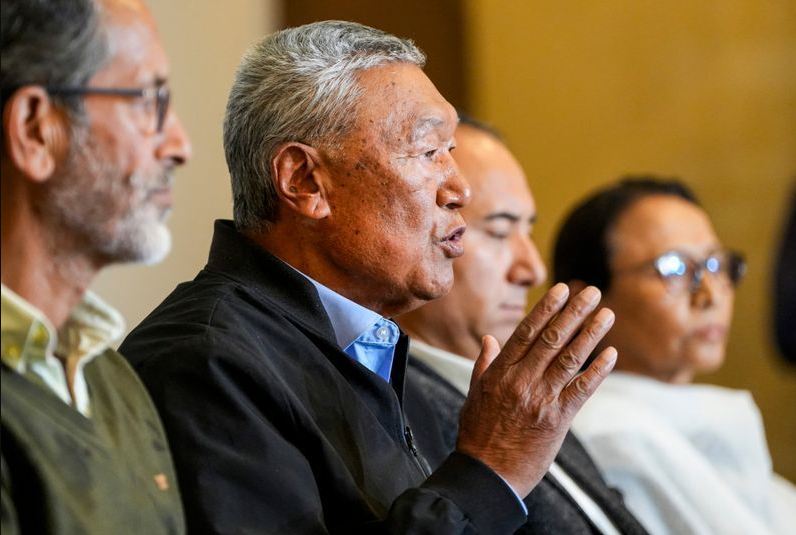
Jammu: Ahead of the crucial talks between Ladakh representatives and the Ministry of Home Affairs (MHA), the Leh Apex Body (LAB) appears to be facing an existential crisis as internal differences have come out in the open, with senior member Nawang Rigzin Jora distancing himself from the organisation and the dialogue process for reasons that remain unclear, while public accusations and counter-allegations among other senior members have further complicated the situation.
It is yet to be ascertained whether Jora’s decision stems from internal differences within the LAB or other personal or political considerations. His absence from recent meetings has triggered speculation at a significant juncture, when the civil society body is preparing for talks with the Centre scheduled for May 22.
The development comes shortly after the LAB formally accepted the resignation of former parliamentarian and former chairman ThupstanChhewang on May 4. Chhewang had submitted his resignation on July 6, 2025, but the decision was accepted only recently after deliberations within the leadership.
During a press conference on May 4, LAB leaders had acknowledged that differences of opinion had surfaced between Chhewang and other members on several occasions, including during high-level meetings with the Lieutenant Governor of Ladakh and Union Home Minister Amit Shah. The organisation had also stated that Chhewang had been unable to attend key meetings since last year due to “health and personal reasons”.
Confirming Jora’s absence from the organisation’s activities, veteran Buddhist leader and LAB co-convener CheringDorjay Lakruk told The News Now that Jora had stopped attending meetings and had conveyed that he did not wish to be part of the dialogue process.
“Jora Sahib has not been attending the meetings of the Apex Body and he has also conveyed not to be part of the dialogue process. We do not know the reasons and it would be better to ask him directly,” Lakruk said.
When asked whether the development pointed to emerging differences within the LAB, Lakruk said it would be “inappropriate to draw conclusions” without hearing from Jora himself. “Only Jora Sahib can explain the exact reasons behind his decision to stay away from the Apex Body and the talks,” he added.
On the issue of replacing Jora or including another representative from the LAB in the proposed sub-committee for talks, Lakruk said no decision had been taken so far. According to him, the MHA is yet to formally seek the names of representatives for the next round of dialogue.
“We will discuss the matter and take a decision once the MHA asks us to submit the names,” he said.
All attempts to contact Nawang Rigzin Jora for his response turned futile, as he did not respond to phone calls.
The next round of MHA-level talks between the civil society groups — the Leh Apex Body and the Kargil Democratic Alliance — is scheduled for May 22. This will be the first meeting between Ladakh leaders and MHA officials after the release of climate activist Sonam Wangchuk from Jodhpur jail on March 14 following the revocation of his preventive detention under the National Security Act (NSA) by MHA.
The resumption of dialogue was announced on April 26 by Ladakh Lieutenant Governor Vinai Kumar Saxena, ahead of Amit Shah’s two-day visit to Ladakh on April 30 and May 1.
The last meeting between two sides was held on February 4 in New Delhi. The leaders from Ladakh had demanded convening of High Powered Committee (HPC) meeting ahead of recently visit of the Union Home Minister to Ladakh for meaningful dialogue.
The HPC is headed by Union Minister of State for Home Nityanand Rai and has wider participation from LAB, KDA, MHA, other Ladakh representatives and UT administration.
The Sub-Committee meeting, however, is chaired by the MHA officials and has less members from LAB and KDA. It was the HPC meeting which was held in New Delhi on February 4 but no breakthrough was made on the demands.
