



Ahmed Ali Fayyaz
SRINAGAR: Thirty-six years after he had to abandon his dream project due to a host of reasons, including the then neonatal armed insurgency in Kashmir in 1989, filmmaker Muzaffar Ali on Tuesday resumed the shooting of ‘Zooni’ in Tral—once the valley’s most dreaded haven of militants and home of the militant icon Burhan Wani.
Padam Shree awardee Muzaffar Ali, now 80, appeared in Tral, alongwith a camera crew and actors, including his son Shad Ali, and resumed the shooting for a biopic on Kashmir’s legendary poetess-queen ‘Habba Khatoon’ at the wildlife sanctuary of Shikargah and an adjoining tourism facility. Senior officials, including Deputy Inspector General of South Kashmir, Javed Iqbal Matoo, visited the troupe and the locales to ensure that everything ran smoothly.
Even as most of the local residents were not left free to gather at the shooting site, youths in large numbers expressed their enthusiasm over the Bollywood film being revived in their area. Some of them managed to shoot brief videos for their social media handles.
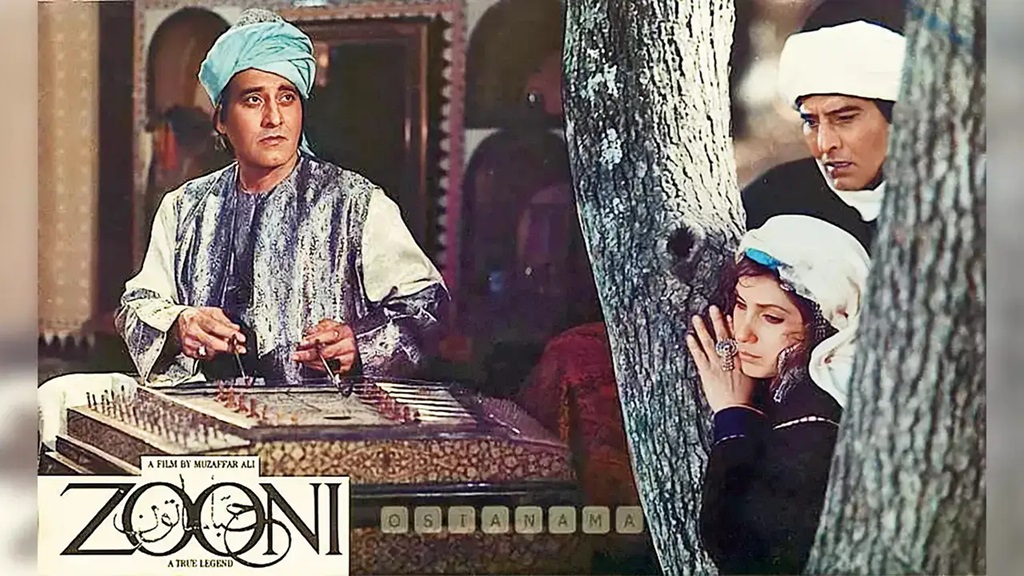
Muzaffar Ali, who made the famous Bollywood film ‘Umrao Jan’ on Mirza Hadi Ruswa’s novel ‘Umrao Jan Ada’ with Rekha and Farooq Shaikh in the lead roles in 1981, began ‘Zooni’ with a financial support from the then National Conference government of Dr Farooq Abdullah in 1988. It was expected to be completed and screened in 1990. However, a slew of inclement adversities including a burgeoning insurgency forced Muzaffar Ali to abandon his Kashmir project. By the time he packed up, he had shot 75,000 running feet on magnetic tapes.
While the then Bollywood heartthrob Dimple Kapadia was playing Habba Khatoon aka ‘Zooni’, Vinod Khanna had been given the stellar role of Kashmir’s last sovereign monarch Yousuf Shah Chak.
In the last 35 years of insurgency and a long separatist movement, in which Tral grew up as a haven for the militants and the Hizbul Mujahideen poster boys Burhan Wani and Zakir Moosa ruled the roost of terror, Muzaffar Ali made several unsuccessful attempts to re-start his project. In 1996-2002, he attempted to seek a fresh financial support from Dr Abdullah’s government which was denied to him outright.
‘Zooni’ was conceived as a period film on the valley’s 16th century legendary poetess-queen whose husband and king Yousuf Shah Chak was deceitfully captured and held in confinement till his death by the Mughal emperor Akbar after losing three invasions on Kashmir.
Habba Khatoon’s life story is a tale crying out to be told within the National and International reach of the Hindi film world. Born in 1554 CE to a poor farmer, Zooni, as she was known, was a fine poetess in her own right. Married to a poor man who disapproved of her poetry and saddled with a hostile mother-in-law, she would divorce her husband and go on to become the empress of Kashmir taking on the name Habba Khatoon after marrying Yusuf Shah Chak, the then ruler of Kashmir.
It is said that it was love at first sight for both when Chak came across her reciting her poetry in the saffron fields of the region. After Emperor Akbar had Chak arrested by treachery and banished to Bihar, a dismayed Khatoon left the palace with her little daughter and lived in a small hut by the banks of the Jhelum, composing soulful poems about love and separation in Kashmiri. Her legendary beauty and mellifluous voice ensured her poetry became extremely popular around Kashmir and remains so in the valley even today, more than 400 years after the death in 1609.
The crew put together by Muzaffar Ali was impressive. The music of the international version was in the hands of Oscar winner Japanese composer, Riyuchi Sakamoto (The Last Emperor, The Revenant), with songs in Kashmiri by Mohan Lal Aima.
The Urdu version’s lyrics were by Shahryar and music by Ali’s favorite composer, Khayyam. Basheer Ali was the cinematographer of the film.
A New York based writer, James Killough,wrote the script with Urdu dialogues by Asghar Wajahat while famous American fashion designer Mary McFadden looked after the costumes of the film.
In an interview to the NY Times in February, 1990, McFadden spoke about her work in Zooni saying, “This is like a Cecil B DeMille production, with 1,000 people in two villages to dress. There are no records of how people looked, and no miniatures like other places. I took a melange of looks from the high courts of Persia and Suleiman the Magnificent in Constantinople, so they have more of a Persian feeling. The Mogul Empire had not yet influenced Kashmir.” She also added that fabrics were donated from Indian mills and antique clothing from private collections.
For his revived project, Muzaffar Ali and his son Shad Ali have replaced Vinod Khanna and Dimple Kapadia with Aditya Roy Kapur and Bhumi Pednekar.

