



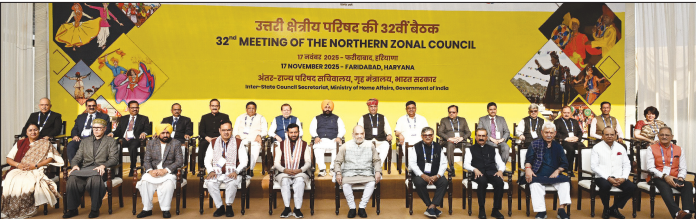
32nd meeting of NZC
LG Sinha stresses zero tolerance to terror, Omar calls for trust in people
Faridabad: Union Home Minister Amit Shah on Monday vowed to track down those responsible for the Delhi blast and asserted that the culprits would be found even from the depths of ‘Patal’ (netherworld) and face the strictest possible punishment.
Addressing the 32nd meeting of the Northern Zonal Council (NZC) here, Shah said under the leadership of Prime Minister Narendra Modi, eliminating terrorism from its roots is the collective commitment of the government.
He said in line with the track record of the Modi government so far, the culprits of the Delhi bomb blast will be traced even from ‘Patal’, brought before the country’s judicial system, and given the strictest possible punishment.
At the start of the meeting, tributes were paid and a two-minute silence was observed in memory of those killed in the car bomb blast near Red Fort and the explosion at Nowgam Police Station in Jammu and Kashmir.
Addressing the 32nd meeting of the Northern Zonal Council here, Shah also said that all states should work in mutual coordination to resolve water resource management and water-related problems.
“Our goal is clear – regional strength along with national progress and India’s global leadership in every field, which will lead us towards the creation of a great India,” he said.
Chief Ministers Nayab Singh Saini (Haryana), Sukhvinder Singh Sukhu (Himachal Pradesh), Bhagwant Mann (Punjab), Bhajan Lal Sharma (Rajasthan), Rekha Gupta (Delhi), Omar Abdullah (J&K), Punjab Governor and Administrator of Chandigarh Gulab Chand Kataria, Lieutenant Governors Manoj Sinha (J&K), V K Saxena (Delhi) and Kavinder Gupta (Ladakh) attended the meeting, officials said.
The home minister said poverty is being eradicated and employment is increasing through cooperation, agriculture, and fisheries.
Referring to Prime Minister Narendra Modi’s mantra of ‘Sahkar Se Samriddhi’ (Prosperity through Cooperation), he said the cooperative sector holds immense potential for employment.
He said that only through growth in employment — especially self-employment — along with Gross Domestic Product (GDP) can the country realise the dream of a developed India.
Shah said the GDP alone is not an indicator of a country’s prosperity; true prosperity is achieved only when every individual rises above the poverty line.
He said the Ministry of Cooperation has initiated 57 measures across the country to strengthen the sector. These include computerisation of Primary Agricultural Credit Societies (PACS), establishment of three new national-level cooperative societies, and the setting up of Tribhuvan Sahkari University, he said.
The home minister said the original spirit and the role of zonal councils is advisory, but in the last decade, they have been accepted as action-oriented platforms and have delivered results.
“With follow-up, we have not only accepted issues between states, between regions and states, and between the Centre and state governments, but also created concrete pathways for their resolution,” he said.
Shah said compared to 2004–2014, the number of zonal council meetings from 2014 to 2025 has increased by about two-and-a-half times, and the government has made these meetings meaningful.
He said between 2004 and 2014, there were a total of 25 meetings of zonal councils and standing committees, whereas from 2014 to 2025 till now, 64 meetings have been held.
He said more than doubling the number of meetings reflects PM Modi’s concept of TEAM Bharat. In these meetings, 1600 issues were discussed and 1303 issues (81.43 per cent) were resolved.
This has been possible due to the cooperation of all state governments, Union territories, and central ministries and departments, with the Inter-State Council Secretariat playing an active role, he said.
The home minister said this year marks the 150th anniversary of ‘Vande Mataram’. At one time, Bankim Chandra Chatterjee’s great composition ‘Vande Mataram’ became the clarion call for our country’s freedom, he said, adding now the Government of India and all states are working together to once again make it the clarion call for building a ‘great India’.
Referring to the implementation of the three new criminal laws, Shah said their enforcement has yielded very positive results. Under the new laws, the conviction rate has increased by approximately 25 to 40 per cent and culprits are receiving timely punishment, he said.
Presenting the administration’s perspective, Lieutenant Governor Manoj Sinha said Jammu & Kashmir has achieved “historic transformation” since August 2019 under the leadership of Prime Minister Narendra Modi and the guidance of Home Minister Amit Shah.
He cited progress in economic growth, investment, infrastructure development, connectivity, and grassroots democracy, along with improved opportunities for youth and women.
Sinha said the UT’s “Zero Tolerance to Terrorism” policy has curbed violence, stone pelting, strikes and local recruitment into terror ranks.
He praised the recent Jammu & Kashmir Police investigation that unearthed a pan-India terror network, calling it an example of strengthened security coordination.
Highlighting progress on national initiatives, the LG said J&K secured first place across the country during the initial phase of the 150th-year commemoration of ‘Vande Mataram,’ with nine of the top ten participating districts belonging to the UT.
He added that J&K’s 360-degree security grid and improved coordination among agencies continue to foil attempts by adversaries.
Speaking at the meeting, Chief Minister Omar Abdullah highlighted the launch of Mission YUVA, describing it as a major push to strengthen education, expand sports infrastructure, and nurture an entrepreneurial ecosystem in the Union Territory.
He expressed gratitude to the Centre for its continued financial support, including the extension of the SASCI scheme to J&K.
Calling the NZC an important platform for cooperation among States and UTs, Abdullah said J&K remains firmly committed to national growth and democratic values.
Referring to recent terror attacks, he noted that while terrorism must be fought with determination, innocent people should not be subjected to suspicion.
“Every resident of J&K should not be seen with doubt. The people of J&K are peace-loving and aspire for Viksit Bharat and Viksit Jammu & Kashmir,” he said, pointing to the enthusiastic turnout in the Nagrota and Budgam by-elections as proof of faith in democracy.

