



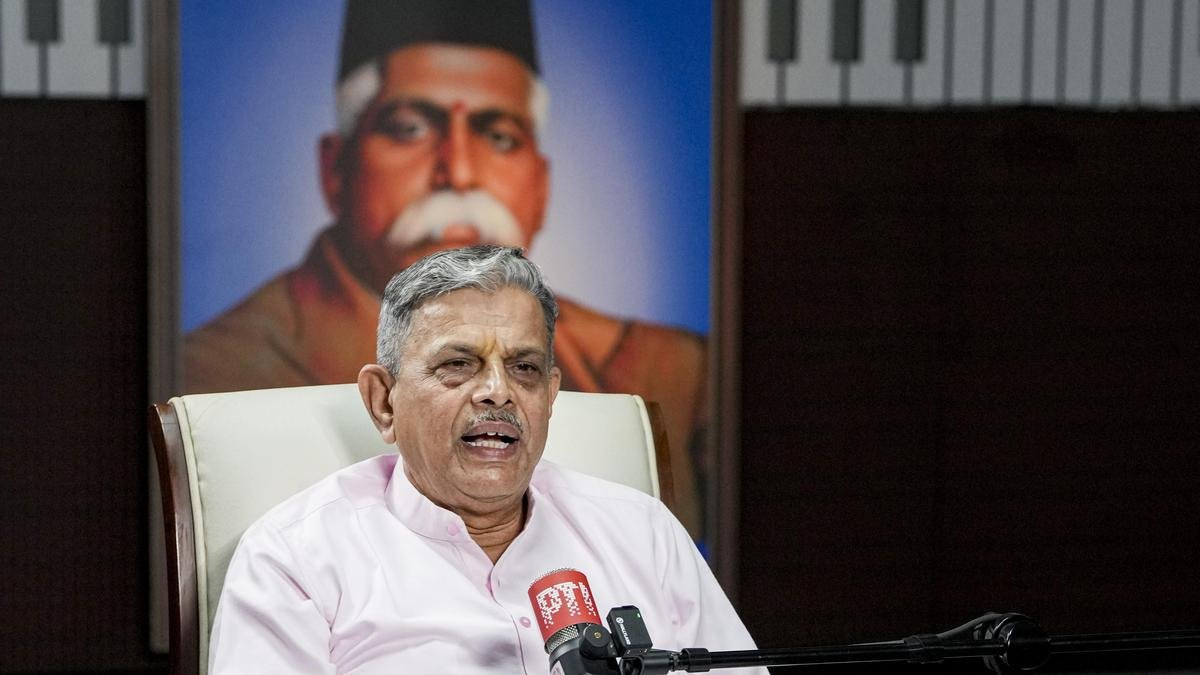
New Delhi: People-to-people contact is key to breaking the deadlock with Pakistan and there should always be a window for dialogue, top RSS functionary Dattatreya Hosabale said on Tuesday.
In an interview, Hosabale said Pakistan’s military and political leadership have lost India’s confidence and it is time for civil society to lead the way.
“The security and self-respect of a country have to be protected and the government of the day should take care of it. But at the same time, we need not close the doors. We should always be ready to engage them in a dialogue,” he said.
The RSS general secretary termed people-to-people contact the key in breaking the deadlock between the two countries and said that it “should be tried more and more now”.
While the government has been silent on track-two diplomacy, several intellectuals, including opposition leaders, have long advocated civil society engagement.
“This is the one hope I think, because I believe strongly that ultimately the civil society relations (will work). Because we have a cultural relation and we have been one nation,” Hosabale said.
“So, that has to be emphasised,” he said.
He was asked how India should deal with Pakistan and its continued sponsorship of terrorism.
“See everything has been tried (diplomatically) and Pakistan keeps making pinpricks,” he said, citing terrorist attacks such as 26/11, Pulwama and Pahalgam.
Trade and commerce, issuance of visas should not stop because “there should be a window (open) always for a dialogue”, he said.
That’s why diplomatic relations have been maintained, Hosabale added.
He said academicians, sportspersons, scientists and community leaders should come forward there, as their political leadership and military leadership have developed some aversion to India.
He added the war in West Asia is not a civilisational conflict but it is about oil.
He said wars are generally a product of a wicked mind or the greed and arrogance of nations or individuals.
Asked if he was referring to US President Donald Trump, Hosabale said he did not say that.
“I did not say that, I did not mention anybody’s name,” he said.
He was asked if the US-Israeli attack on Iran was about nuclear weapons or about wiping out a civilisation as Trump had threatened in a social media post.
Hosabale replied, “Wars, battles, skirmishes, conflicts have always been there in every part of the world in the entire world history.
“Wars generally take birth in minds. When I was in school, there was a lesson titled ‘War is a wicked thing’. That wicked thing comes because of a wicked mind,” he said.
“When you want to take hold of something that is not yours, or you have become too greedy, or a nation, a society, or leadership becomes one of these things, wars break out,” he said.
He said this may be a war for oil, but it has already been predicted that the next war may be over water.
“That means, if this war is over and there is going to be a war for water, we would have survived this war to wage the next war.
“Wars are not going to finish humanity, but definitely it will alter… human life,” he said.
He noted that prominent thinker Dr Samuel Huntington had predicted the war of civilisations. But, this is not it, he said.
The entire Christian world is not with one country and all Muslim nations are not under one umbrella, he said.
Supporting Prime Minister Narendra Modi’s austerity call, he said it is in the best interest of the country.
Even in the absence of war, India’s way of life should be of austerity and simplicity, he said.
“That is the basic thing that we should observe and practice. This should be imbibed and practised… at times of crisis and challenge. It is necessary,” he said.
On the West Asia war, Hosabale also said India can play a role in appealing to the good sense of nations and leaders.

