



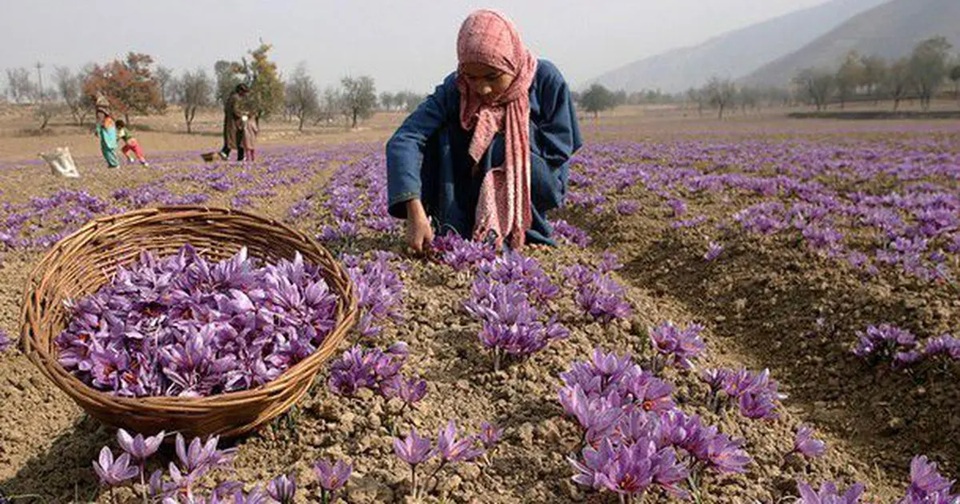
Crops value down from ₹302.35 Cr to ₹262.2 Cr
WAJAHAT SHABIR
SRINAGAR: The value of saffron production and exports in Jammu & Kashmir has shown a gradual recovery after experiencing a dip in 2022. While the value of saffron production fell from ₹302.35 crore in 2021 to ₹262.2 crore in 2023.
The question was raised by MLA Hasnain Masoodi, whether it is aware of the importance of Saffron as a “key Cash Crop” with a pivotal role in the economy of Jammu & Kashmir, generating a business of more than five hundred crores and earning crores in foreign exchange for the Country
The government replied it is rejuvenating and improving the productivity of saffron cultivation through the implementation of the National Mission on Saffron, focusing on value addition, G.I. certification, and boosting exports
On being asked whether there is a corresponding loss of business and income?
The saffron industry has stabilized since the launch of the National Mission on Saffron. The area under cultivation has remained at 3,715 ha since 2010-11, and although the productivity faced declines due to natural weather-related vagaries during 2014-15, 2017-18, and 2018-19, it has generally improved, leading to increased production and exports, the government informed.
A comprehensive study was carried out by SKUAST-K in 2010. The study showed a decline in the area under cultivation of saffron in Kashmir. The decline was mainly attributed to: Low benefit-cost ratio, High cost of cultivation, Low productivity (1.27 kg/ha in 2000-01), Traditional cultivation methods, Biotic and abiotic stresses. Changes in weather patterns resulting in moisture stress at the terminal growth stages, which discouraged farmers from continuing saffron cultivation, the government informed assembly.
To boost saffron production, the Ministry of Agriculture and Co-operation, Government of India, introduced the “Economic Revival of Saffron Sector in J&K” in 2010-11 based on the SKUAST-K study. As a result, 2,573.73 ha have been rejuvenated out of 3,715 ha, and productivity has increased from 2.50 kg/ha (2009-10) to 5.14 kg/ha (2020-21) and 4.42 kg/ha (2022-23), they said.
Under the National Mission on Saffron, no such facility with an outlay of Rs. 37.00 crore has been established for providing an exclusive GI facility to saffron growers. However, one Spice Park/India International Kashmir Saffron Trading Center (IIKSTC) has been constructed under the National Saffron Mission at Dussu, Pampore. The facility has been created with an estimated cost of Rs. 37.81 crore by the National Horticulture Board, Government of India, the government said.
The introduction of an e-auction facility at IIKSTC has improved market access and enabled farmers to achieve better prices for their produce.
The rejuvenated area under saffron cultivation in Jammu & Kashmir has shown fluctuations in production and productivity over recent years. In 2020-21, a total of 2,572.73 hectares was rejuvenated, yielding 13.22 metric tons (MTs) of saffron with a productivity rate of 5.14 kg per hectare. The following year, in 2021-22, the rejuvenated area slightly increased to 2,598.73 hectares, but production declined to 11.43 MTs, resulting in a lower productivity rate of 4.4 kg per hectare. In 2022-23, the rejuvenated area remained unchanged at 2,598.73 hectares, with a marginal increase in production to 11.49 MTs, and a slight improvement in productivity to 4.42 kg per hectare.
The Traditional (Non-Rejuvenated) Area under saffron cultivation in Jammu & Kashmir has shown a declining trend in both production and productivity over the years. In 2020-21, the area under cultivation was 1,142.27 hectares, producing 4.11 metric tons (MTs) of saffron, with a productivity rate of 3.60 kg per hectare. In 2021-22, the cultivated area slightly reduced to 1,116.27 hectares, and production dropped to 3.44 MTs, leading to a further decline in productivity to 3.08 kg per hectare. By 2022-23, the cultivated area remained the same at 1,116.27 hectares, with a marginal increase in production to 3.45 MTs, and a slight rise in productivity to 3.09 kg per hectare.
In 2021, saffron production stood at 17.33 metric tons (MTs), but it declined to 14.87 MTs in 2022 before showing a slight recovery to 14.94 MTs in 2023. The export quantity followed a similar trend, dropping from 15.597 MTs in 2021 to 13.383 MTs in 2022, before a minor increase to 13.446 MTs in 2023.
The value of saffron production in 2021 was estimated at ₹302.35 crore, decreasing to ₹261.38 crore in 2022, but rebounding to ₹291.33 crore in 2023. Similarly, the value of saffron exports, which was ₹272.12 crore in 2021, fell to ₹235.25 crore in 2022, before recovering to ₹262.2 crore in 2023.

