



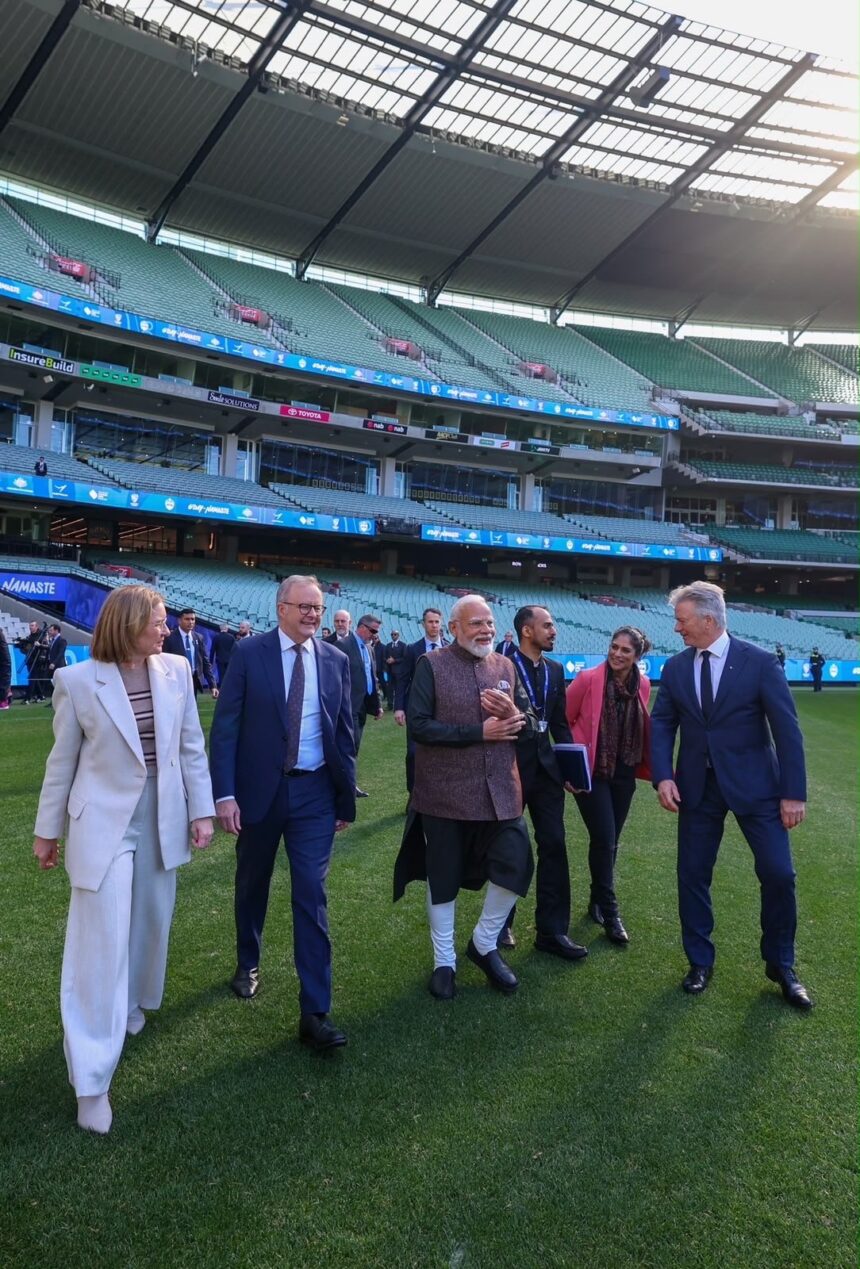
Melbourne, Jul 10 (PTI) Prime Minister Narendra Modi, who is on a three-day visit to Australia, met the country’s Leader of Opposition Angus Taylor on Friday and discussed bilateral ties, according to the Ministry of External Affairs.
“They held productive discussions on the growing India-Australia Comprehensive Strategic Partnership. The warm and cordial meeting reflected the strong bipartisan support in Australia for deepening ties with India,” the Ministry of External Affairs Spokesperson Randhir Jaiswal said on X.
Sharing details of the interaction, Modi also posted on the microblogging platform.
“Met Mr. Angus Taylor, Leader of the Opposition of Australia. We had an engaging conversation on the growing strength of India-Australia ties and the many opportunities ahead. I deeply value the warmth and broad support that our partnership enjoys across Australia,” he wrote.
The prime minister landed in Australia on July 8 after completing his visit to Indonesia. From here, he is scheduled to leave for New Zealand — the last leg of his six-day, three-nation tour.
During his three-day visit to Australia, the two countries sealed a raft of landmark pacts spanning civil nuclear energy, maritime security and critical minerals sectors.
PM Modi held summit talks with his Australian counterpart Anthony Albanese, and both leaders reinforced the vital role of the bilateral partnership in ensuring a peaceful Indo-Pacific.
A major highlight of the summit talks between the two leaders was their focus on significantly ramping up defence ties, especially in the maritime domain.
An agreement on civil nuclear energy to facilitate the commercial supply of uranium from Australia to India to fuel New Delhi’s nuclear power projects was sealed after over two years of negotiations.
In another significant decision, India and Australia decided to work expeditiously to firm up the proposed Comprehensive Economic Cooperation Agreement as well as a bilateral investment protection framework to further enhance the trade and investment relations.
A joint declaration on defence and security cooperation, a maritime security collaboration roadmap, a joint statement on energy security, and a partnership for cyber, critical technologies and supply chains were among 18 pacts signed following summit talks between the two prime ministers.
PM Modi also pitched for early finalisation of the proposed India-Australia Comprehensive Economic Cooperation Agreement (CECA) as it will further accelerate bilateral trade and investment ties.
The prime minister also addressed an Indian diaspora event, ‘Melbourne meets Modi’, also attended by Australian Prime Minister Anthony Albanese.
Meanwhile, he arrived in New Zealand on the final leg of his three-nation visit, during which he will hold talks with his counterpart Christopher Luxon and address the Indian diaspora.
This is the first visit to New Zealand by an Indian prime minister in 40 years.
Modi was received by Luxon at the airport, where the two leaders exchanged a warm hug.
“Reached Auckland a short while ago. Thankful to Prime Minister Luxon for the welcome at the airport,” Modi said in a post on X.
“This visit is historic, being the first Prime Ministerial visit to New Zealand in four decades. I look forward to holding talks with Prime Minister Luxon and discussing the complete range of the India-NZ friendship. I will also be addressing a community programme tomorrow in Auckland,” he said.
In a post on X, the Ministry of External Affairs (MEA) said, “This historic visit is set to strengthen bilateral ties and unlock new avenues of cooperation across several areas especially trade, defence, sports, culture, education, and people-to-people exchanges.”
Calling it as a “special welcome in Auckland!”, the MEA in another post on X said the iconic Sky Tower was illuminated to mark Modi’s visit to New Zealand, “symbolising the friendship between our two countries.”
In his departure statement in New Delhi, the prime minister had said that his visit would “meaningfully build” upon the strong momentum in India-New Zealand ties pursuant to Luxon’s visit to India in March 2025.
Modi said his visit to Indonesia, Australia and New Zealand will further strengthen India’s Act East Policy, MAHASAGAR Vision, as well as its outlook towards a free and open Indo-Pacific.
During his two-day visit to New Zealand, he will hold talks with Luxon on ways to further enhance economic, trade and commercial engagements.
He will also address the Indian diaspora at a community programme.
Modi arrived in New Zealand after concluding a three-day visit to Australia, where he held summit talks with Prime Minister Anthony Albanese, and both leaders reinforced the vital role of the bilateral partnership in ensuring a peaceful Indo-Pacific.
A major highlight of the summit talks between the two leaders was their focus on significantly ramping up defence ties, especially in the maritime domain.
An agreement on civil nuclear energy to facilitate the commercial supply of uranium from Australia to India to fuel New Delhi’s nuclear power projects was sealed after over two years of negotiations.
Modi was in Indonesia before that, where 14 agreements were inked to boost cooperation in critical minerals, maritime security and other key sectors.

