



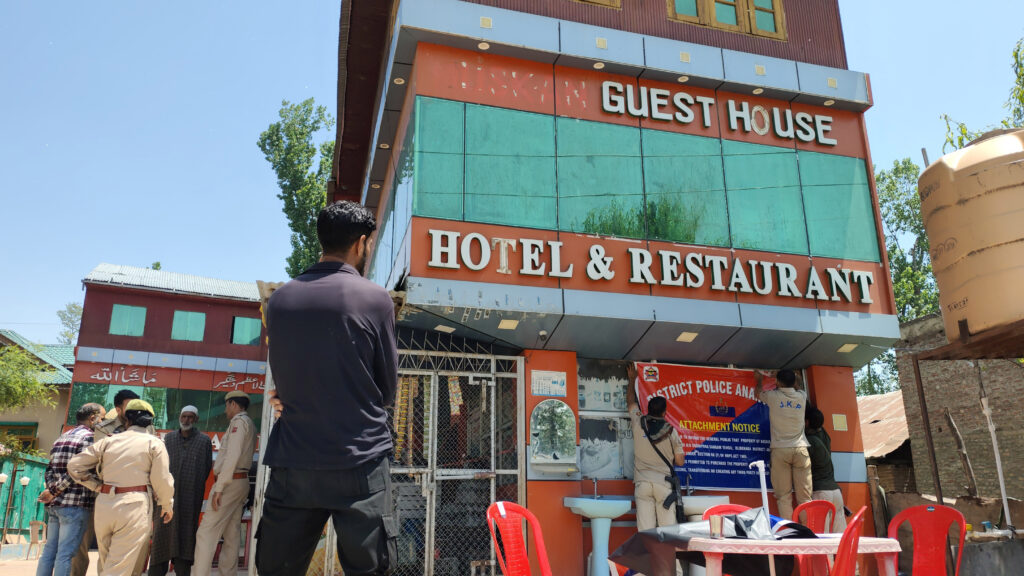
Jammu:The Jammu and Kashmir is set to roll out a first-of-its-kind long-term rehabilitation framework for victims of drug abuse, focusing on treatment, social reintegration and livelihood generation, even as a parallel political debate intensified over the use of bulldozer action and property attachment in anti-drug operations across the Union Territory.
Chief Secretary Atal Dulloo chaired a high-level meeting of administrative secretaries and senior officials to review a comprehensive rehabilitation plan prepared by the Social Welfare Department in consultation with multiple stakeholders and government departments.
During the meeting, the Chief Secretary stressed the need for a practical and result-oriented rehabilitation strategy capable of delivering tangible outcomes on the ground.
He directed departments to further refine the plan through consultations with civil society stakeholders, mental health professionals and experts from the Institute of Mental Health and Neurosciences (IMHANS) and psychiatry departments of Government Medical Colleges.
Dulloo emphasized the role of trained patient mentors in the rehabilitation process and called for the creation of a dedicated pool of resource persons in every district.
He said at least 30 to 40 mentors should be identified and trained through specialized modules at IMHANS to provide continuous counselling and support to recovering addicts.
He observed that professionally trained mentors would form the backbone of the rehabilitation programme and said their responsibilities should be clearly defined according to the needs of each patient to ensure sustained recovery and social reintegration. He also directed officials to devise an incentive mechanism for motivating mentors associated with the programme.
The Chief Secretary further stressed the need to link rehabilitated individuals with various government schemes for skill development, self-employment and educational reintegration.
He also asked the National Informatics Centre (NIC) to develop a dedicated digital portal for monitoring rehabilitation progress and ensuring long-term stabilization of affected individuals within society.
Meanwhile, the issue of handling the drug menace triggered sharp political reactions after Health Minister Sakeena Itoo questioned the demolition of residential properties during anti-drug operations.
Speaking to reporters, Itoo said that while she appreciated the efforts of Lieutenant Governor Manoj Sinha under the “Nasha Mukt Jammu Kashmir” campaign, targeting families and demolishing homes under the garb of fighting drug abuse should stop.
“You arrest someone with drugs and then demolish a property which is not even in his name but in the name of his parents. It causes suffering to the families and creates more negativity,” she said.
The minister claimed that drug abuse cases were higher in the Jammu region than in Kashmir but coercive action appeared to be concentrated in the Valley. She said the focus should instead be on dismantling drug trafficking networks and rehabilitating addicts through counselling and support.
“Our aim should be to stop drugs from coming here. If someone is a drug addict, what is the fault of his father?” she asked, appealing to the administration to stop bulldozing houses and attaching properties belonging to family members.
The debate further intensified after Srinagar Member of Parliament Ruhullah Mehdi alleged that drug trafficking in Jammu and Kashmir could not take place without the connivance of certain officials in the security establishment.
Speaking to reporters in Srinagar, Mehdi said strict action should be taken against police officers in whose jurisdictions drug trafficking takes place.
He also criticized the demolition of residential properties of accused persons and termed it “profiling” of Kashmiris.
“If someone is involved, strict punishment should be given to him, but which law allows punishment to extended family members?” he said.
The MP alleged that bulldozer action disproportionately targeted people in Kashmir and said authorities should focus on dismantling trafficking networks instead of creating fear among ordinary families.
He further claimed that with multiple layers of security and surveillance in Jammu and Kashmir, large-scale drug trafficking could not happen without the knowledge of enforcement agencies, asserting that accountability should extend to officials responsible for curbing narcotics smuggling.

