



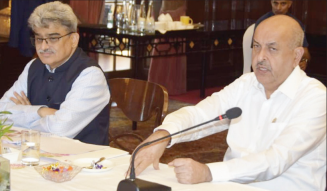
SRINAGAR: In a high-level review meeting held in Srinagar, Tarun Kapoor, Advisor to the Prime Minister, assured that the Central Government remains fully committed to transforming Jammu and Kashmir into a model of inclusive development and digital governance.
The meeting brought together the Chief Secretary of Jammu & Kashmir, Atal Dulloo, along with administrative secretaries of the UT government and senior officials from various central agencies involved in implementing key infrastructure, energy, urban development, and governance reform projects.
The meeting began with a detailed review of major hydroelectric power projects that form the backbone of J&K’s energy strategy. These included the 1,000 MW Pakal Dul project, being developed at a cost of ₹12,757 crore and scheduled for completion by December 2026, the 624 MW Kiru project with 60% physical progress, the 540 MW Kwar project with 22% progress, and the 850 MW Ratle project which has reached 23% physical progress. Strategic projects like Sawalkote, Uri Phase-II, Kirthai-II, Bursar, and Tulbul Storage were also discussed, with the Advisor calling for efficient organizational structures and faster decision-making to ensure timely execution.
Rail connectivity projects also received significant attention, particularly the Udhampur–Srinagar–Baramulla Rail Link (USBRL), a transformative initiative for the region. Proposed new lines, including the Qazigund–Budgam double line, Baramulla–Uri, Sopore–Kupwara, Anantnag–Pahalgam, and Jammu–Katra double line corridors, were reviewed as key components for enhancing mobility, cutting travel time, and improving market access, especially for horticultural produce.
In the road infrastructure sector, the Advisor examined the pace of work under the National Highways Authority of India (NHAI), National Highways and Infrastructure Development Corporation Limited (NHIDCL), and Border Roads Organisation (BRO). Discussions included the need to streamline the availability of construction material and issuing short-term permits to fill supply gaps.
The review also included an assessment of healthcare infrastructure, particularly the progress of AIIMS campuses in Jammu and Srinagar. While AIIMS Jammu is already functional, AIIMS Kashmir is scheduled for completion by November this year. The Advisor reviewed updates on faculty recruitment and procurement of advanced medical equipment, emphasizing the need to ensure world-class healthcare delivery in both institutions.
On the renewable energy front, the Advisor examined the progress under the PM Surya Ghar: Muft Bijli Yojana. He directed officials of the Power Development Department (PDD) and the J&K Energy Development Agency (JAKEDA) to prioritize the installation of grid-connected rooftop solar panels for domestic consumers and government buildings to promote sustainable energy use.
Environmental preservation was also discussed, particularly the health of Dal Lake. The Advisor reviewed the performance and future plans for sewage treatment plants (STPs) meant to improve water quality and maintain the ecological balance of the iconic waterbody. He emphasized the importance of sustainable lake management to safeguard Ladakh and Kashmir’s natural heritage.
Urban infrastructure projects in Jammu and Srinagar were another focus of the meeting. These included initiatives under PM eBus Sewa, the Intelligent Traffic Management Systems (ITMS), modern parking facilities, IMS Katra, inland water transport, and urban development schemes under Smart City and AMRUT. The Advisor noted that these initiatives will significantly enhance urban mobility, reduce emissions, and provide more efficient public services to citizens.
During the review, the Advisor appreciated the efforts under Mission YUVA, aimed at enabling sustainable livelihoods for J&K’s youth. He emphasized the importance of identifying viable sectors and providing financial and institutional support to promote nano enterprises, MSMEs, and startups through an umbrella scheme tailored to local aspirations.
The meeting also covered the status of digital and telecom connectivity in the region. The Advisor was briefed on BharatNet, a flagship initiative to deliver high-speed internet access to every corner of Jammu and Kashmir, including its most remote villages. In parallel, he assessed the progress of IT-based governance reforms being implemented in partnership with BISAG-N, which are designed to increase transparency, accountability, and accessibility in government services through integrated digital platforms.
Summing up the meeting, Tarun Kapoor expressed satisfaction with the scale of progress across sectors. However, he also stressed the need for faster execution, effective coordination between UT and central agencies, and achieving outcomes that directly benefit the people of Jammu and Kashmir. He reaffirmed the Centre’s resolve to give the region the highest developmental priority, stating that Jammu and Kashmir will be developed as a national example of digital governance, modern infrastructure, and inclusive growth.

