



EWS, RBA categories face cuts; proposal sent to LG amid sharp political reactions
Jammu: In a major restructuring of Jammu & Kashmir’s reservation matrix, the Union Territory’s cabinet on Wednesday approved a proposal to reduce quotas in the Economically Weaker Sections (EWS) and Reserved Backward Area (RBA) categories to enhance the Open Merit (OM) share to 50 per cent.
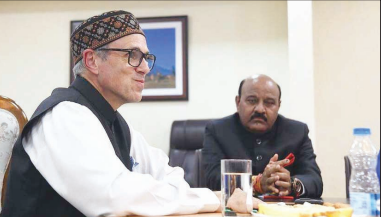
As per reports, the proposal—cleared at a cabinet meeting chaired by Chief Minister Omar Abdullah—has now been forwarded to Lieutenant Governor Manoj Sinha for approval.
According to senior officials familiar with the deliberations, the cabinet endorsed the Cabinet Sub-Committee’s recommendations in full, approving a seven per cent cut in the EWS quota and a three per cent cut in the RBA quota.
The cumulative 10 per cent reduction is proposed to be shifted to the Open Merit pool, significantly altering the reservation structure for government jobs and admissions.
The sub-committee, led by Minister Sakina Itoo, had advised against changing the quotas of Scheduled Tribe-I, Scheduled Tribe-II, Scheduled Castes, Other Backward Classes, or the Actual Line of Control/International Border (ALC/IB) categories.
Presently, ST-I, ST-II, RBA and EWS each enjoy 10 per cent reservation, OBCs and SCs have 8 per cent each, while ALC/IB has 4 per cent.
If approved by the LG, the restructured policy would lift the OM share from the existing 40 per cent to 50 per cent—one of the most significant adjustments to the reservation framework in recent years.
However, as per the 2019 Transaction of Business Rules, the LG must consult the Union Home Ministry before giving consent, given the proposal’s potential impact on minority communities and backward classes.
Briefing reporters after the meeting, Chief Minister Omar Abdullah said the government had honoured a key poll promise by undertaking a detailed and necessary rationalisation of the quota policy.
He declined to share specifics, citing protocol, as the file has been sent to the LG.
“We have tried to rationalise the policy in the best possible manner while ensuring justice to all sections,” he said, adding that the matter underwent extensive scrutiny.
“Every issue was reviewed more than once. The process came to the cabinet multiple times. We could not have done a more detailed exercise.”
Abdullah stressed that the intention was neither political nor targeted. “This is not about any individual or party. This is about the people of Jammu and Kashmir, and we have fulfilled a major election promise,” he said.
Even before the proposal becomes public, the political landscape has turned charged. While several prominent leaders advocating rationalisation were yet to respond, the Opposition fiercely criticised the government’s handling of the issue.
The People’s Democratic Party accused the administration of dodging responsibility.
“No rationalisation of reservation or age relaxation despite being promised. Instead, the government is engaging in theatrics and blaming others,” PDP leader Iltija Mufti posted on X, adding that youth across J&K were in “distress and despair”.
People’s Conference chairman Sajad Gani Lone, who had been demanding rationalisation alongside other reforms, said the government was stoking divisions.
“The elected government is passing on the buck and trying to create a wedge in Kashmiri ranks,” he wrote on X.
Lone argued that instead of restoring district- and division-level recruitment—something he said would enhance fairness and improve Kashmiri representation—the government had chosen to reduce the only category he claimed benefited Kashmiris: the RBA quota.
He said the larger structural issue remained unaddressed. “The problem lies between Jammu and Kashmir, with the dice heavily loaded in favour of Jammu. Even with changes, 80 per cent reservations will still go to Jammu,” he claimed, citing earlier official data.
Reservations have become a dominant political issue in J&K over the last five years after the Centre introduced new categories and expanded existing quotas.
These include a separate 10 per cent quota for Paharis and other tribes, alongside an enhanced 8 per cent quota for OBCs—moves that pushed the reservation share in the UT close to 70 per cent.
Growing public pressure and demands for “rationalisation” prompted the government to set up a Cabinet sub-committee in December last year, which submitted its findings in October.
Wednesday’s cabinet decision marks the first concrete step taken by the elected government on the matter.

