



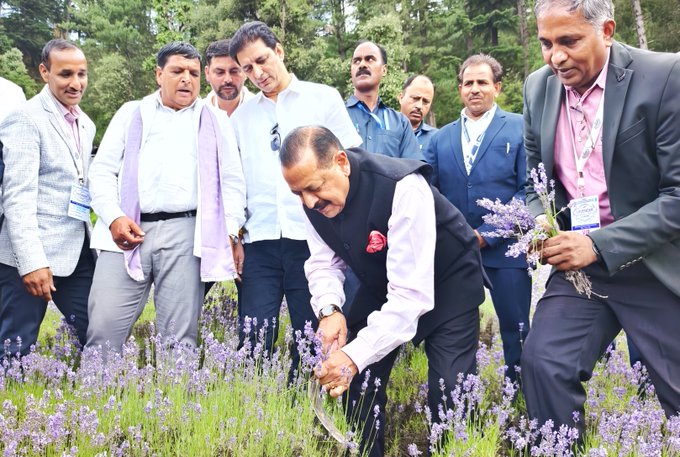
Jammu: The picturesque Bhaderwah valley in Jammu and Kashmir’s Doda district, saw a resurgence of the ‘purple revolution’, with the beginning of the two-day lavender festival on Saturday.
Union Minister Jitendra Singh, while inaugurating the 4th lavender festival, hailed the region’s transformation into a national hub of lavender cultivation and aroma-based entrepreneurship.
Singh credited Prime Minister Narendra Modi’s vision of startup India and science-driven development for the success of the lavender mission, saying it gave Bhaderwah, also known as ‘Mini Kashmir’, a distinct identity for its significant role in India’s economic growth.
“Lavender has given the small town of Bhaderwah a national identity and a national role in India’s economic growth. What was once considered a remote hill town has today emerged as a beacon of India’s rural startup movement,” Singh said.
Organised by the CSIR-Indian Institute of Integrative Medicine (CSIR-IIIM), Jammu, under the theme ‘lavender goes global’, the festival highlighted Bhaderwah’s transformation from a traditional agrarian region into the country’s leading hub of lavender cultivation and aroma entrepreneurship.
Singh described Bhaderwah as one of the most successful examples of technology-led rural transformation in the country, saying the purple revolution had demonstrated how scientific research could be translated into sustainable livelihoods and entrepreneurship in remote mountainous regions.
He recalled that Prime Minister Modi had devoted a significant portion of an episode of ‘Mann Ki Baat’ to Bhaderwah’s lavender success story and said the model was now being studied and replicated in several Himalayan and northeastern states.
“The purple revolution launched through the CSIR aroma mission has emerged as one of the most successful examples of transformation under Prime Minister Narendra Modi’s government,” he told reporters in Bhaderwah.
Addressing farmers, entrepreneurs, scientists and industry representatives at the festival, Singh said the success of lavender cultivation in Bhaderwah stands as a living example of the changes brought about during the last 12 years of the Modi government.
“The transformation that has taken place over these years is clearly visible through the aroma mission. The purple revolution, which began in the hills of Bhaderwah, has received national and international recognition and has become a model for rural entrepreneurship,” said Singh, who was accompanied by BCCI president Mithun Manhas who hails from Bhaderwah.
Highlighting the economic impact of the initiative, the minister said many young entrepreneurs associated with lavender cultivation were earning substantial incomes through cultivation, processing and marketing of value-added products.
Emphasising the vision of a developed India, he said the aroma mission was closely linked to the Himalayan ecosystem, and would continue to contribute to sustainable development in the region. What began in Jammu and Kashmir has now expanded to states, including Himachal Pradesh, Uttarakhand and Arunachal Pradesh, he added.
He said the Council of Scientific and Industrial Research (CSIR), through its various institutes, has contributed significantly to innovation-driven development and entrepreneurship.
Referring to the success of lavender cultivation, Singh said it has demonstrated that startups and innovation are not confined to the IT sector and that young people without advanced academic qualifications can also become successful entrepreneurs with the right technology and support.
Highlighting the government support for lavender growers, Singh said distillation units have been established and farmers are being linked with the perfume industry to ensure value addition and better returns. He added that the government is facilitating market access and creating industry linkages to strengthen the lavender ecosystem.
The minister revealed that discussions are underway with stakeholders in Grasse, France, which is regarded as the perfume capital of the world, to explore collaborations and scale up lavender production in India.
“Experts have found that lavender oil produced in Bhaderwah is of better quality than that produced in many other countries. However, we need to increase production volumes before we can fully tap export markets. The export potential is already there; now we have to scale up,” he said.
Describing Bhaderwah as the birthplace of India’s Purple Revolution, Singh said industry representatives from different parts of the country, including Maharashtra and Karnataka, participated in the festival, reflecting growing commercial interest in lavender-based products and essential oils.
“The Purple Revolution has gone global. NRIs and international buyers are increasingly recognising the quality of our lavender products. Many experts believe that the lavender grown in Bhaderwah is among the best in the world,” he said.
On the possibility of securing intellectual property protection for the crop, Singh said efforts are focused on expanding cultivation and production while continuing engagement with international perfume-producing nations.
Director, CSIR-IIIM, Zabeer Ahmed, said nearly 1,500 hectares had been brought under lavender cultivation during the mission’s three phases, benefiting over 4,500 farmers and farming families.
Ahmed said the initiative has resulted in the extraction of more than 4,000 kilograms of high-value lavender oil and generated cumulative revenues exceeding Rs 18 crore, significantly enhancing rural incomes.

