



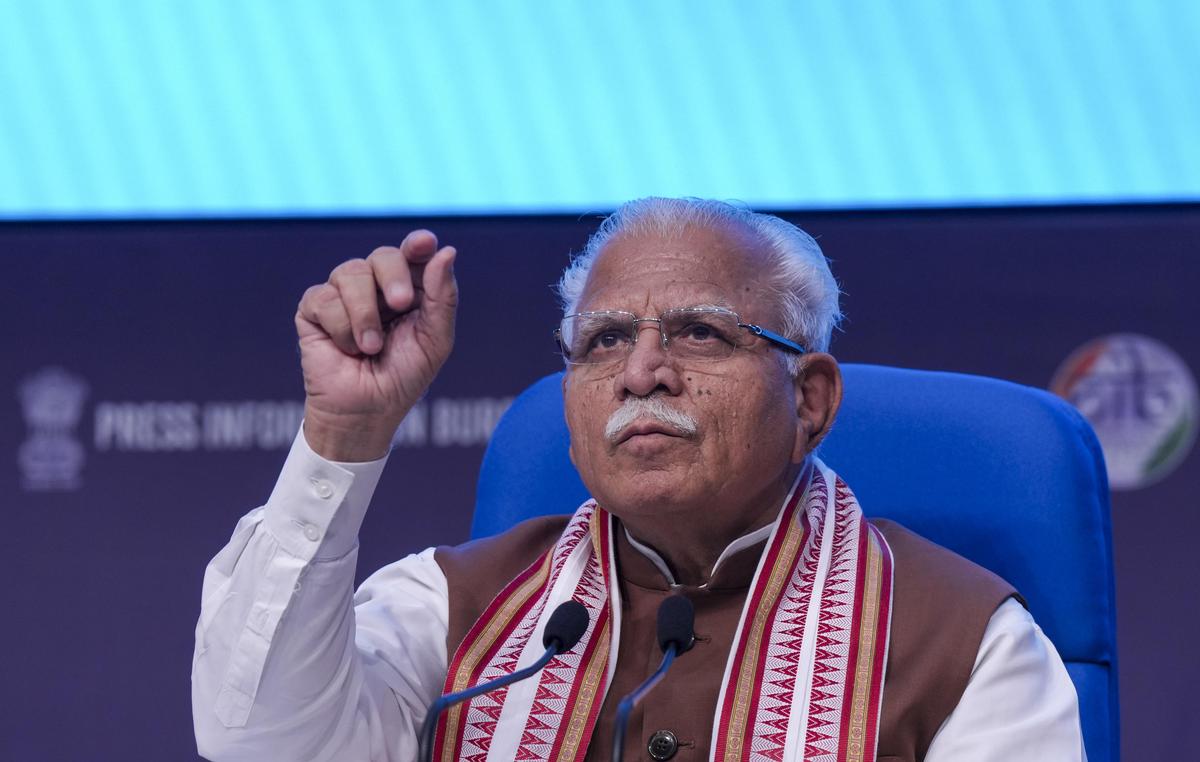
Jammu: Union Power Minister Manohar Lal on Sunday issued a firm message to Pakistan, saying that no objections from Islamabad will be entertained over India’s hydropower projects in the Indus and Chenab river basins, asserting that the country’s water resources will be utilised exclusively for the benefit of India and its people.
The Union Minister made the remarks during his two-day visit to Jammu and Kashmir while reviewing progress on multiple strategic hydroelectric projects, including the 690-MW Salal Hydroelectric Project in Reasi district, the 800-MW Sawalkot project, and the 1,856-MW Ratle Hydroelectric Project in Kishtwar.
Referring to the decision to keep the Indus Water Treaty (IWT) in abeyance, Manohar Lal said Prime Minister Narendra Modi has sent a clear and decisive message that India will no longer allow its legitimate water resources to flow unutilised.
“Water of the Chenab and Indus will be used for the benefit of our own people. No objections from Pakistan will be entertained,” he said.
At the NHPC-operated Salal Power Station on the Chenab river, the minister reviewed the operational status, security arrangements, power generation capacity, and technical activities from the dam control room.
NHPC Chairman and Managing Director Bhupendra Gupta briefed him on the progress of various hydropower projects in Jammu and Kashmir, including sediment removal operations at Salal, which are being undertaken after the IWT was kept in abeyance to remove accumulated silt and maximise utilisation of water resources.
The Union Minister also undertook a plantation drive within the power station premises and held meetings with the local administration and senior officials of concerned departments to ensure coordinated efforts for the timely execution of hydropower works across the Union Territory.
Later in the day, Manohar Lal travelled to Kishtwar, where he laid the foundation stone for dam concreting works at the 1,856-MW Ratle Hydroelectric Project, a key project on the Chenab basin.
He also reviewed progress of under-construction power projects and said all NHPC projects in Jammu and Kashmir are now underway despite long-standing technical, security, and logistical challenges.
Referring to the 800-MW Sawalkot Hydroelectric Project, the minister said the project has officially entered the execution phase after overcoming multiple hurdles.
He said once completed, the project will add significantly to the national power grid and strengthen India’s energy security. “Completing these projects on time will substantially boost the country’s power generation capacity,” he said.
Addressing concerns over security and workforce engagement, the Union Minister said strict vigilance is being maintained and made it clear that no individual with an unlawful background would be engaged in hydropower projects, particularly in Kishtwar.
He said workers are hired through local contractors and their credentials are verified through institutional mechanisms.
“Only verified and law-abiding people will get work. Good people should get employment,” he said.
When asked about allegations regarding relatives of terrorists being engaged in power projects, Manohar Lal said he had no specific information on such cases and ruled out any probe by the National Investigation Agency.
He said routine complaints would be addressed at the local level, while serious issues would be examined as per established procedures.
During his visit, the Union Minister also reviewed other development initiatives, including canal projects and works at Kowl Fort, and inspected final project sites in Kishtwar.
His visit came shortly after Union Minister of State in the Prime Minister’s Office Jitendra Singh announced that a canal system on the Ujh River has been approved to check infiltration and harness the uncontrolled flow of water towards Pakistan, with the proposal already cleared by the Ministries of Defence and Home Affairs.
Earlier in the day, Manohar Lal attended a Hindu Samelan organised as part of the centenary celebrations of the Rashtriya Swayamsevak Sangh (RSS) at the Mahadev temple.
Addressing the gathering, he described Hindutva as a broad nationalist concept rooted in service to the nation, stating that anyone who loves the country and is willing to make sacrifices for it is part of Hindutva.
He said that following the abrogation of Article 370 in 2019, a renewed wave of nationalism had emerged in Jammu and Kashmir. Praising the RSS, he said its motto “Country first, self later” has, over the past 100 years, evolved into a powerful social movement driven by millions of volunteers committed to nation-building.

