



Avinav Verma
Leh: Amid growing opposition from political and civil society groups over holding elections during the harsh winter months, the Ladakh Administration on Tuesday announced the schedule for elections to all eight Ladakh Autonomous Hill Development Councils (LAHDCs), fixing December 4 as the polling date.
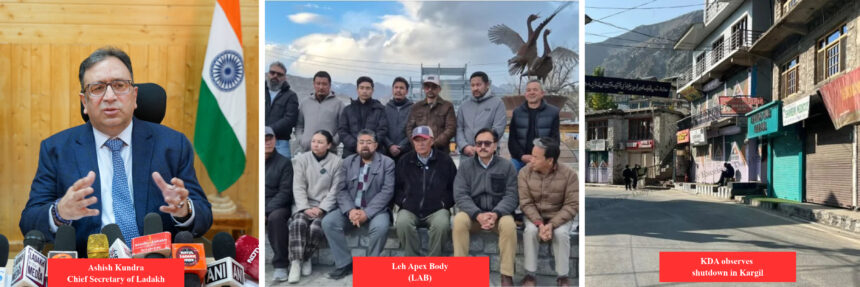
The announcement came on a day when Kargil observed a complete shutdown called by the Kargil Democratic Alliance (KDA), while the Leh Apex Body (LAB) announced another phase of agitation from November 12, demanding postponement of the elections until weather conditions improve and a review of the recently completed delimitation exercise.
Defending the administration’s decision, Chief Secretary Ashish Kundra described the elections as a watershed moment for strengthening democratic institutions in Ladakh and appealed to people, particularly youth, women and senior citizens, to participate in the electoral process.
Responding to concerns over the timing of the elections, Kundra said December 4 should not pose any particular difficulty for voters, pointing out that schools in Ladakh generally remain functional until December 15 or 16.
“Schools in Ladakh traditionally remain functional until December 15 or 16. If schoolchildren can go to school, I do not think there should be any particular difficulty for adults in going out to vote,” the Chief Secretary said.
He, however, assured that the administration was conscious of the weather conditions and had instructed all Deputy Commissioners to ensure adequate arrangements at polling stations, including heating facilities and separate queues for senior citizens, besides other necessary facilities.
Kundra also explained the administrative reasoning behind holding the elections in December, saying the newly elected councils would get January, February and March to prepare the budget for the next financial year.
“If the councils are constituted after that, the entire budget preparation process could be missed, potentially delaying it by a full year,” he said, stressing that the budget has to be prepared before March.
On concerns regarding winter connectivity, the Chief Secretary said road infrastructure in Ladakh had improved considerably over the past five years and most roads now provided all-weather connectivity.
While acknowledging that heavy snowfall could occasionally affect one or two mountain passes, he said district administrations had prepared alternative routes and contingency arrangements to ensure polling parties reached their destinations.
The election schedule, issued by the State Election Commission, provides that November 17 will be the last date for filing nominations, followed by scrutiny on November 18.
Candidates can withdraw their nominations by 3 pm on November 20. Polling, if required, will take place between 8 am and 5 pm on December 4, while the entire election process is scheduled to conclude by December 8.
The announcement has, however, intensified the political disagreement over the timing and preparedness of the electoral exercise.
In Kargil, the KDA’s shutdown call received a response across the district, with shops and business establishments remaining closed and traffic remaining thin on roads. Security arrangements were strengthened, with additional police personnel deployed at several places as a precautionary measure.
The KDA had announced the shutdown to protest the proposed winter elections, alleged irregularities in the delimitation exercise and what it described as the erosion of democratic rights in the Union Territory. Essential services, including medical facilities, water supply and school buses, were exempted from the shutdown, which continued until 5 pm.
KDA co-chairman Sajjad Kargili, accompanied by Ladakh Lok Sabha MP Haji Hanifa Jan and civil society representatives, had also announced a candlelight march under the banner of ‘Save Democracy’.
The opposition is not confined to Kargil. In Leh, the Leh Apex Body reiterated its demand for postponing the LAHDC elections until April-May, arguing that conducting polls in December could substantially restrict public participation because of extreme weather, snowfall and seasonal migration.
Addressing a press conference, LAB chairman Chering Dorjay questioned the urgency behind holding the elections during winter, particularly when several areas of Ladakh, including Drass and Zanskar, experience temperatures dropping to minus 30 degrees Celsius and remain vulnerable to snowfall and closure of mountain passes.
He argued that around 40 per cent of Ladakh’s population moves outside the region during winter, while a substantial number of young people remain away for education and other purposes. According to him, many elderly residents, parents, patients and other people also migrate to warmer parts of the country, raising concerns about the representativeness of an election conducted during this period.
Dorjay also questioned the time provided under the announced election schedule for nomination and withdrawal of candidature, alleging that the short timelines could affect the ability of people to exercise their right to contest elections. He said the matter raised concerns regarding compliance with the Representation of the People Act.
The LAB chairman further linked the demand for postponement with the pending findings of the judicial inquiry commission constituted after the September 24, 2025, violence in Leh, in which four people were killed and dozens injured during protests demanding constitutional safeguards for Ladakh.
Questioning the delay in making the inquiry findings public, Dorjay said the administration was moving swiftly to conduct elections but had not delivered the findings of an inquiry that had been pending for more than a year.
He demanded justice for those killed and injured, a decision on the cases registered against around 70 people, and resolution of the concerns of affected families before moving ahead with the electoral exercise.
Announcing the next phase of the agitation, Dorjay said the LAB would begin a sit-in protest from November 12, with people from across Ladakh expected to join. He said the protest would continue until their demands were addressed.
The LAB has called for holding the LAHDC elections in May or June, when weather conditions are more favourable and a larger section of the population is present in the region.
Meanwhile, the administration has maintained that the electoral exercise is essential for strengthening grassroots democracy.
Kundra said the elected councils would retain the powers vested in them under the existing law and would also exercise functions envisaged for district panchayats under the 73rd Constitutional Amendment.
He also pointed out that panchayat elections had not been held in Ladakh for the past three years, making the upcoming electoral exercise an important opportunity to strengthen democratic participation.
Ladakh-centre talks on hold till polls conclude
Leh: The next round of talks between Ladakh’s representative groups and the Ministry of Home Affairs (MHA), which was scheduled for October 22, is expected to be held after the ongoing electoral process concludes, Ladakh Chief Secretary Ashish Kundra said on Tuesday.
Kundra said the proposal to hold the next round of talks between the representative groups — the Leh Apex Body (LAB) and Kargil Democratic Alliance (KDA)– and the MHA was referred to the State Election Commission for clearance in view of the Model Code of Conduct currently in force.
He said the talks could proceed once the Commission’s approval was received.
“Until we receive clearance from the Commission, we cannot take the matter forward. Only after that can further steps be taken,” the chief secretary told a press conference here.
Asked whether the talks would take place after the elections, Kundra replied, “Yes, certainly. They will take place afterwards.”
Emphasising the need to strengthen democratic institutions alongside the ongoing political dialogue, the chief secretary said the administration was committed to deepening democracy and expanding people’s democratic rights in Ladakh.
“We want democracy to be deepened and democratic rights to be expanded. On the one hand, people (LAB and KDA) say that Ladakh has become a bureaucratic state, while we are making efforts to strengthen democratic governance and expand people’s rights,” he said.
Kundra said the emergence of the Apex-level representative body should not become a reason to delay the constitution of other elected institutions, including panchayats, municipal bodies and the LAHDCs.
“The Apex-level body in the Union Territory is also taking shape. However, should we stop holding other elections until that body is fully constituted? I do not think that would be appropriate,” he said.
Referring to discussions with the sub-committee, Kundra said the demand for notifying panchayat elections had itself been raised during one of the meetings, and the administration had acted accordingly.
He said it was important to adopt a reasonable approach in the larger public interest rather than putting the electoral process on hold.
“There is no intention whatsoever to undermine the ongoing dialogue process. However, other democratic institutions also need to be constituted,” he maintained.
The chief secretary also appealed to political and community leaders in both Leh and Kargil to participate in the December 4 LAHDC elections, saying that a strong democratic mandate would reinforce Ladakh’s position in its engagement with the Central government.
He urged people to demonstrate through their participation that Ladakh wanted democracy, stronger democratic institutions and a meaningful process of dialogue.
“We want democracy, we want democratic institutions, and we want these institutions to be strengthened,” Kundra said, appealing to leaders from both regions to encourage participation in the elections.
He observed that active democratic participation, combined with sustained dialogue, would help develop a representative institutional framework at the Union Territory level.
“It is through such participation, combined with an active process of dialogue, that we will collectively build an institution that will take shape at the Apex level for the Union Territory,” he said.
On concerns surrounding the delimitation exercise for LAHDCs, Kundra defended the process, stating that the number of seats allocated to each district was determined through a prescribed formula, while the demarcation of constituency boundaries was undertaken exclusively by the State Election Commission.
He described the exercise as balanced and fair, urging people to look beyond individual grievances and participate in the larger democratic process.
“Minor difficulties and grievances may arise, but everyone should participate in the larger cause,” he said.
The chief secretary, responding to questions about the judicial inquiry into the firing in September last year that left four protesters dead in Leh, Kundra assured that the report would be released shortly, although its timing is to be decided.
55 sarpanches, 1,186 panchs elected unopposed
Leh: Ladakh Chief Secretary Ashish Kundra on Tuesday said 55 sarpanches and 1,186 panchs have been elected unopposed in the ongoing Panchayat electoral process, while 36 out of the 100 seats in the eight Ladakh Autonomous Hill Development Councils (LAHDCs) have been reserved for women.
In the Leh Municipal Council, elections will be held in all 21 wards, while four out of 17 wards in the Kargil Municipal Council have elected representatives unopposed, Kundra told a press conference here.
Panchayat and Municipal elections in Ladakh are scheduled for November 11, while elections to the eight Ladakh Autonomous Hill Development Councils (LAHDCs) are scheduled for December 4.
Sharing the election figures, the Chief Secretary said out of 192 Panchayat Halqas, 55 Sarpanches have been elected unopposed, while elections will be held for the remaining 137 seats.
Similarly, 1,186 panch candidates have been elected unopposed out of 1,428, the chief secretary said.
He also highlighted that, for the first time, 36 out of the 100 LAHDC seats have been reserved for women, marking a significant step towards strengthening women’s representation in grassroots democratic institutions.
On concerns raised regarding the Excise Policy, the Chief Secretary said the Administration had held detailed discussions with women representatives and other stakeholders, keeping local sensitivities in mind.
He assured that the policy would be reviewed through wider consultations after the conclusion of the elections, as no changes could be made during the enforcement of the Model Code of Conduct.
Emphasising the importance of balancing local customs and sensitivities with economic considerations, he noted that tourism remains central to Ladakh’s economy and supports the livelihoods of a large number of people.
Referring to the teachings of Lord Buddha and the principle of the Middle Path, he stressed the need for a balanced approach while formulating the next year’s Excise policy.

