



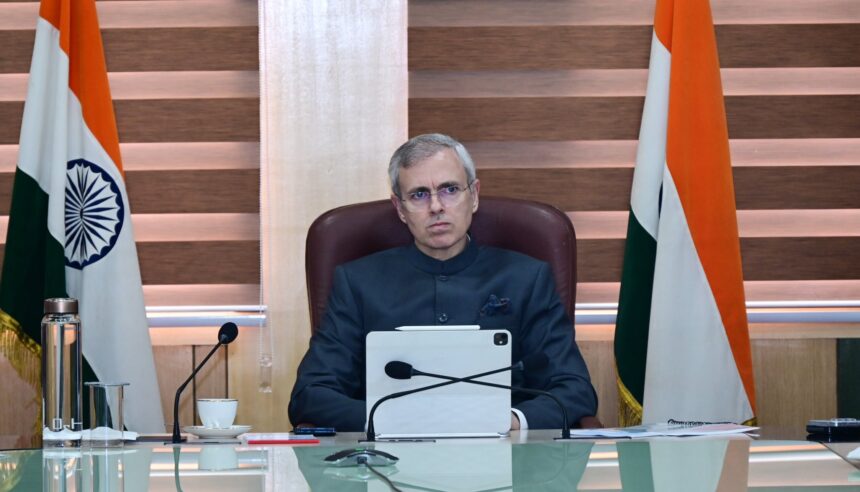
Jammu: Jammu and Kashmir Chief Minister Omar Abdullah on Tuesday directed concerned departments to ensure time-bound completion of ongoing works under the Scheme for Special Assistance to States for Capital Investment (SASCI), with a focus on meeting financial targets within the stipulated sunset period.
Chairing a review meeting to assess the progress of SASCI works, Abdullah also called for expediting execution, strengthening inter-department coordination and ensuring optimal utilisation of funds.
The review covered physical and financial progress of projects undertaken during FY 2025-26, availability of funds and expenditure targets for FY 2026-27, besides steps taken for effective implementation of projects during FY 2027-28, an official spokesman said.
The chief minister reviewed progress across key sectors, including public works, Jal Shakti, youth services and sports, power, and housing & urban development.
Abdullah called for special focus to the disaster management component, aimed at strengthening disaster mitigation and resilience, besides restoring infrastructure damaged in natural disasters.
He also directed expediting SASCI Part-I works and ensuring full utilisation of approved funds by March 2027 to qualify for the second instalment.
He stressed strict adherence to revised deadlines for completion of works under the SASCI 2025-26 disaster management component and directed departments to achieve the prescribed financial targets within the stipulated period.
Emphasising financial discipline and transparency, the chief minister called for strict compliance with public financial management system (PFMS) uploads and timely submission of action plans on the budget estimations, allocation & monitoring system (BEAMS).
He also called for the closure of all single nodal agency bank accounts relating to Centrally-sponsored schemes.
In view of the forthcoming visit of an Inter-Ministerial Central Team (IMCT) to assess damages, departments were asked to finalise comprehensive, sector-wise damage assessment reports to facilitate the assessment process, the spokesman said.
The chief minister also directed all departments to identify and prepare a robust shelf of encumbrance-free projects by March 2027 to facilitate timely tendering and smooth execution during FY 2027-28.
He stressed advance planning and close inter-department coordination to ensure that the next year’s SASCI plan is finalised well in time.
Reviewing the performance for FY 2025-26, the meeting was told that against an overall allocation of Rs 5,166.46 crore, comprising untied funds, shares for Centrally-sponsored schemes, incentive-based allocations and disaster management components, an expenditure of Rs 3,367.64 crore had been incurred, the spokesman said.
He said the meeting was also told that the state executive committee has approved Rs 1,416 crore for post-disaster needs assessment across social, infrastructure, productive and cross-cutting sectors, against a National Disaster Management Authority (NDMA) ceiling of Rs 1,534.58 crore.
An amount of Rs 424.79 crore has been proposed for immediate release, the spokesman said.
For FY 2026-27, he said, Rs 811 crore is available under SASCI Part-I united funds, including Rs 541 crore in current-year receipts and Rs 270 crore carried forward as unutilised funds from the previous financial year.
Departments have been assigned an expenditure target of Rs 608 crore to qualify for the second instalment, he said.
Under Part-II, relating to Centrally-sponsored schemes, J&K has received Rs 116 crore, constituting 66 per cent of the Rs 176 crore SASCI loan assistance sought for 10 major schemes linked to J&K, he said.
The spokesman said the meeting also reviewed the J&K administration’s efforts to leverage an incentive-based funding pool of Rs 2,890.51 crore available for FY 2026-27, linked to governance reforms, improved financial management and sector-specific performance benchmarks.
Significant progress was reported under the Digital Public Infrastructure for Agriculture initiative (AgriStack), with 7.59 lakh farmer IDs generated, representing 59 per cent of the target.
A digital crop survey has been completed in 5,714 villages, covering 83.3 per cent of the target and more than 30.27 lakh land parcels, he said.
The pilot distribution of AgriStack-enabled fertilisers through farmer IDs commenced on November 5 in Jammu and Srinagar districts, the spokesman said.
Abdullah emphasised that SASCI should be leveraged not merely as a special funding window but also as a strategic instrument for accelerating capital investment, strengthening public infrastructure and improving governance outcomes across Jammu and Kashmir.
He underscored the importance of timely execution, efficient financial management and sustained coordination among departments to maximise the benefits available under the scheme, the spokesman said.
Assures all possible assistance to fire-affected traders in Jammu
Jammu: Jammu and Kashmir Chief Minister Omar Abdullah on Tuesday assured traders affected by the recent fire incidents in Jammu that the government would extend all possible assistance to them.
Abdullah gave the assurance during his interaction with a BJP delegation comprising Member of Parliament from Jammu Jugal Kishore Sharma and several Legislators including Sham Lal Sharma, Vikram Randhawa, Narinder Singh Raina, Yudhvir Sethi and Arvind Gupta who called on him and discussed the recent fire incidents in Jammu city and the situation of the affected traders, an official spokesman said.
The public representatives apprised the Chief Minister of the damage caused by the fires at Shiv Market near Jammu Railway Station, the warehouse near Nehru Market and Pahari Mohalla.
They highlighted the difficulties being faced by the affected traders and shopkeepers and sought financial assistance for the affected traders and shopkeepers, an official spokesman said.
Abdullah had already taken prompt cognisance of the fire incidents. He had personally visited Shiv Market near Jammu Railway Station to assess the damage and interact with the affected shopkeepers.
He had also deputed the Deputy Chief Minister and a Cabinet Minister to visit the Warehouse Nehru Market to take stock of the situation and assess the losses suffered by the traders.
Choudhary Mohd Akram, an independent MLA from Surankote in Poonch, also called on the Chief Minister and discussed developmental issues and public welfare concerns pertaining to his constituency.
Meanwhile, a BJP spokesman said the party delegation submitted a four-point memorandum to the chief minister, seeking urgent government intervention and a time-bound rehabilitation plan for the affected trading community.
Highlighting the gravity of the situation, the BJP leaders pointed out that the recent fires had gutted dozens of shops at Shiv Market near Jammu Railway Station on October 25 and eight shops and godowns at Warehouse Market, and one shop at Pahadian Mohalla on Sunday night, leaving several families facing severe financial hardship.
The BJP delegation demanded immediate financial assistance of Rs 15 lakh per affected shop or godown from the Chief Minister’s Relief Fund, stressing that traders who have lost their shops, stocks and essential equipment cannot be left struggling for survival while awaiting lengthy administrative procedures.
The leaders urged the government to ensure prompt verification of losses and speedy disbursement of relief so that affected businesses could restart without further delay, the spokesman said.
He said the memorandum also sought a one-time relaxation of Constituency Development Fund (CDF) norms, enabling willing MLAs from Jammu to sanction appropriate amounts from their respective allocations for immediate relief through the State Disaster Response Fund (SDRF).
Taking up the long-pending concerns of Warehouse Market traders, the BJP leaders further demanded identification and allotment of suitable land for godowns, along with government sanction for their construction within a specified timeframe.
The delegation also called for a time-bound fire safety audit of commercial establishments across Jammu, particularly densely populated markets and storage areas.
It demanded installation of fire alarms, extinguishers, hydrants and other preventive facilities, besides inspections of electrical safety and emergency access arrangements to prevent such tragedies in the future, the spokesman said.

