



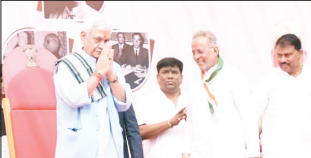
Jammu: Lieutenant Governor Manoj Sinha on Monday said that the history of Jammu & Kashmir would have taken a different course if Sardar Vallabhbhai Patel had been entrusted with full responsibility for its integration in 1947.
“History of J&K would have been different if Sardar Patel had been given full responsibility for its integration in 1947,” the Lieutenant Governor said while addressing “Sardar@150 Unity March (Padyatra)” in Vadodara today, a nationwide initiative marking the 150th birth anniversary of Sardar Vallabhbhai Patel.
The march started from Patel’s ancestral home in Karamsad and will cover nearly 190 km over 11 days, culminating at the Statue of Unity on December 6.
Speaking on the theme “Kashmir, Hyderabad and Sardar”, the Lieutenant Governor said that Sardar Patel’s decisive leadership would have ensured complete and irreversible integration of Jammu and Kashmir if he had handled its affairs during 1947.
“History of J&K would have been different if Sardar Patel had been given full responsibility for its integration in 1947,” the LG said. He added that despite not being directly in charge, Patel played a crucial role in ensuring that Jammu & Kashmir remained an integral part of India. “From the beginning, Sardar Patel had said we will not give even an inch of Jammu & Kashmir to Pakistan,” he stated.
The LG recalled that Patel had expressed strong disagreement with the then Prime Minister Jawaharlal Nehru’s approach to J&K, particularly on taking the issue to the United Nations. “In one of his public rallies, Sardar Patel categorically spoke about the complete integration of Jammu & Kashmir. His decisive action would have altered the course of history,” Sinha said.
Highlighting Patel’s legacy, the LG said the Iron Man of India continues to guide the nation’s path of unity, equality, and social justice. “As the architect of modern India, Sardar Patel symbolises our self-confidence, self-respect and courage,” he said.
The LG asserted that Prime Minister Narendra Modi is realising Sardar Patel’s vision through key national reforms. “With the abrogation of Article 370, he has woven the entire country into a single thread of unity, fulfilling the resolve of one flag, one constitution and one leader,” Sinha said.
He also referred to several national initiatives—‘One Nation, One Tax’, ‘One Nation, One Ration Card’, ‘One Nation, One Health Card’, ‘One Nation, One Grid’, the National Education Policy, PM Gati Shakti and the Kashi-Tamil Sangamam—as steps that have strengthened national unity.
Calling upon the youth to take forward Patel’s legacy, the LG said unity rests on three core pillars: shared values, shared identity and a shared purpose. “These pillars act as a powerful force for sustained progress and development,” he added.

