



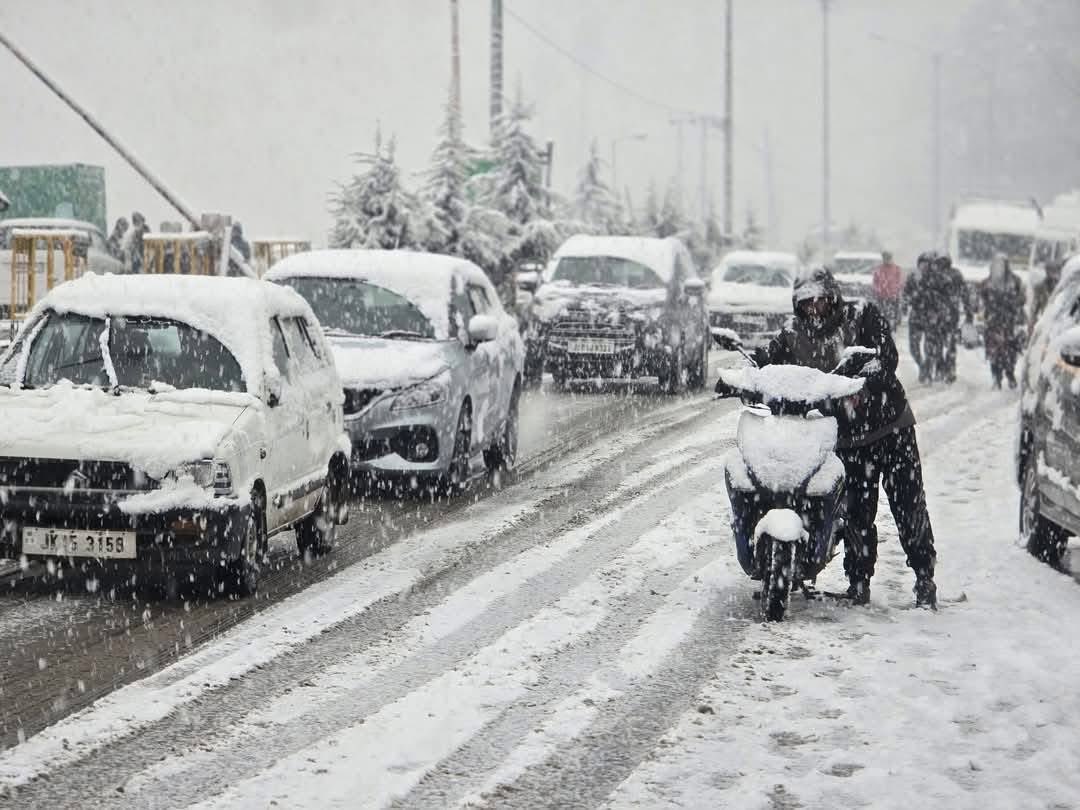
Jammu: Fresh snowfall across Kashmir on Friday brought life to a standstill, causing flight disruptions and road closures in many parts of the region.
The snowfall, which covered both higher reaches and plains, marked the season’s first for several areas, including Srinagar.
Meanwhile, Jammu was drenched in persistent rain throughout the afternoon and evening, intensifying the wintry chill.
A western disturbance hit Jammu and Kashmir on Friday, bringing light snowfall across many areas of the valley.
Snowfall was recorded in popular ski resorts such as Gulmarg, as well as tourist destinations like Sonamarg and Pahalgam. Other affected areas included Gurez, Zojila Axis, Sadhna Top, Mughal Road, and districts like Bandipora, Baramulla, and Kupwara. Notably, the season’s first snowfall also occurred in the plains of Srinagar, Ganderbal, Anantnag, Kulgam, Shopian, and Pulwama districts.
The India Meteorological Department (IMD) reported that, under the influence of the western disturbance, light rain is expected in Jammu’s plains, while light snowfall is predicted for the higher reaches of the Chenab Valley and Pir Panjal Range. A light snowfall over middle and higher reaches, particularly in south and central Kashmir, is expected to continue through the evening and night.
The inclement weather also led to major disruptions at Srinagar International Airport, with several flights delayed or canceled. Authorities at the airport worked to clear the runway, but visibility issues and icy conditions hampered operations.
Additionally, the fresh snowfall led to the closure of the Srinagar-Leh Highway and Mughal Road. The authorities also suspended traffic on the Srinagar-Jammu National Highway. Inspector General of Police (Traffic) Suleman Choudhary stated, “Traffic on the highway has been suspended in Qazigund due to slippery road conditions. Around 350 heavy motor vehicles (HMVs) are stranded between Qazigund and the Nayug Tunnel.”
Choudhary also added that small vehicles were being cleared, but no fresh traffic was allowed from Udhampur. “Traffic will resume on Saturday morning, subject to road conditions,” he said, advising commuters to avoid traveling on the highway until the weather improves.
Officials from the Border Roads Organization (BRO) confirmed that traffic through the Jawahar Tunnel was suspended due to heavy snowfall on both sides of the tunnel.
Deputy Commissioner (DC) Anantnag, Syeed Fakhrudin Hamid, stated that while the area had not received heavy snowfall, roads had turned slippery after the wet spell, slowing down traffic movement. “We are working to clear the traffic through the Jawahar Tunnel,” Hamid added. Police officers from Kulgam were also providing assistance to stranded vehicles along the Jammu-Srinagar National Highway.
Jammu and Kashmir’s Chief Minister, Omar Abdullah, expressed concern for families and children among the stranded commuters, instructing the DC to ensure that such vehicles were given priority. “The icy conditions have caused traffic to back up. The stranded vehicles are slowly moving, and necessary assistance is being provided. I’ve instructed the DC to ensure that vehicles with families and children are prioritized. If needed, arrangements for overnight shelter will be made,” Abdullah posted on X.
Meanwhile, an intense cold wave prevailed across Kashmir, with temperatures dropping well below freezing. Srinagar recorded a minimum temperature of minus 7.3 degrees Celsius, slightly colder than the previous night’s minus 7 degrees. Gulmarg registered a low of minus 6 degrees Celsius, while Pahalgam recorded minus 8 degrees Celsius. The coldest area was Konibal in Pampore, with a low of minus 9.5 degrees Celsius. The cold temperatures have caused water supply lines to freeze, and a thin layer of ice covered water bodies, including the iconic Dal Lake.
While weather conditions are expected to remain mainly dry from December 29 to 31, light snowfall is possible at isolated locations in Kashmir between January 1 and 5.
In Jammu, the persistent rain since the afternoon has caused a sharp drop in temperatures, leading to cold weather and disruptions in daily activities.

