



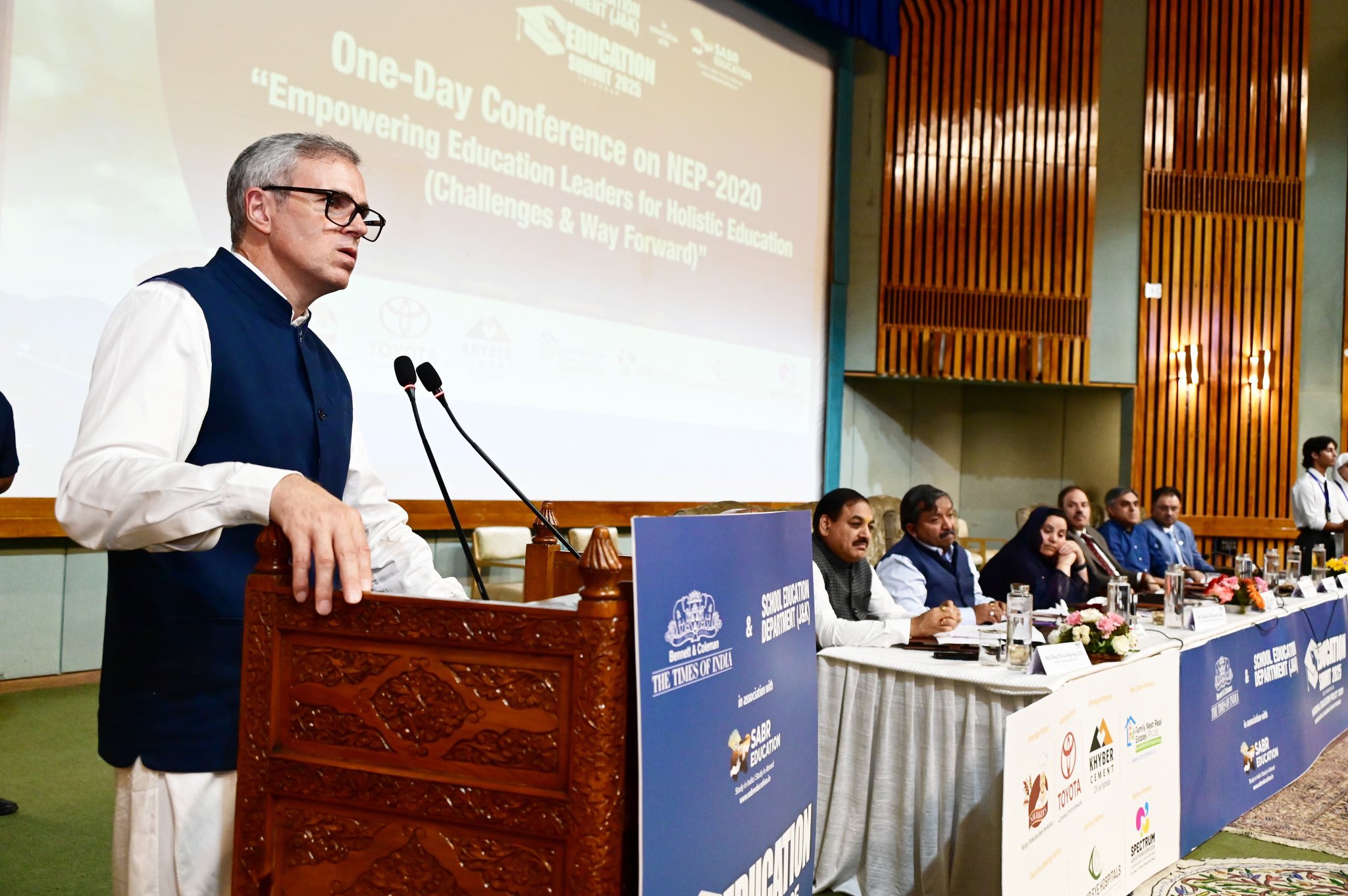
‘Calls for holistic implementation of NEP’
Srinagar: Highlighting persistent disparities in subject availability and staffing, Jammu and Kashmir Chief Minister Omar Abdullah on Monday said many government schools and colleges continue to struggle with faculty shortages that limit subject offerings.
“In Jammu, only a few schools offer Urdu; in Kashmir, few offer Hindi. Even regional languages like Kashmiri, Dogri, or Punjabi are taught in a very limited number of institutions,” he said, adding, “These gaps need to be filled gradually, within our available resources.”
Addressing a one-day conference on NEP-2020 at the Sher-i-Kashmir International Convention Centre (SKICC), themed “Empowering Education Leaders for Holistic Education,” the Chief Minister emphasized the importance of inclusive, accessible, and locally relevant education.
He also addressed comparisons between private and government institutions, noting that government schools often serve the most remote and underserved areas.
“Setting up a school in Srinagar is easy. Try opening one in Gurez, Tangdhar, or Machil. Our teachers work in extreme conditions, far from the spotlight, and they deserve our recognition,” he remarked.
Earlier, the Chief Minister visited an exhibition held at the venue, where students showcased innovative models addressing real-life issues such as water conservation, climate change, low-plastic alternatives, and winter-specific water piping systems.
“Our children don’t lack talent—they lack exposure and opportunity,” Abdullah said.
“Their creativity, thinking, and innovation give us hope that we are moving in the right direction.”
On inclusivity, he stressed the need to ensure education is accessible to children with physical or learning challenges. “Every child deserves a chance to learn. This workshop is a good step toward that inclusive vision,” he said.
Touching on the broader social connection with education, the Chief Minister pointed out how decisions on school holidays, exams, or online learning spark widespread household debates—reflecting education’s central role in society.
He also acknowledged the challenges posed by the digital divide. “As our financial capacity grows, we will intensify efforts to bridge the digital gap, ensuring equitable access to technology,” he added.
Calling NEP-2020 a “magnificent and far-reaching” document, Omar Abdullah said its success depends on how well it is understood and implemented at the grassroots level.
“The policy is now five years old. This is the time to evaluate our successes, identify gaps, and course-correct where necessary. A policy is only as effective as its application,” he said.
He concluded by stating, “The future of Jammu and Kashmir is in the hands of our educators. You are not just teaching curriculum—you are shaping citizens, instilling values, and building futures.”
Minister for Education Sakina Itoo also addressed the gathering, reiterating the government’s commitment to making education more equitable, inclusive, and future-ready.

