



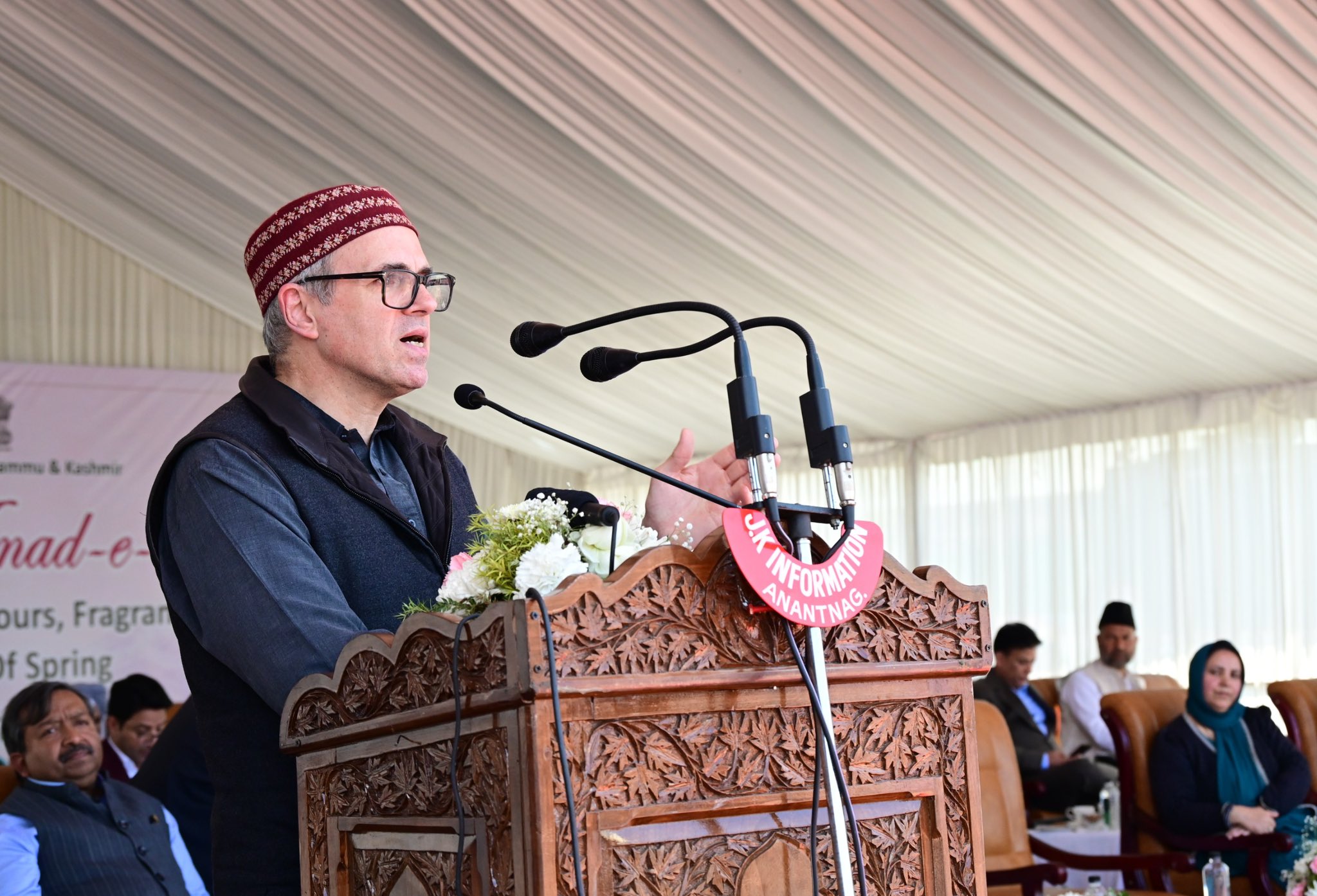
SRINAGAR: Jammu and Kashmir Chief Minister Omar Abdullah on Tuesday strongly condemned the incident in Ramban, asserting that taking the law into one’s own hands cannot be justified under any circumstances.
Omar Abdullah was referring to April 12 incident whereinTanveer Ahmad Chopan (25), a resident of MundkhalPogal in Ukhral tehsil, was travelling from Jammu towards his native village in a Tata Mobile vehicle ferrying a milch cow and two calves.
Locals claimed that he was allegedly chased and assaulted by cow vigilantes. According to eyewitness accounts,Chopan jumped into the nearby Nallah Bishlari while trying to save himself.
Speaking on the issue, Abdullah said that such actions raise serious questions about who has permitted individuals to assume authority and target people transporting livestock by branding them as illegal. He termed such acts as “goondaism” and an attempt to impose “jungle raj,” making it clear that the elected representatives of Jammu and Kashmir will not allow such a situation to prevail.
“We, as elected representatives of the people, including myself and our local MLA, will not allow jungle raj to be established in Jammu and Kashmir,” he said.
Responding to a query regarding reported demands for waiving of farmers loan, the Chief Minister said that the matter has been taken up with the Central Government. He added that appropriate steps will be taken once approval is received.
Abdullah further said that the current phase is not merely about celebration but about reminding people of the government’s efforts to usher in a new beginning. He pointed to key decisions taken during the recent budget session, describing them as measures aimed at public welfare and structural reform.
He highlighted initiatives such as the provision of six LPG cylinders to economically weaker sections and the extension of free electricity under the Surya Ghar scheme. He also underlined what he termed as a major decision—allowing the establishment of private universities in Jammu and Kashmir.
The Chief Minister said that the move is intended to address long-standing challenges faced by students who are forced to travel outside the Union Territory for higher education, often at significant financial and personal cost.
“We have opened the doors for private universities to come to Jammu and Kashmir. We will reach out to institutions across the country and invite them to set up campuses not only in Jammu and Kashmir but also in remote areas, so that our students can access quality education within the region,” he said.
Meanwhile, he inaugurated a spring festival on the occasion of Baisakhi, at Jablipora in Anantnag district.
The chief minister described spring as a symbol of renewal and hope, stating that the festival represents not just a seasonal transition but also a new phase of development and governance in Jammu and Kashmir.
“We always celebrate the arrival of spring because spring is a new beginning for us. These spring celebrations are not only to celebrate the beginning of this year’s spring, but also to remind people that after the arrival of our government, there was not only an effort, but a path was made. There is a new spring, a new beginning,” Abdullah said while addressing the gathering.
Highlighting recent policy initiatives, Abdullah referred to key decisions taken during the recent budget session, including the provision of free six LPG cylinders to poor households and free electricity under the Surya Ghar Muft Bijli Yojana.
He also emphasised the decision to allow the establishment of private universities in Jammu and Kashmir, aimed at expanding access to quality higher education within Jammu and Kashmir.
“Our children are struggling. In other states, to get admission in private universities, their expenses also increase, and they have to face difficulties from time to time. We have now opened the doors for those private universities to come to J-K. Now, we will go to different states and invite these universities to come here to establish their campuses in remote areas,” Abdullah said.
Reaffirming his government’s commitment to strengthening rural livelihoods, the chief minister noted that efforts are underway to boost farmers’ incomes and build a sustainable, self-reliant agriculture sector in Jammu and Kashmir.
The chief minister highlighted a series of transformative and forward-looking initiatives undertaken by his government in the agriculture and allied sectors, describing them as pivotal to reshaping the rural economy of Jammu and Kashmir.
He underscored that these interventions are not only aimed at enhancing productivity and farmers’ income but also at promoting sustainability, diversification, and value addition.
The chief minister said that several ambitious programmes are in the pipeline, including the expansion of high-density plantations, strengthening of cold storage and marketing infrastructure, and greater integration of technology in farming practices.
“Our vision is to build a resilient and self-reliant agricultural economy that empowers farmers and contributes significantly to the overall economic growth of J-K,” he added.
Referring to the immense potential of south Kashmir, Abdullah noted that the region is richly endowed with fertile land and a favourable climate, making it ideal for both agriculture and tourism.
He said that South Kashmir offers a unique blend of natural beauty and agricultural diversity, which can be leveraged to promote agro-tourism.
Abdullah asserted that such initiatives can create new livelihood opportunities for local communities while simultaneously showcasing the region’s rich agrarian heritage to the world.

