



The future strength of the Indian Air Force will depend on more than the acquisition of advanced fighter aircraft. It will be determined by India’s ability to develop the propulsion systems, weapons, sensors, electronic warfare capabilities and network architecture that underpin modern air combat.
China’s rapid progress in military aviation has exposed an important distinction between possessing advanced aircraft and possessing the technological ecosystem required to design, manufacture and continuously upgrade them. Beijing’s development of the J-36 and J-50 demonstrates an ambition to move towards an integrated air-combat architecture in which manned fighters, unmanned platforms, long-range weapons and distributed sensors operate as a coordinated system.
For India, the challenge is not simply to develop a comparable aircraft. It is to establish the industrial and technological foundations necessary to remain competitive across successive generations of military aviation.
This requires a fundamental shift in defence planning: from platform-centric procurement towards capability-driven force development.
The immediate requirement: Strengthening the existing combat fleet
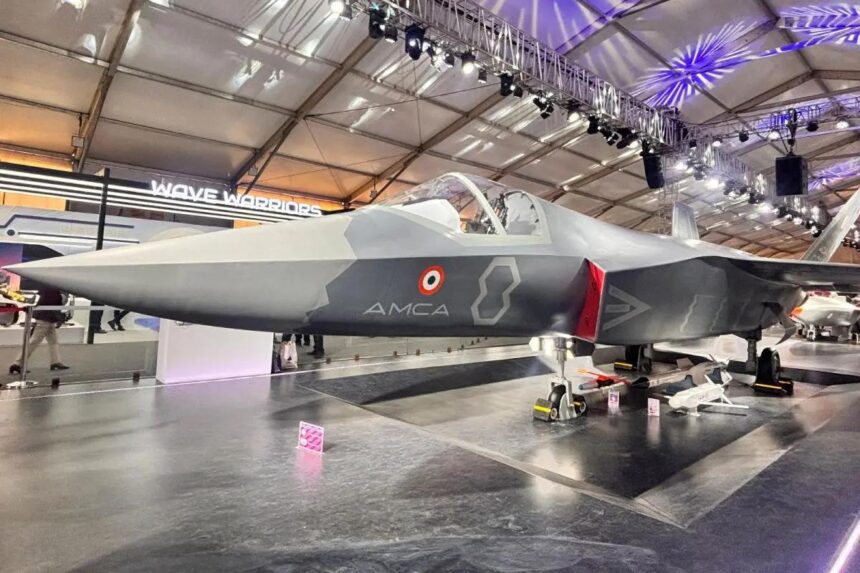
India cannot wait for the Advanced Medium Combat Aircraft (AMCA) to become operational before addressing the changing regional air-power balance.
The Rafale and Su-30MKI will remain the principal platforms through which the Indian Air Force must manage the emerging capability gap. Their operational relevance will depend on sustained modernisation, improved weapons and integration with a wider surveillance and command-and-control network.
The Rafale offers advanced electronic warfare, sensor fusion and the Meteor beyond-visual-range missile. However, its effectiveness against increasingly sophisticated adversary aircraft will depend on the availability of longer-range weapons, improved radar capabilities and support from airborne early-warning systems.
The proposed F5-standard modernisation and integration of indigenous weapons could extend the platform’s operational value. The Rafale should therefore be treated as a bridge towards India’s future stealth capability, not as a replacement for it.
The Su-30MKI presents a different opportunity. Its payload capacity, operational range and substantial existing fleet make it particularly suitable for modernisation. The proposed Super-30 programme, with improved radar, infrared search-and-track systems, electronic warfare and longer-range weapons, could preserve its relevance well into the next decade.
The Astra Mk2 and Astra Mk3 programmes are equally important. The objective must be to ensure that Indian fighters are not disadvantaged by the growing range of Chinese air-to-air weapons.
India should also accelerate the integration of the R-37M missile on the Su-30MKI, as envisaged in the comparative assessment.
These upgrades cannot be viewed as isolated procurement projects. They must form part of a coherent weapons and sensor modernisation strategy.
The unmanned combat aircraft opportunity
One of the most important changes in future air warfare is the emergence of collaborative combat aircraft.
The sixth-generation concept envisages manned fighters operating as command platforms, directing multiple unmanned aircraft that can perform surveillance, electronic warfare, decoy and strike missions.
This architecture has considerable implications for India.
The Chinese J-20S and J-36 programmes indicate that Beijing is moving towards greater integration between manned fighters and uncrewed systems. The United States is pursuing a similar direction through its Collaborative Combat Aircraft programmes.
India cannot afford to approach this development as a secondary technological experiment.
The CATS Warrior, Ghatak and other indigenous unmanned aviation initiatives offer an opportunity to develop a domestic capability in this field. However, producing an advanced unmanned aircraft is only one part of the requirement.
The more important challenge is integrating these platforms with manned fighters through secure communications, autonomous mission management, artificial intelligence and common operational networks.
The Rafale and Su-30MKI should eventually be capable of coordinating compatible unmanned systems, subject to the necessary technical integration and certification.
Such an arrangement could provide the IAF with additional operational mass without requiring every mission to depend on an expensive manned fighter.
It could also distribute risk by assigning selected high-risk missions to unmanned platforms.
For India, crewed–uncrewed teaming is therefore not simply a technological ambition. It is a potential force multiplier against an adversary with a larger aircraft inventory.
The engine problem: India’s most consequential technological weakness
If one area deserves priority above all others in India’s long-term aerospace strategy, it is fighter-engine development.
India’s dependence on foreign propulsion systems remains a structural weakness. The Tejas Mk1 uses the American F404 engine, while the Tejas Mk2 and AMCA Mk1 programmes are associated with the F414.
The Kaveri programme illustrates why this dependence has persisted.
Sanctioned in 1989, the Kaveri was intended to produce approximately 81 kN of wet thrust. The programme delivered around 70–73 kN, falling short of the original requirement for the Tejas.
The problem was not a lack of scientific or engineering talent. It was the absence of a sufficiently mature industrial ecosystem capable of developing, manufacturing, testing and certifying advanced fighter engines.
A modern turbofan requires expertise across multiple disciplines, including advanced metallurgy, combustion, aerodynamics, thermal management, turbine manufacturing and digital engine control.
Single-crystal turbine blades, high-temperature coatings, powder-metallurgy components and precision manufacturing processes are particularly demanding. These technologies cannot be acquired simply through licensed assembly or the transfer of selected engineering drawings.
They require sustained research, manufacturing experience and repeated testing.
India also lacks the comprehensive altitude-testing infrastructure required to independently validate a modern fighter engine across its full operating envelope.
The institutional structure has contributed to the problem. Research, manufacturing, certification and production have historically been divided across different organisations without a single industrial entity assuming responsibility for the complete development cycle.
This fragmented approach must change.
Turning foreign partnerships into Indian technological capability
The proposed Safran partnership for a 120 kN-class engine for the AMCA Mk2 represents an important opportunity.
Its strategic significance lies not merely in securing an engine for a future aircraft but in potentially acquiring the design and manufacturing expertise that India has struggled to develop independently.
However, the distinction between technology transfer and genuine technological ownership must remain central to negotiations.
India must secure clearly defined access to critical technologies, including hot-section design, advanced materials, turbine manufacturing, digital engine controls and testing processes.
The partnership should also establish Indian engineering teams capable of independently modifying, upgrading and eventually developing subsequent engine generations.
The Rolls-Royce proposal provides another potential avenue. Its strategic value lies partly in creating competition among foreign partners and improving India’s negotiating position.
The UK–India engine cooperation framework can also contribute to materials research and test infrastructure.
Similarly, the F414 production arrangement should be used to deepen India’s aerospace manufacturing capabilities rather than remain confined to assembly and component production.
The National Aero Engine Mission, proposed in the comparative assessment, should bring these activities under a coordinated long-term framework.
India needs a dedicated engine-development ecosystem with protected multi-year funding, a national altitude-test facility, advanced materials infrastructure and a clearly accountable industrial lead.
The involvement of private-sector companies will be essential.
The experience of the Kaveri programme demonstrates that a fighter engine cannot be developed through short funding cycles and institutional fragmentation. India needs an organisation capable of sustaining multiple generations of engine development.
The objective should be to build a national capability, not simply complete one procurement project.
AMCA must be developed as a combat system, not just a stealth fighter
The AMCA represents India’s most important indigenous fighter-development programme.
However, its long-term significance will depend on the technological architecture adopted during development.
India should avoid approaching AMCA Mk2 as merely a response to China’s existing J-20. By the time the aircraft becomes operational, the character of air warfare will have evolved further.
The aircraft must be designed around advanced sensor fusion, electronic warfare, secure communications, open architecture and the ability to coordinate collaborative combat aircraft.
Its propulsion system must also provide sufficient electrical generation and cooling capacity to support future sensors and electronic warfare systems.
The AMCA should function as a networked combat node, capable of receiving information from satellites, airborne surveillance platforms, ground-based sensors and other aircraft.
This would give India the opportunity to develop an aircraft whose effectiveness is derived not only from its stealth characteristics but also from its integration into the wider military network.
The involvement of private-sector companies in the programme offers an opportunity to improve development efficiency and expand India’s aerospace industrial base.
However, the programme must be governed by clear milestones, accountability and continuity of funding. Delays in aircraft development cannot be allowed to become a recurring feature of India’s strategic planning.
The importance of international technology partnerships
India’s aerospace ambitions cannot be pursued in isolation.
Partnerships with France, the United Kingdom, the United States, Japan and other technologically advanced countries can provide access to expertise that would otherwise take decades to develop independently.
India should explore meaningful participation in international future-combat-aircraft initiatives, including GCAP and FCAS, wherever institutional and political conditions permit.
Such engagement could provide opportunities in advanced propulsion, sensor technology, electronic warfare, autonomous systems and next-generation communications.
However, international cooperation must complement indigenous development rather than replace it.
India’s experience with previous defence programmes demonstrates the risks of becoming dependent on foreign suppliers for critical technologies. The objective of future partnerships must be to create domestic design capabilities and an industrial base that can sustain the technologies after the initial collaboration ends.
A new model of air-power development
India’s future air-power requirements demand a more integrated approach to defence planning.
The immediate priorities are clear: modernise the Rafale and Su-30MKI fleets, accelerate long-range missile programmes, strengthen counter-stealth surveillance and expand airborne early-warning capabilities.
At the same time, India must develop collaborative combat aircraft, strengthen space-based intelligence and integrate military command-and-control networks.
The longer-term priorities are equally important: AMCA development, indigenous fighter-engine technology and the establishment of a sustainable aerospace manufacturing ecosystem.
These programmes must not compete with one another for attention and resources. They must be developed as complementary elements of a single national air-power strategy.
China’s progress demonstrates the advantages of sustained investment, industrial coordination and rapid development cycles. India must respond with institutional reform, technological ambition and greater accountability in defence production.
The coming decade will determine whether India remains primarily dependent on imported propulsion and advanced aircraft technology or emerges as a country capable of designing and producing the systems that define future air warfare.
Ultimately, the measure of India’s aerospace strength will not be the number of advanced fighters it acquires.
It will be the extent to which India can independently design, manufacture, integrate and sustain the technologies on which its future air superiority depends.
This article is the concluding instalment of a three-part series examining China’s sixth-generation fighter programmes, the evolving China–Pakistan air-power equation and the strategic challenges facing India. It focuses on the capabilities, technologies and policy decisions that will shape the future of Indian air power

