



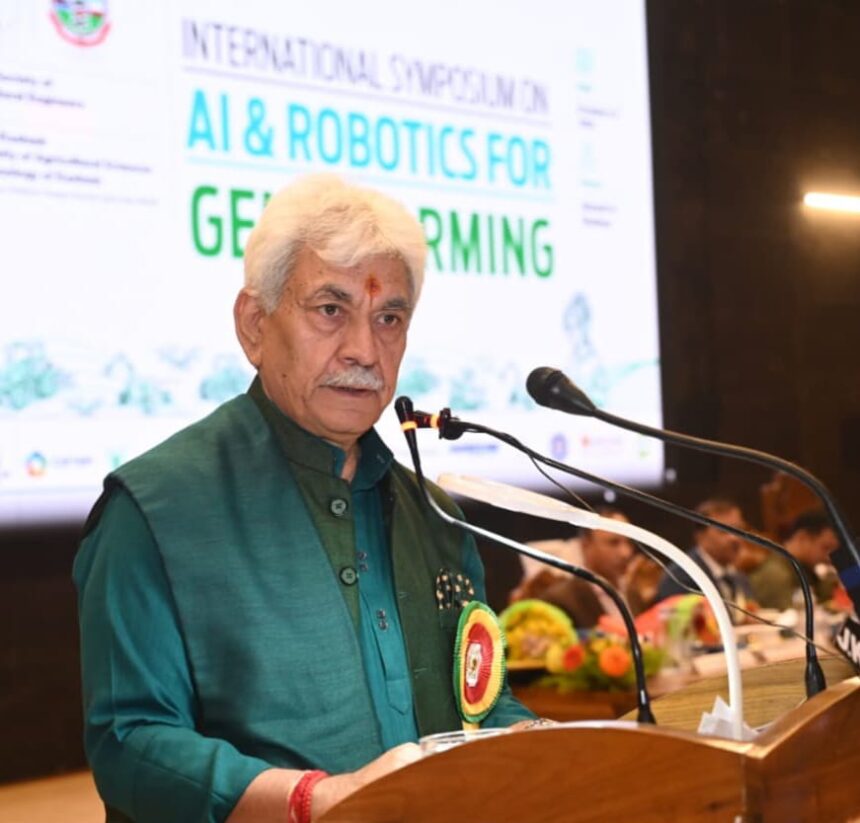
Srinagar: Lieutenant Governor Manoj Sinha has stressed the urgent need to protect the Himalayan ecosystem through science-based planning and sustainable mountain development, while calling for equitable access to healthcare facilities across urban and rural areas and greater emphasis on compassion in medical practice.
In separate messages to the valedictory session of the 13th Sustainable Mountain Development Summit and a conference on “Advancing Internal Medicine: From Evidence to Excellence in Clinical Practice”, organised by Government Medical College, Srinagar, the Lieutenant Governor outlined priorities for ecological security and patient-centric healthcare.
Congratulating the Integrated Mountain Initiative (IMI) and Sher-e-Kashmir University of Agricultural Sciences and Technology of Kashmir for jointly organising the summit, LG Sinha said climate change, global warming, environmental degradation and unplanned development were posing increasingly serious challenges across the Himalayan region.
He said the Himalayas were the source of rivers, protectors of biodiversity and vital regulators of climate, warning that any disturbance to their ecological balance would have far-reaching consequences.
“The vision of a developed India can be realised only when development and environmental protection advance together,” he said, emphasising that economic growth must be balanced with the conservation of natural resources.
The Lieutenant Governor outlined a four-pillar roadmap for a resilient Himalayan future, focusing on science-based planning, climate-resilient infrastructure, regenerative livelihoods and a zero-waste mountain economy.
The first pillar calls for determining the carrying capacity of mountain regions and adopting scientific zoning to ensure sustainable land use. The second emphasises environmentally sensitive construction, stronger disaster preparedness and community-based early warning systems integrating modern technology with traditional local knowledge.
Under the third pillar, LG Sinha called for promoting regenerative and inclusive livelihoods through high-value horticulture, organic farming, modern sericulture, eco-tourism and other green-economy activities. He stressed the need to empower women and youth as entrepreneurs and job creators.
The fourth pillar advocates a zero-waste and circular mountain economy through improved solid waste management, wastewater treatment and recycling systems across urban, rural and tourist destinations.
The Lieutenant Governor commended the summit for preparing a draft policy addressing ecological security, responsible tourism, disaster management and sustainable livelihoods. He expressed hope that the document would evolve into a comprehensive policy and implementation framework through wider consultations.
At the medical conference, LG Sinha highlighted the role of physicians in delivering holistic, evidence-based and compassionate healthcare. He said internal medicine required clinical knowledge, experience, careful observation and an understanding of the human body as an interconnected system.
Congratulating Government Medical College, Srinagar, on organising the conference, he acknowledged its contribution to medical education and healthcare, noting that generations of doctors trained at the institution continued to serve across Jammu and Kashmir and the country.
The Lieutenant Governor expressed concern over the growing burden of lifestyle-related disorders, including diabetes, hypertension, obesity, fatty liver disease and cardiovascular ailments. He stressed that advances in diagnostics, therapeutics and medical technologies must reach patients and physicians in rural and remote areas as effectively as they do in urban centres.
“We must ensure that there is not even the slightest gap between urban and rural areas in access to facilities and available tools. This should be the first objective of this conference,” he said.
LG Sinha called for strengthening indigenous medical research to generate evidence relevant to India’s diverse population, stating that the country’s demographic diversity and medical expertise offered significant opportunities for scientific discovery and innovation.
He also outlined key priorities for the medical community, including expanding access to advanced medical knowledge through digital health platforms and telemedicine, prioritising preventive healthcare and early detection, and using artificial intelligence and technology as supportive tools while preserving clinical judgement.
The Lieutenant Governor stressed the need to strengthen research capacity, address professional burnout and safeguard doctors’ wellbeing. He said healthcare institutions must ensure better working environments and conditions for physicians alongside quality patient care.
“Along with caring for patients, hospitals and institutions, it should be ensured that doctors are cared for too. Providing them with better workplaces and working conditions should be a priority,” he said.
Urging physicians to lead community-level prevention campaigns, LG Sinha said early detection of diabetes, hypertension and liver disease could help reduce treatment expenses. He encouraged young doctors to embrace innovation and learn from experienced mentors, while calling upon senior physicians to share their clinical knowledge with the next generation.

