



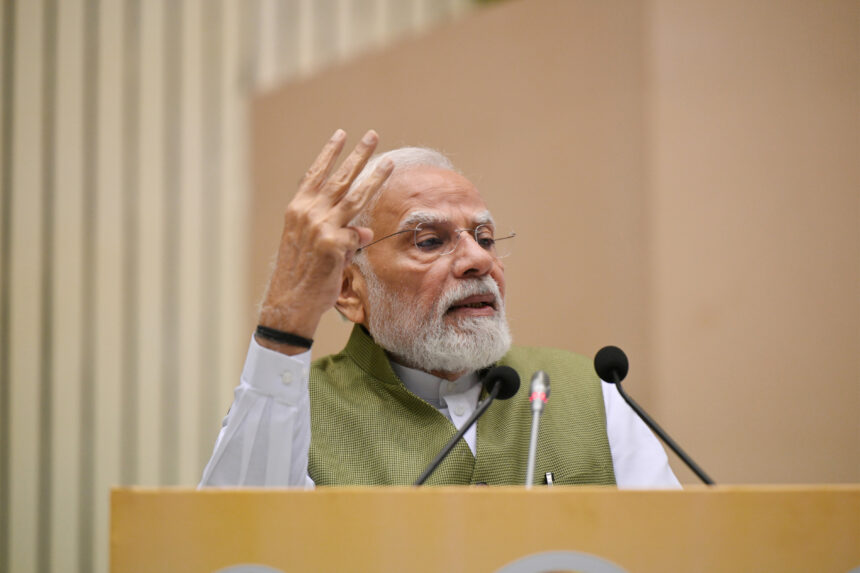
New Delhi: Prime Minister Narendra Modi on Friday asserted that the gap between cities and villages in India has significantly narrowed in the last 12 years.
Interacting with participants of ‘Seva Yatra’, an ongoing motorcycle rally travelling from Varanasi to Vadnagar, Modi also said that ever since his government came to power in 2014, self-reliance has increased among the women of the country.
“Over the past 12 years, the gap between cities and villages in India has significantly narrowed. Today, infrastructure in villages has improved significantly,” he said.
The prime minister also told the participants that one should work for constant reform and positive change in society, not just for politics of vote bank.
Altogether two bike rallies were flagged off at Vadnagar and Varanasi on September 17, Modi’s 76th birthday, and it will end on October 7.
The bike rallies — from Vadnagar to Varanasi and from Varanasi to Vadnagar — are being carried out to mark Prime Minister Modi’s 25 years of public service.
Vadnagar in Gujarat is the birth place of Modi, while Varanasi in Uttar Pradesh is his Lok Sabha constituency since 2014.
The two rallies are passing through towns, districts, and villages to take the spirit of service directly to the grassroots.
Modi said Vadnagar gave him the values that shaped his life, and Kashi (Varanasi) has added countless colours of service to those values.
“I am glad that all of you are also enriching this journey with the many colours of service,” he said.
The two bike rallies are bringing together several dimensions of public engagement, including ‘seva’ (service), ‘sampark’ (connect), youth participation, social welfare, cultural connect and community mobilisation and carrying them from one grassroots location to another.
On Thursday, the prime minister interacted with those taking part in the rally travelling from Vadnagar to Varanasi.
Meanwhile, he also highlighted the success of his government’s ‘Make in India’ initiative, and said creation of infrastructure, enterprise and innovation allows the country to prosper.
The ‘Make in India’ programme was launched on September 25, 2014 with the ambition of making India a global hub for manufacturing, design and innovation.
“More made in India. More investment in India. More exports from India. A transformation visible across sectors. ‘Make in India’ is about creating infrastructure, enterprise and innovation that allow India to grow and prosper,” he said in a post on X.
The prime minister also posted a video on his social media handles showcasing the success India achieved in semiconductor industry, aerospace, train engines and coach manufacturing, ship building, metro networks, automobile, medicines, solar power, mobile phone making among others.
The ‘Make in India’ initiative is focused on facilitating investment, fostering innovation and developing world-class infrastructure. Guided by ‘Minimum Government, Maximum Governance’, it has also sought to modernise processes and policies.
Over the years, ‘Make in India’ has opened new opportunities for businesses and investors to participate in India’s manufacturing journey.
The initiative has subsequently been expanded under ‘Make in India 2.0’. The initiative now focuses on 27 sectors, which include 15 in manufacturing and 12 in services.
