



WAJAHAT SHABIR
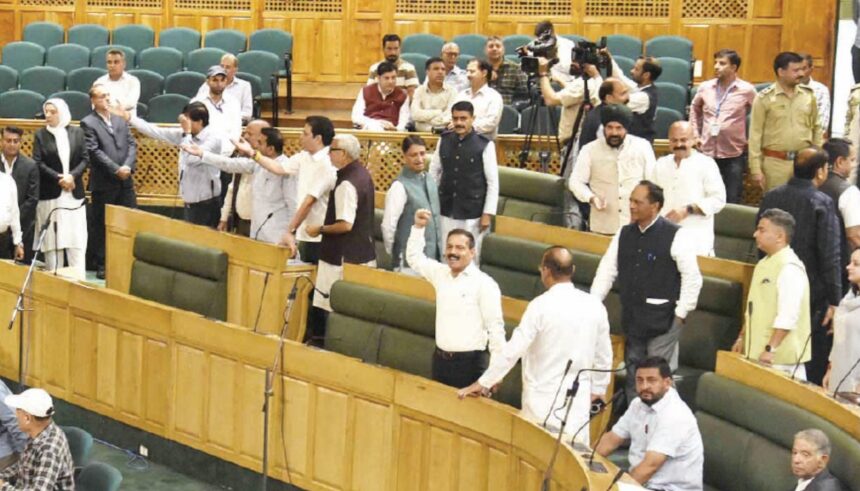
SRINAGAR: The second day of the autumn session of the Jammu and Kashmir Legislative Assembly witnessed a sharp clash between the National Conference and BJP over the demand for restoring a holiday on the birth anniversary of Sheikh Mohammad Abdullah, with BJP legislators staging a walkout after the issue was raised in the House.
The day also saw the Assembly pass the Jammu and Kashmir Cooperative Societies (Amendment) Bill, 2026, while a resolution seeking exemption of government teachers appointed before January 1, 2019 from the TET was moved by Education Minister Sakina Itoo, with a debate on the resolution scheduled for Thursday.
As the session began, Larmi stood up from his position and said that September 23 is observed as a holiday on the birth anniversary of Maharaja Hari Singh and urged the government to also grant a holiday on the birth anniversary of Sheikh Mohammad Abdullah.
He further said that if a holiday for Sheikh Mohammad Abdullah is not granted, the holiday on Maharaja Hari Singh’s birth anniversary should also be withdrawn. The remarks were followed by objections from BJP MLAs, who stood up and questioned why the Maharaja Hari Singh holiday should be removed.
Speaker Abdul Rahim Rather intervened and clarified that he was neither the authority to grant a holiday nor to remove one, saying that a member had only expressed his perspective before the House.
PDP MLA Waheed Para also raised and said that the sentiments of the people should be respected. He urged that a holiday on Sheikh Mohammad Abdullah’s birth anniversary should be granted and also raised the demand for a holiday in connection with the July 13 martyrs.
Moments later, the BJP legislators walked out the assembly except MLA Yudvir Sethi. Sethi remained in the House after his party colleagues staged a walkout during a dispute over the demand for restoration of a holiday on Sheikh Mohammad Abdullah’s birth anniversary.
The BJP MLA subsequently raised a question during the proceedings, prompting Abdullah to comment on his decision to remain in the House. Abdullah described Sethi as an MLA who chose to continue participating in the proceedings despite the walkout by other BJP members.
Later session saw various question and answers where legislators raised various questions from their constituencies.
Further, The Jammu and Kashmir Legislative Assembly on Tuesday passed the Jammu and Kashmir Cooperative Societies (Amendment) Bill, 2026, on the second day of the ongoing Assembly session, introducing a series of changes to the cooperative sector and repealing the Jammu and Kashmir Self-Reliant Cooperative Act, 1999.
The Bill, listed as L.A. Bill No. 09 of 2026, amends the Jammu and Kashmir Cooperative Societies Act, 1989 and provides for the transition of self-reliant cooperatives into the framework of the 1989 Act.
Under the legislation, all Self-Reliant Cooperatives registered under the 1999 Act immediately before the commencement of the new law will be deemed to be registered under the 1989 Act. Such societies will, however, have three years from the commencement of the Amendment Act to comply with requirements including adoption of compliant byelaws, submission of audited accounts and financial statements, membership eligibility and governance, audit and supervisory provisions.
The Bill provides that a self-reliant cooperative failing to comply with the prescribed requirements within the stipulated period may face cancellation of registration and dissolution in the manner prescribed.
The legislation also introduces additional safeguards for registration of cooperatives. For cooperative banks, prior written consent of the Reserve Bank of India will be mandatory, while cooperative housing societies will have to establish lawful possession of land through certified documents. Professional or technical institutions will require approval or licences from the concerned regulatory authorities, while societies operating in regulated sectors such as medicines and fertilisers will require the relevant NOC or licence.
The Bill further provides for prior written approval of the RBI and/or NABARD, as applicable, before amendments to the bylaws of cooperative banks are made or registered.
Another significant provision relates to auditing. Accounts of Urban Cooperative Banks, Central Cooperative Banks and Apex Cooperative Banks will be audited and certified by Chartered Accountants appointed from a panel approved by the RBI or NABARD. The Registrar will also be empowered to order special audits of cooperative banks and cooperative credit societies and forward the audit report to the concerned regulatory institutions.
The Bill raises the minimum number of applicants for primary agricultural and non-agricultural cooperative societies to 25 and provides for cancellation of registration where a cooperative society fails to get its accounts audited for three consecutive years.
It also substantially increases certain penalties under the 1989 Act, replacing fines of ₹200 with ₹2 lakh in specified provisions and ₹500 with ₹1 lakh in another provision.
The legislation formally repeals the Jammu and Kashmir Self-Reliant Cooperative Act, 1999, while protecting actions, orders, notifications and bylaws made under the repealed law insofar as they are not inconsistent with the amended framework.
The Bill records that it was passed by the Jammu and Kashmir Legislative Assembly on September 22, 2026, with Speaker Advocate Abdul Rahim Rather signing the legislation.
The bill saw suggestions and questions as well. BJP had raised several questions over the bill. Jammu and Kashmir Education Minister Sakina Itoo on Tuesday moved a resolution in the ongoing autumn session of the legislative assembly seeking to exempt government teachers in the union territory from the Teacher Eligibility Test (TET).
The Legislative Assembly will now debate the resolution moved by the education minister.
“This House unanimously urges the Union Government to make necessary statutory amendment to Section 23 of Right of Children to Free and Compulsory Education Act, 2009, to exempt all Teachers appointed before 01.01.2019 from appearing in the Teacher Eligibility Test (TET),” the resolution said.
“This House further urges the Union Government to take all legal steps and issue the requisite Notification through National Council for Teacher Education (NCTE) for exemption of Teacher Eligibility Test (TET),” it further read.
Moving the resolution in the House, Itoo urged the Centre to make the necessary statutory amendment to Section 23 of the Right of Children to Free and Compulsory Education Act, 2009, to provide the exemption to teachers appointed before the cut-off date.
The resolution, though, was not opposed by the Opposition Bharatiya Janata Party (BJP), but they sought a debate on it. The Speaker of the Assembly Abdul Rahim Rather said that a debate will be held on Thursday when the session resumes on September 23.
