



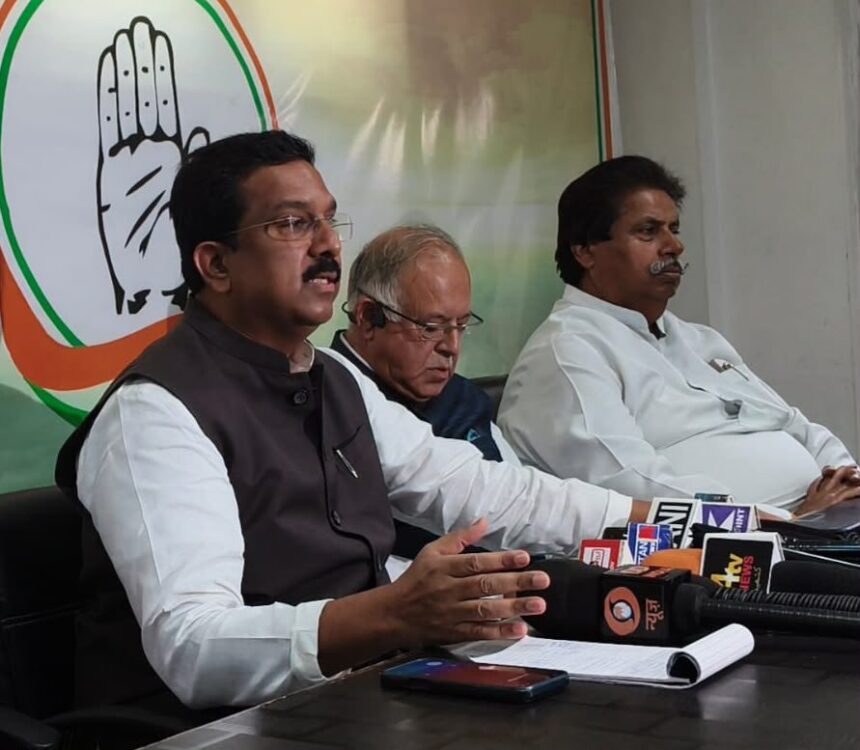
Srinagar: Congress Rajya Sabha MP and AICC General Secretary in-charge of Jammu & Kashmir and Ladakh Dr Syed Naseer Hussain on Sunday launched a sharp attack on the BJP-led Union government, saying the anger visible among students across the country goes beyond alleged examination paper leaks and reflects a wider frustration among the youth.
Addressing reporters in Srinagar, AICC general secretary in charge of J&K and Ladakh, Hussain said the manner in which the student protest at Jantar Mantar was handled raised serious questions about democratic space and the functioning of institutions in the national capital.
He particularly questioned the delay in registration of an FIR over an alleged firing incident during the protest, saying it was unprecedented that Congress Leader of Opposition Rahul Gandhi, Priyanka Gandhi Vadra and other senior party leaders had to spend nearly six hours at a police station before an FIR was registered.
Hussain said a student who was allegedly injured in the firing had repeatedly approached the police seeking registration of a case and an investigation into the incident.
According to him, the student had visited the police station several times along with his parents and friends, but the complaint was not initially converted into an FIR.
The Congress leader alleged that the student had suffered injuries from pellets during the incident and questioned why the police had taken so long to register a case.
He said the FIR was eventually registered against an unidentified person in connection with the alleged firing, despite more than a month having passed since the incident.
Hussain said the Jantar Mantar mobilisation should not be viewed merely as a protest over examination irregularities.
He recalled that students from different parts of the country had initially gathered over alleged paper leaks, including concerns related to NEET and subsequently other competitive and recruitment examinations.
However, he said the character of the mobilisation showed that students were expressing a much broader sense of frustration.
“I was trying to understand very closely what was happening,” Hussain said, referring to his own association with student movements.
He pointed to the posters, graffiti, street plays, songs, storytelling sessions, speeches, public classes and social-media broadcasts organised by the protesters as evidence of a wider mobilisation.
According to Hussain, the students were not merely demanding action over examination leaks but were also expressing concerns over employment, recruitment opportunities and the future of young people.
“It was very clear that it was not just about paper leaks,” he said, arguing that the protests reflected a wider frustration with the government.
The Congress leader’s remarks in Srinagar assume significance in the context of the party’s political focus on employment, recruitment and opportunities for young people in Jammu & Kashmir.
As the party’s AICC general secretary in charge of J&K and Ladakh, Hussain has been seeking to strengthen the Congress organisation in the Union Territory and raise issues concerning youth and public welfare.
He said the concerns being expressed by students nationally should be understood against the backdrop of growing aspirations among young people.
Hussain’s comments also come at a time when employment and recruitment remain politically sensitive issues in Jammu & Kashmir, where thousands of young people compete for limited government and private-sector opportunities.
He said political parties and governments should listen to the concerns of young people rather than treating student mobilisation merely as a law-and-order issue.
Hussain also questioned the circumstances surrounding the alleged firing at Jantar Mantar and the subsequent police response.
He said that once a complaint concerning a cognisable offence is submitted, the law provides for registration of an FIR followed by investigation.
Instead, he alleged, the complainant had to make repeated visits to the police station before the case was registered.
The Congress leader said the incident had wider implications for democratic rights and the ability of citizens, particularly students, to raise their concerns through peaceful protest.
He also criticised the BJP government’s claim of India being the “mother of democracies”, saying democratic credentials must be reflected in how institutions deal with dissent and public protests.

