



‘Public outrage over terror attack marks beginning of terrorism’s end’
NAVNEET DUBEY
Jammu: Putting statehood for Jammu and Kashmir on the backburner for the time being in the wake of massive terror attack, Chief Minister Omar Abdullah today affirmed that he is not going to exploit the situation for political advantage.
Reiterating that security responsibilities in Jammu and Kashmir are not under the elected government, Omar Abdullah made it clear that he would not use the tragedy for political advantage.
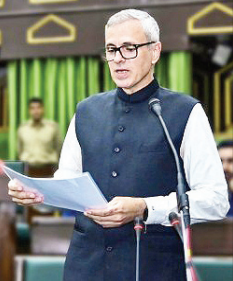
Winding up a discussion on a resolution in the House to condemn the Pahalgam terror attack that claimed 26 innocent lives, CM said, “I have too much respect for the sanctity of these 26 lives to indulge in petty politics. I will not exploit their martyrdom to raise demands for statehood or any other political gain today,” he declared.
The Chief Minister said that this is not the time to do politics and seek statehood. “It will be a curse on me if I take this opportunity to seek statehood from the Government of India. We will get ample opportunities in the future to ask for it and this is not the time to do politics, for business rules or seek statehood,” Omar said and told members not to thump the desks.
“The only thing which we need is to condemn this act of terror and express sympathy with the bereaved families,” he said. Chief Minister assured the Assembly that discussions around governance, rights, and aspirations would take place at an appropriate time, but today was a day solely for grief, solidarity and resolve.
Despite the deep wound inflicted by the attack, the Chief Minister identified a glimmer of hope: the spontaneous, widespread public condemnation of the attack across Jammu and Kashmir. From Kathua to Kupwara, ordinary citizens raised banners and placards reading “Not In My Name,” distancing themselves from terrorism without any political prompting.
“This attack was not done for us — it was done against us,” he stressed, adding that true and lasting peace would only be achieved when the people stand firmly with the forces of peace and governance.
He cited a significant moment of mourning at the Jamia Masjid in Srinagar, where a two-minute silence was observed after Friday prayers — an act that, he said, carried profound meaning for every Kashmiri.
The Chief Minister also narrated stirring examples of humanity shown by ordinary Kashmiris like a ponywala risking his life to save tourists, a humble fruit seller on Dal Lake offering free meals to stranded visitors despite meagre earnings and taxi drivers, hoteliers, and boatmen opening their hearts and homes to guests. These acts, he said, represented the true spirit of Kashmiri hospitality, even in the darkest of times.
Abdullah also appealed to the Centre to avoid steps that will alienate the public in the aftermath of the April 22 attack.
Chief Minister reflected on the painful circumstances that brought the House together. “It is hard to believe that just a few days ago, we were engaged in vibrant debates in this very House — over the Budget and many other important matters. We had hoped that we would meet again in normal conditions. None of us could have imagined that we would be meeting in such tragic and painful circumstances ,” he said.
The Chief Minister expressed gratitude to the Lieutenant Governor for convening the special session and emphasized the significance of the Assembly to understand the gravity of this tragic loss of innocents. “No other Parliament or Assembly can understand the pain of these 26 innocent lives lost, as much as this House does,” he stated.
Reflecting on the personal losses among legislators themselves, the Chief Minister recalled the sacrifices of members like Shagun Parihar, Sakina Itoo and Sajad Lone, and the horrors of the October 1, 2001, Assembly attack. He asserted that perhaps no Assembly can understand this grief better than theirs.
On behalf of the House, the Chief Minister strongly condemned the terrorist attack and expressed solidarity with the victims’ families. “This was not just an attack on people from one state — it was an attack on the very soul of India,” he declared. He highlighted that the victims hailed from across India, from Arunachal Pradesh to Gujarat, from Kerala to Jammu and Kashmir, symbolizing a national tragedy.
Omar Abdullah lamented that despite hopes that terrorism was a chapter of the past, the brutal attack marked the tragic return of terror involving death of so many civilians after 22 years. Remembering his own presence at the police control room to pay last respects, he spoke of the profound helplessness he felt facing the bereaved families. “What apology would ever suffice?” he asked.
The Chief Minister acknowledged that although security responsibilities no longer rested with the elected government, he, as Chief Minister and Minister of Tourism, bore responsibility for having invited the visitors and ensuring their safe return — a responsibility he felt he had failed to uphold.
Narrating the heart-wrenching words of a newly wed young woman who had lost her husband in the attack, the Chief Minister underscored the senselessness of the violence. “But who amongst us can ask for such violence? No one in this House or outside it, would ask for blood to be spilled ? No!” he stated emphatically.

