



Arteev Sharma
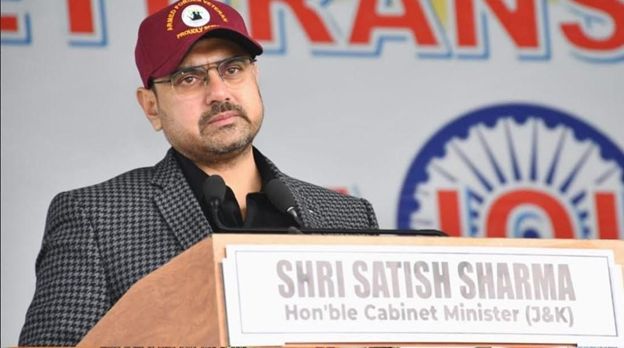
Jammu: The much-awaited reshuffle of Chief Minister Omar Abdullah’s Council of Ministers has brought the issue of regional balance and community representation in Jammu and Kashmir back into focus, with the removal of Independent MLA Satish Sharma from Cabinet leaving the Hindu-majority districts of the Jammu region without representation in the Cabinet.
The reshuffle, carried out on Tuesday, witnessed the induction of four ministers from the Kashmir Valley, while Sharma, who represents the Chhamb Assembly constituency and the only minister representing the Hindu-majority plains of the Jammu region, was dropped from the Council of Ministers.
His exit has altered the regional and community composition of the Cabinet, triggering questions about the representation of the Jammu plains in the Omar Abdullah-led government.
Following Sharma’s removal, Deputy Chief Minister Surinder Choudhary remains the only Hindu minister in the eight-member Council of Ministers. Choudhary represents the Nowshera Assembly constituency in Rajouri district, which has a Muslim-majority population.
Consequently, none of the four Hindu-majority districts of Jammu, Samba, Kathua and Udhampur has a representative in the Council of Ministers.
Sharma, a former Congress leader, won the 2024 Assembly election as an Independent candidate from Chhamb. His induction was seen as an attempt by the ruling National Conference to project an “inclusive approach” by accommodating representatives from different regions and communities which was beyond the National Conference’s traditional support base.
His inclusion had also provided representation to the Hindu-majority plains of Jammu in the Cabinet. His removal has now changed that equation, with the reshuffled Council of Ministers facing questions over whether the interests and concerns of these districts will receive adequate political representation within the government.
Following his exit, none of the four Hindu-majority districts—Jammu, Samba, Kathua and Udhampur—has a representative in the Council of Ministers. This is probably for the first time when Jammu district—having capital city—will have no representation in the Cabinet.
The development holds great political significance against the backdrop of the long-standing debate over equitable representation between the Jammu division and the Kashmir Valley. The two regions have distinct demographic and electoral profiles, and the composition of the government has frequently figured in discussions about political inclusion, administrative priorities and the distribution of power.
The reshuffle is also likely to provide fresh political ammunition to the Bharatiya Janata Party (BJP), which won 29 seats in the 2024 Assembly elections. The party has repeatedly raised concerns over the alleged bias treatment to the Jammu region, and the absence of ministers from Hindu-majority districts could become another point of contention in its political campaign against the ruling National Conference-led government.
For the ruling dispensation, the challenge will be to address these concerns while fulfilling the expectations of different regions, communities and political constituencies. The induction of four ministers from the Kashmir Valley alongside Sharma’s exclusion has therefore placed the question of regional balance at the centre of the political debate surrounding the reshuffle.
A senior Jammu-based NC, however, negated the theory of any regional bias, saying “the Cabinet’s composition does not, by itself, establish whether any region is being discriminated against in governance or resource allocation”,
He, however, admitted that the absence of representation from the four Hindu-majority districts may definitely bring the government’s approach to regional inclusion under scrutiny. “It will be important to see whether the government can allay concerns over representation and demonstrate an inclusive approach to governance amid the ongoing political discourse surrounding the new Cabinet”.

