



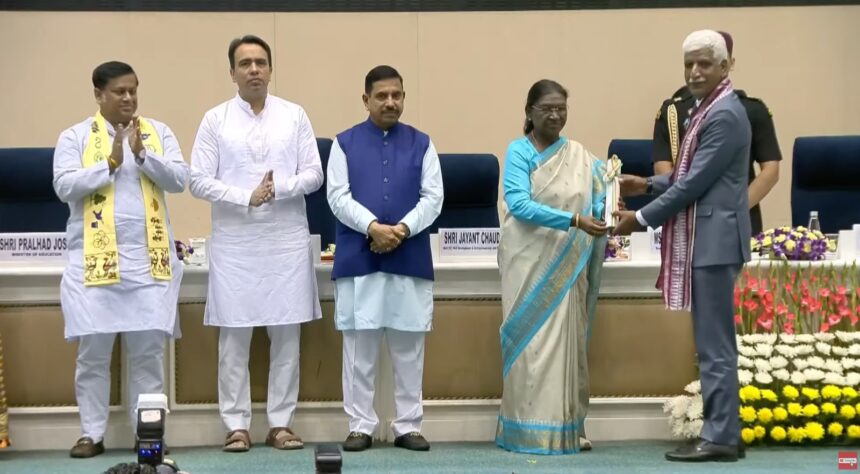
Jammu: President Droupadi Murmu on Saturday stressed the crucial role of teachers in shaping future generations, saying that childhood is the most effective stage for inculcating good conduct and developing responsible citizens.
Addressing the National Teachers’ Awards ceremony in New Delhi on the occasion of Teachers’ Day, the President said school education forms the foundation of the entire education system and teachers have a vital responsibility in ensuring the intellectual, physical and moral development of children.
She said while knowledge and skills could be acquired at any stage of life, lessons in good conduct imparted during childhood have a far greater impact.
“By diligently focusing on the intellectual, physical, and moral development of children in the early grades, our teachers can prepare future generations of excellent students and dutiful citizens,” Murmu said.
The President also highlighted the role of education in ensuring equality of opportunity, describing it as the most effective means of realising the constitutional ideal of providing equal opportunities to all.
She appreciated the contribution of teachers towards reducing school dropout rates, while pointing out that students come from diverse social and economic backgrounds and often face different challenges.
Murmu said many children belong to economically disadvantaged families, with some being first-generation learners. Some students also move from small village schools to larger urban institutions, while others may be shy, highly talented but lacking self-confidence, or have special educational needs.
“It is the special responsibility of teachers to instil confidence in them and uplift all such students who, for any reason, feel a sense of inadequacy,” she said.
Emphasising the importance of a compassionate approach towards students, the President said teachers should nurture not only knowledge but also inspiration, morality and sensitivity through their affection and dedication.
She further underlined the importance of academic excellence, skill development and entrepreneurship in India’s development journey.
Murmu said establishing India as the skill capital of the world and transforming the country into a knowledge superpower were among the national priorities. She added that the goal of building a Viksit Bharat could be achieved only through a world-class education system.
The National Teachers’ Awards also brought recognition to educators from Jammu and Kashmir and Ladakh.
From Jammu and Kashmir, Mohd Ayaz Raina, of Higher Secondary School Dalhori, Dalhori, was among the teachers felicitated at the national-level ceremony.
From Ladakh, Mohd Mustafa Kumal, of Government Middle School Zgangjing, Sankoo, Kanoor, was also honoured for his contribution to education.
A total of 82 teachers and educators from three departments were felicitated during the ceremony.
The awardees included 48 teachers from the Department of School Education and Literacy, 21 teachers and faculty members from higher educational institutions and polytechnics, and 13 skill trainers from the Ministry of Skill Development and Entrepreneurship.
The recognition of educators from Jammu and Kashmir and Ladakh at the national ceremony highlights their contribution to strengthening education and nurturing students across the region, particularly in diverse and challenging educational settings.
PM urges teachers to stay vigilant against student drug addiction
New Delhi: Prime Minister Narendra Modi has urged teachers to stay vigilant against student drug addiction and help children tackle excessive screen time through sports, physical play, and creative activities.
Interacting with the national award-winning teachers on Friday, the eve of Teachers’ Day, Modi asked the teachers to preserve childhood and nurture children’s natural curiosity.
He said teachers should share creative approaches to make classroom learning more engaging.
The prime minister emphasised that teachers need to look beyond the academic performance of children and be attentive to their behaviour and everyday lives.
He said teachers have an increasingly important role to play in the lives of children now that there are fewer joint family set-ups.
On drugs, Modi said that in some big cities and universities, it is difficult to identify if anyone gets affected by the problem, as no one knows who gives whom what.
He said that in some big cities and universities, it is difficult to tell if anyone is being affected by the problem, as no one knows who gives whom what.
“In these circumstances, teachers should take the initiative for awareness and also observe minutely if any change (in behaviour) is witnessed in any child,” he said.
A video of the interaction at the prime minister’s Lok Kalyan Marg residence was released on Saturday.
The prime minister said the teachers should enter the lives of the students, going beyond books and syllabuses.
“You should not allow the childhood of a student to die. The biggest contribution can be given by the teachers by keeping childhood alive in students’ lives,” he said.
Modi also talked about how teachers can keep the students away from long hours of screen time and encourage them towards outdoor sports activities.
The prime minister said children have the same basic nature and curiosity, and if teachers nurture and channelise this curiosity, they can make a significant contribution to their development.
He said screen time has become a major concern among students, as he urged the teachers to speak to parents about how much time their children spend on screens and whether they continue using mobile phones late at night.
Screen time can be cut naturally by developing an interest in sports, physical games and creative activities, he said.
Referring to the National Education Policy, Modi stressed the importance of taking children outside the classroom and connecting them with real-world skills and forms of work.
The prime minister praised a teacher who spoke about making women in her vicinity aware of breast cancer, and said a breast cancer awareness campaign was launched by him in Varanasi, his Lok Sabha constituency.
“I am happy to share with you that more and more women are coming forward for screening (for breast cancer), even setting a Guinness World Record for it,” he said.
This year, 82 teachers and educators have been selected for the National Teachers Awards from three departments. These include 48 teachers from the Department of School Education and Literacy, 21 teachers/faculty members from higher educational institutions and polytechnics, and 13 skill trainers from the Ministry of Skill Development and Entrepreneurship.

