



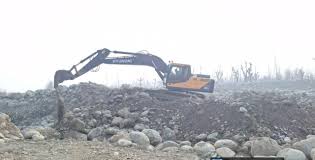
SRINAGAR: A committee constituted by the National Green Tribunal (NGT) has flagged “large-scale, unregulated and potentially illegal” extraction of riverbed material from Sukhnag Nallah in Central Kashmir’s Budgam district, warning that the activity has caused serious environmental degradation and damage to the river ecosystem.
The report, submitted by the Jammu and Kashmir Pollution Control Committee (JKPCC) before the Principal Bench of the NGT in the case titled “Raja Muzaffar Bhat Vs Union Territory of J&K & Ors,” stated that a joint committee inspected the site on March 18, 2026, to assess the extent of riverbed mining and its environmental implications.
According to the report, the committee observed visible signs of “indiscriminate and unscientific extraction” of riverbed material within the active river channel as well as adjoining catchment areas. It said flood-control gabion walls had been constructed along both sides of the river, but the scale of excavation inside the riverbed had raised “serious environmental concerns.”
The committee noted that although no fresh mining activity was seen during the inspection, analysis of a nearly two-kilometre stretch upstream of Sail Bridge revealed extensive excavation across a large portion of the riverbed. The river width in the area was found varying between 30 metres and 180 metres, with the total riverbed area estimated at around 1,54,911 square metres.
The report stated that based on field measurements showing an average excavation depth of 5.22 metres, the total quantity of extracted riverbed material was estimated at nearly 15.3 lakh tonnes. Even using a conservative excavation depth of 3.86 metres, the extraction was assessed at around 10.62 lakh tonnes.
It further said the large-scale extraction had significantly altered the river morphology and damaged underlying aquifer systems, adding that the absence of scientific assessment and non-compliance with regulatory provisions reflected “serious institutional lapses.” The environmental degradation, the report warned, could have long-term impacts on the river ecosystem, fisheries sector and groundwater levels.
The committee also identified two major excavation pits in the riverbed. One pit covered nearly 799 square metres with an average depth of 2.84 metres, while another extended over 620 square metres with a depth of 4.42 metres. The report termed the second pit “particularly alarming,” saying excavation had gone below the active riverbed into the alluvial aquifer zone, potentially causing irreversible hydrogeological damage.
The report pointed to several procedural and regulatory violations in mining operations, stating that Office Memorandums and safeguards issued by the Ministry of Environment, Forest and Climate Change (MoEF&CC) in August 2022, July 2023 and August 2023 were not followed while issuing permissions and challans. It also noted that project proponents failed to inform the Pollution Control Committee at least 14 days before commencement of mining activities as required under regulations.
The committee further observed that no replenishment study had been conducted in Sukhnag Nallah between 2020 and 2024, despite it being mandatory for sustainable sand mining. It said permissions for excavation of nearly five lakh metric tonnes of material were granted without preparing a Detailed Project Report (DPR) or carrying out scientific modelling under the National Framework for Sediment Management.
As per data submitted by the District Mineral Officer, around 6,32,940 tonnes of material were permitted for extraction between 2020 and 2024 through various permits, of which nearly 77 percent — about 4,85,794 tonnes — was allotted to M/s NKC Projects.
The committee also examined losses suffered by trout farmer Peerzada Rayees. During the inspection of his trout farm, officials found that nearly 2,000 trout fish were allegedly lost after illegal mining activities disrupted and diverted water supply to the farm during night hours. The report estimated the biomass loss at around 600 kilograms, translating into a financial loss of nearly Rs 13 lakh at the rate of Rs 500 per kilogram.
In its recommendations, the committee proposed a complete moratorium on all mining activities within a five-kilometre stretch upstream and downstream of Sail Bridge up to Beerwah town, which falls within the designated trout zone.
The panel also recommended strict implementation of Sustainable Sand Mining Management Guidelines, installation of CCTV and surveillance systems at mining hotspots, restoration of riverbeds, filling of deep trenches, rehabilitation of fish habitats, trout restocking and regular monitoring by a task force to curb illegal mining activities.

