



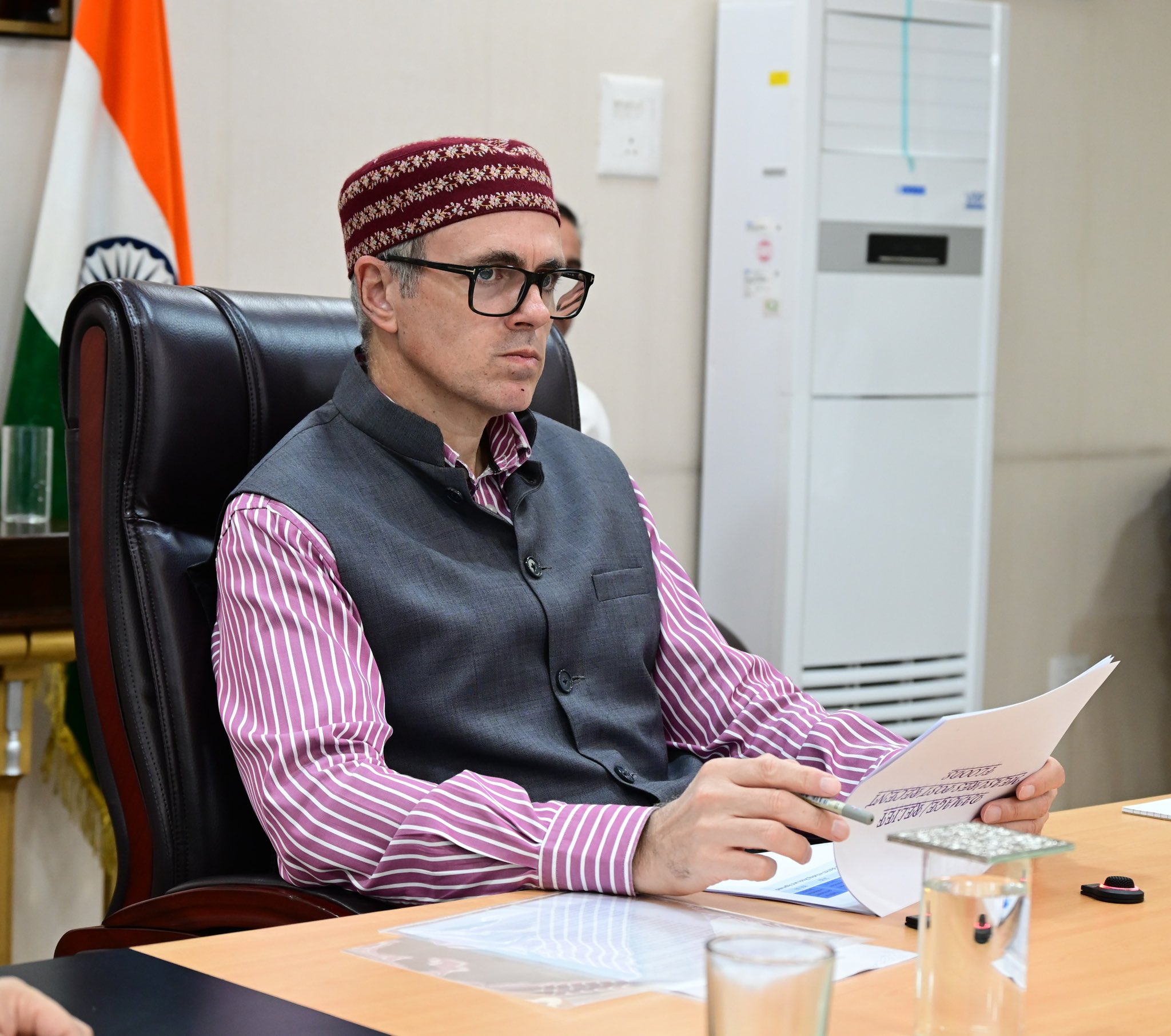
Srinagar: Chief Minister Omar Abdullah on Monday reviewed the stock and supply of LPG cylinders, petroleum products and essential commodities across Jammu and Kashmir and directed officials to ensure there is no artificial scarcity or black marketing ahead of the upcoming Eid-ul-Fitr and Navratri festivals.
Chairing a high-level meeting in Srinagar, Abdullah asked deputy commissioners to maintain strict oversight at the district level to ensure smooth supply and fair distribution of essential commodities, especially in view of the prevailing tensions in West Asia.
The Chief Minister stressed that while the Food and Civil Supplies Department is responsible for managing supply chains, district administrations must actively monitor the situation to prevent hoarding or manipulation of prices.
“I think the administration as a whole is well aware of the situation and is on top of things. However, the work of the Food and Supplies Department must be complemented by strong monitoring at the district level,” Abdullah said.
He cautioned officials that the duration of the present crisis remains uncertain and urged them to remain prepared for any prolonged disruption in supply lines.
“We do not know how long the situation will last. It may last a few days or several weeks. We must assume it could continue longer than we are comfortable with and ensure that no artificial scarcity or black marketing takes place,” he said.
Abdullah also directed the Information Department to keep the public informed about the availability of essential commodities so that rumours and panic buying can be avoided.
The Chief Minister instructed the administration to closely monitor the availability of commercial LPG as well, particularly because of the ongoing Navratras, the approaching Eid-ul-Fitr festival and the beginning of the tourist season in the Valley.
Officials were asked to consult stakeholders such as restaurant owners and hoteliers before undertaking any rationalisation of commercial LPG supply in view of the expected tourist inflow.
According to officials, several regulatory measures have already been introduced to ensure fair distribution and prevent misuse of LPG connections. These include the Delivery Authentication Code (DAC) system, which verifies that cylinders are delivered only to genuine consumers.
Oil marketing companies have also launched an e-KYC campaign to verify customers and identify inactive or duplicate LPG connections.
For non-domestic LPG consumers, authorities have temporarily capped supply at 20 percent of the average monthly consumption while ensuring uninterrupted supply to essential institutions such as hospitals and educational establishments.
The meeting was attended by ministers Sakina Itoo and Satish Sharma, Advisor to the Chief Minister Nasir Aslam Wani and Chief Secretary Atal Dulloo.
Meanwhile, Food and Civil Supplies Minister Sharma said Jammu and Kashmir currently has sufficient stocks of fuel and essential commodities to last around 21 days.
Speaking to reporters in Srinagar, Sharma said the government is closely monitoring the supply chain and warned of strict action against those involved in hoarding, adulteration or black marketing.
“Anyone found guilty, whether a petrol pump or a gas agency, will face cancellation of licence,” he said.
The minister also announced that kerosene distribution, which had earlier been discontinued after Jammu and Kashmir was declared a kerosene-free region, has been temporarily resumed as a relief measure during the ongoing geopolitical crisis.
Around 2.5 litres of kerosene will be provided per family to support households, he said, adding that enforcement teams have been deployed across districts to prevent artificial shortages of LPG, petrol and other essential commodities.
Sharma also appealed to people to avoid panic buying and assured that the government is coordinating with the Centre to enhance LPG allocations if required.
Meanwhile, authorities in Jammu conducted inspections at LPG outlets following complaints of delivery delays and panic buying. Long queues had been reported at several outlets in recent days amid fears of supply disruptions due to the West Asia conflict.
Additional Deputy Commissioner Jammu Ansuya Jamwal said most issues were related to delivery delays rather than availability of cylinders.
“It is a home-delivery system. In some cases delivery is shown in the system and messages are sent to consumers even though cylinders have not actually been delivered. Action is being taken against such agencies,” she said.
Inspection teams checked stock registers, booking records and delivery systems at several LPG agencies and also interacted with customers who had gathered at outlets to collect cylinders directly.
Officials said over 2,200 pending deliveries were found at one agency during the inspections, while other outlets were functioning normally.
Authorities also urged consumers not to visit LPG outlets unnecessarily and to book cylinders through online modes, assuring that deliveries will be made at homes as per the established system.
Under government guidelines, officials said, urban consumers cannot make a new booking within 25 days of the previous delivery, while in rural areas the gap is 45 days.
Police in Jammu also seized around 50 LPG cylinders allegedly stored illegally for black marketing and arrested those involved.
Officials reiterated that adequate stocks are available across the Union Territory and appealed to the public to remain calm and avoid hoarding of essential commodities.

