



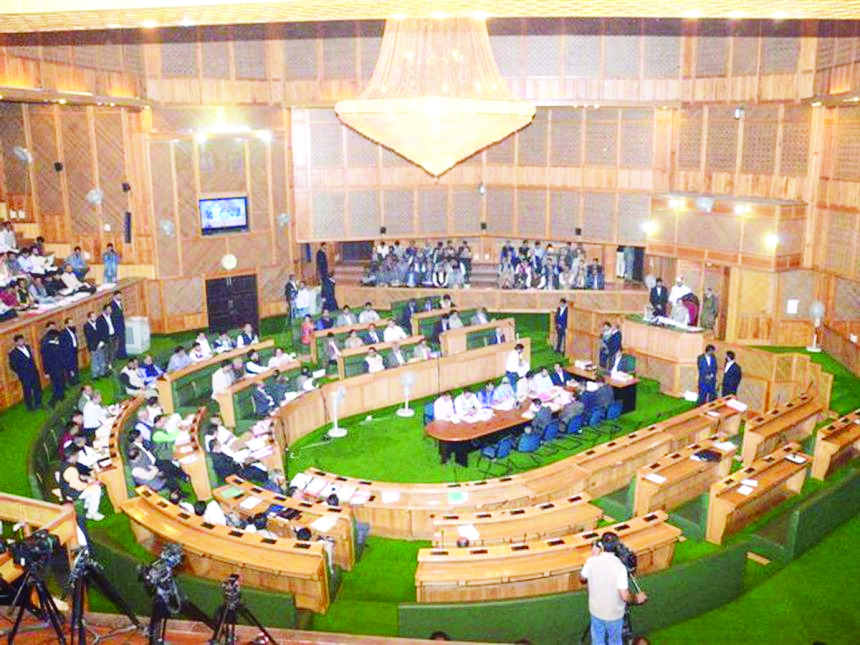
JAMMU: Preparations are in full swing for the much-awaited Budget Session of the Jammu and Kashmir Legislative Assembly, scheduled to commence on March 3, 2025.
This crucial session will be inaugurated in Jammu by Lieutenant Governor Manoj Sinha, who will address the members and outline the government’s vision for the upcoming fiscal year.
Extensive arrangements have been made to ensure the smooth conduct of the session. Security has been significantly enhanced around the legislative complex, and infrastructure upgrades are being completed to facilitate seamless proceedings.
Given the significance of the session, key discussions on financial matters and deliberations on the budget are expected to shape the trajectory of the Union Territory’s governance.
The Budget Session arrives at a pivotal time when the Jammu and Kashmir administration is focusing on infrastructural growth, welfare programs, and economic revitalization.
Officials have hinted that the budget will prioritize key sectors such as tourism, agriculture, and education, aiming to propel the region’s development. With Jammu and Kashmir undergoing a transformative phase politically and economically, the legislative proceedings are expected to have far-reaching implications for governance and policymaking.
This session is particularly notable as it marks the first budget presentation under the Omar Abdullah-led National Conference government since it assumed power on October 16, 2024.
This transition brought an end to six years of central rule, restoring an elected government to the Union Territory. Consequently, the discussions and decisions taken during this session will be closely watched, as they will set the policy direction for the newly formed administration.
Amid the preparations, a key unresolved issue remains—the nomination of five non-elected members to the Assembly. Despite provisions for these seats under the J&K Reorganisation Act, neither the Raj Bhawan nor the state government has initiated the process of filling them.
The J&K Legislative Assembly currently consists of 90 elected members, with the potential to expand to 95 once these nominations are completed.
Under the J&K Reorganisation Act, 2019, the Lieutenant Governor holds the authority to nominate two women to the Assembly if female representation is deemed inadequate. Furthermore, a 2023 amendment allows for three additional nominations—two from the Kashmiri migrant community, including one woman, and one representing displaced persons from Pakistan-occupied Jammu and Kashmir (PoJK). However, despite this legal framework, the nomination process remains in a state of uncertainty.
Government sources indicate that discussions on the matter have stalled, with no clear directive on whether the nominations should be made solely by the Lieutenant Governor or in consultation with the elected government.
Before the Assembly elections in October 2024, there was speculation that these nominated members could play a decisive role in shaping the balance of power. However, with the National Conference securing a comfortable majority of 42 seats, backed by the Congress, the urgency surrounding these nominations has diminished.
The first Assembly session, held in November 2024, was dominated by discussions on the restoration of Jammu and Kashmir’s statehood. As the upcoming Budget Session unfolds, it is expected to provide critical insights into the new government’s policy agenda and its vision for the Union Territory’s future.

