



Jammu: Invoking a Kashmiri proverb, “Patim mashraav, bronthkunnazarthaav” (forget the past and look towards the future), Defence Minister Rajnath Singh on Saturday called for a forward-looking approach to Jammu and Kashmir, asserting that the abrogation of Article 370 weakened terrorism and separatism while accelerating the region’s development.
Singh said the constitutional change in 2019 marked a turning point for the Union Territory, removing longstanding impediments to people’s rights, security and development.
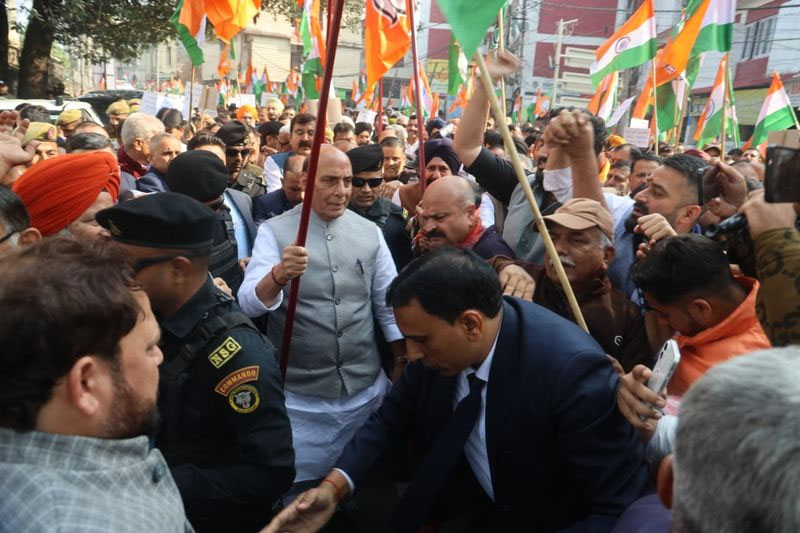
“There is a Kashmiri saying…‘Patim mashraav, bronthkunnazarthaav’. Do you understand what it means? Perhaps not. It means, ‘Forget the past and look towards the future.’ In other words, the outlook of Jammu and Kashmir must be forward-looking. We must move ahead and focus on the future,” the defence minister said, addressing a public rally after leading the BJP’s ‘Loktantra Bachao, ArajaktaHatao’ (‘Save Democracy, End Anarchy’) foot march here.
A sizeable number of BJP leaders and supporters from Kashmir attended the event, though the gathering was largely dominated by Dogras, including a significant presence of women.
He said the proverb captured the need to leave behind the years of uncertainty and focus on peace, progress and prosperity.
Linking this vision with the abrogation of Article 370, Singh asserted, “After the abrogation of Article 370, no power in the world can stop Jammu and Kashmir from becoming a developed state of India.”
Blaming the Congress for “historical mistakes”, Singh said the party had taken several wrong decisions soon after Independence, including the introduction of Article 370.
Holding the provision responsible for the prolonged problems faced by Jammu and Kashmir, he remarked, “As the saying goes, a mistake committed in a moment can result in punishment lasting for centuries…but our Prime Minister Narendra Modi declared that enough was enough.”
Singh said the BJP had consistently opposed Article 370 since the time of Shyama Prasad Mukherjee and the Dogra leadership, promising to revoke the provision once it secured a clear majority in Parliament.
“And you have seen it for yourselves. We did what we had promised. There is no difference between our words and our actions,” he said, describing the 2019 decision under Modi’s leadership as the fulfilment of Mukherjee’s vision.
Singh argued that Article 370 had kept Jammu and Kashmir behind other parts of the country, alleging that rights and entitlements available to citizens elsewhere were denied to people in the region. He also claimed that the provision had encouraged terrorism and separatism.
“I also want to remind you that our leader, the late Atal Bihari Vajpayee, had emphasised the principles of Insaniyat (humanity), Jamhooriyat (democracy) and Kashmiriyat (the distinctive ethos of Kashmir). However, for several decades in Kashmir, humanity continued to suffer defeat at the hands of terrorism. We had resolved that we would not rest until terrorism was wiped out.
“I can say that we have achieved considerable success in eliminating terrorism from the soil of Jammu and Kashmir,” he said, adding the abrogation of Article 370 had led to the gradual weakening of terrorism, separatism and separatist forces in Kashmir, while creating conditions for faster development.
To underline the discriminatory nature of the earlier constitutional arrangement, Singh referred to an account in the book ‘Kashmir Under 370: A Personal History’, by former Jammu and Kashmir DGP Mahendra Sahrawal.
According to the account cited by him, even the President was once reportedly told that he was a non-state subject when he sought registration of a piece of land in Jammu and Kashmir.
“Just imagine! A person occupying the highest constitutional office in the country, who is also the Supreme Commander of the three armed forces, was told that even the President of India was a non-state subject in Jammu and Kashmir,” Singh said, clarifying that he was citing the book and not making the claim independently.
Recalling earlier administrative arrangements, he said IAS and IPS officers posted in Jammu and Kashmir were sometimes asked, “Are you going to India?” When they were due for transfer, suggesting that such practices conveyed the impression that the region was not part of India.
The defence minister said the abrogation of Article 370 had extended rights and entitlements to people in Jammu and Kashmir that had earlier remained unavailable to them.
He maintained that development activities had also gathered momentum since the constitutional change.
He also highlighted tourism growth, stating that Jammu and Kashmir received 4.76 crore tourists over a three-year period between 2017 and 2018, compared with 7.85 crore tourist arrivals during 2023-2025.
Singh said tourist arrivals generated economic activity beyond the hospitality sector, as visitors purchased local products and goods from shops and markets, thereby benefiting traders and strengthening the local economy.
“This is the transformation Jammu and Kashmir has witnessed following the abrogation of Article 370,” he said, adding that the region was now setting new records in development.
Taking a swipe at opposition leaders, Singh said that instead of taking pride in the achievements, some were engaged in damaging India’s image.
He also described Jammu and Kashmir as the crown jewel of India, saying its accession to the country was not merely about integrating a geographical territory but a commitment to preserving India’s soul, spirit, unity and integrity.
Addressing a rally after leading the BJP’s ‘Loktantra Bachao, ArajaktaHatao’ (Save Democracy, End Anarchy) foot march over a one-kilometre stretch from Panjtirthi Chowk, near Lok Bhawan, to Brahmana Sabha at Parade Chowk, here, Singh also criticised the Congress over its allegations of ‘vote chori’, questioning the party’s claims and saying it had failed to produce credible evidence to substantiate them.
“Jammu and Kashmir is the crown jewel of India, its pride and glory. Therefore, its accession to India was not merely a question of integrating a geographical territory. Rather, it was a commitment to preserving the soul, spirit, unity and integrity of India,” Singh said.
Recalling Jammu and Kashmir’s historical significance in the BJP’s political journey, the defence minister paid tribute to Pandit Prem Nath Dogra for his struggle for the complete integration of the region with India.
He also recalled Syama Prasad Mookerjee’s slogan, ‘Ek Desh, Ek Vidhan, Ek Nishan’ (One Nation, One Constitution, One Flag), raised from the region.
Singh said a large number of people from Jammu and Kashmir had sacrificed their lives to safeguard the country’s unity and integrity, and paid tribute to those who made the supreme sacrifice.
‘PM Modi is not going anywhere’
Jammu: Defence Minister Rajnath Singh on Saturday said Prime Minister Narendra Modi’s political authority stemmed from the mandate of the people and not political inheritance, asserting that only voters could decide when he should leave office.
Addressing a rally after leading the BJP’s ‘Loktantra Bachao, ArajaktaHatao’ (Save Democracy, End Anarchy) foot march here, Singh accused the Congress and its allies of attempting to destabilise the country and create an atmosphere of uncertainty to dislodge Modi from power.
He said the responsibility of making Modi the prime minister had been entrusted to him by the people of India, and only they had the authority to take it away.
“He did not become the Prime Minister because of anyone’s inheritance. The people of India gave him this responsibility. And if anyone can take it back, it is only and only the people of India. No one else can do so,” he said.
Invoking Modi’s description of himself as a ‘faqir’, Singh said the prime minister had repeatedly maintained that he had no personal attachment to power and would leave office whenever the people wanted him to.
“You must have heard our Prime Minister Modi say on several occasions, ‘I am a faqir. When the people say so, I will pick up my bag and leave’,” he said.
Questioning the Congress’s attempts to target a prime minister who had secured his position through public support, Singh asked, “Are you trying to remove such a person from power? Are you trying to impose baseless allegations on him?”
He then issued a direct challenge to the opposition, declaring that Modi would continue in office despite what he described as attempts to discredit his leadership.
“Let the Congress leaders listen carefully. Modi Ji is not going anywhere. I want to convey this message to Congress leaders across the country: Modi Ji is not going anywhere,” he said.
In a counterattack, Singh said it was the Congress, rather than the prime minister, that needed to prepare for a political exit.
“The time has come for the Congress to pack up and leave. If anyone has to go, it is the Congress, not Modi,” he said, drawing applause from the gathering.
The Defence Minister also contrasted Modi’s political journey with that of Congress leaders, alleging that political inheritance had shaped the careers of several opposition leaders, while the prime minister had risen through his own political journey and public support.
“The Congress and its allies want to somehow remove Modi from office and capture power. It is this desperation and restlessness that is driving their repeated attempts to create anarchy in the country. The Congress leaders have forgotten that neither Prime Minister nor most of his associates have inherited anything in the way that the Congress leaders have inherited political power and privilege,” he said.
Singh said the BJP believed in entering politics for nation-building rather than merely securing political office, describing this as the fundamental distinction between his party and its opponents.
He urged people to defend India’s unity, integrity, Constitution and democratic institutions, saying attempts to undermine the democratic mandate through anarchy would not be accepted.
He asserted that the people’s verdict remained the ultimate authority in a democracy and that political power could neither be inherited nor seized through pressure tactics.
Targets Congress over vote theft claims, questionRahul Gandhi’s PM ambitions
Jammu: Defence Minister Rajnath Singh on Saturday launched a sharp attack on the Congress and its leadership, accusing the opposition party of questioning democratic institutions, undermining the electoral process and attempting to create political instability out of frustration over repeated electoral defeats.
Addressing a BJP rally in Jammu, Singh targeted Congress leader Rahul Gandhi over allegations of vote theft, his challenge to Prime Minister Narendra Modi for a debate and his political ambitions, asserting that the opposition should accept electoral verdicts instead of questioning the credibility of democratic institutions.
Referring to the Congress slogan ‘Vote Chor, Gaddi Chhod’ raised at a party gathering in Hyderabad, Singh asked people whether they believed their votes had been stolen, asserting that the BJP could not indulge in electoral malpractice whether in power or out of power.
He accused the Congress of repeatedly blaming Electronic Voting Machines (EVMs) and targeting the Chief Election Commissioner instead of examining the reasons behind its electoral setbacks.
Drawing an analogy with a student failing an examination, Singh said parents do not blame the school, teachers or question paper when their child fails, but instead identify the weaknesses and work towards improvement.
“The Congress, however, keeps failing the electoral examination repeatedly,” he said, alleging that the party had failed to undertake introspection despite losing three consecutive Lok Sabha elections over the past 12 years.
Questioning the basis of allegations against the Election Commission, Singh pointed out that the election commissioners in office when the BJP-led government first came to power in 2014 had been appointed during the Congress regime.
Turning his attack towards Rahul Gandhi, the Defence Minister accused the Congress leader of considering the Prime Minister’s post his birthright and being unwilling to accept anyone else in the country’s highest constitutional office.
“There is nothing wrong with aspiring for a position in politics. However, considering a position, particularly the country’s highest office, one’s birthright is certainly wrong,” Singh said.
Citing an account attributed to a journalist, he claimed that Gandhi had told friends before and after the 2014 Lok Sabha elections that his time to become Prime Minister would come in 2024.
“But 2024 has come and gone and Narendra Modi is still the Prime Minister of India,” he remarked, alleging that Gandhi had adopted an attitude of “if I cannot have it, no one else should” after failing to realise his political ambition.
Singh also questioned Gandhi’s challenge to Modi for a debate, saying Parliament was the highest democratic forum where issues could be discussed. He argued that the Leader of Opposition should first demonstrate greater participation in parliamentary proceedings and use the House to raise public concerns rather than focus on building what he described as a false narrative against the Prime Minister.
The Defence Minister also accused Gandhi of making misleading statements on national security and damaging India’s image through his remarks about Chinese troops allegedly thrashing Indian soldiers. He further criticised Congress leaders for their comments on Hinduism and the consecration ceremony at the Ram temple in Ayodhya.
“Opposing the government and opposing India are two entirely different things,” Singh said.
Revisiting the Congress-led UPA government’s tenure, Singh alleged that important decisions were taken through a system of remote control, with the National Advisory Council headed by Sonia Gandhi exercising considerable influence.
Referring to a book written by former Prime Minister Manmohan Singh’s media adviser Sanjay Baru, he claimed that important Cabinet files were sent to Sonia Gandhi for approval.
He also recalled the 2013 ordinance brought by the Manmohan Singh government, which Rahul Gandhi had publicly criticised as “nonsense”, leading to a reversal of the decision.
“Congress governments might have been run through remote control, but no power can run a BJP government that way,” he said.
Rejecting opposition allegations that the country was witnessing an Emergency-like situation, Singh said the comparison was misplaced, alleging that Congress leaders invoked the Emergency whenever legal action was taken against a politician or restrictions were imposed to prevent political violence.
Recounting his own experience during the Emergency, Singh said he had spent 18 months in jail at around the age of 24, including several months in solitary confinement. He said his mother died while he was incarcerated, but the then Congress government did not grant him parole.
Accusing the Congress of pursuing negative politics and attempting to replace democracy with “mobocracy”, Singh appealed to people to stand united in defence of democratic institutions.
He asserted that attempts to destabilise an elected government through agitation and political manoeuvring would not be tolerated by the people of India.
Taking a final swipe at the opposition, Singh said the Congress’s “expiry date has long passed” and asserted that the Modi government would continue its development agenda without allowing political opposition to derail the country’s progress.

