



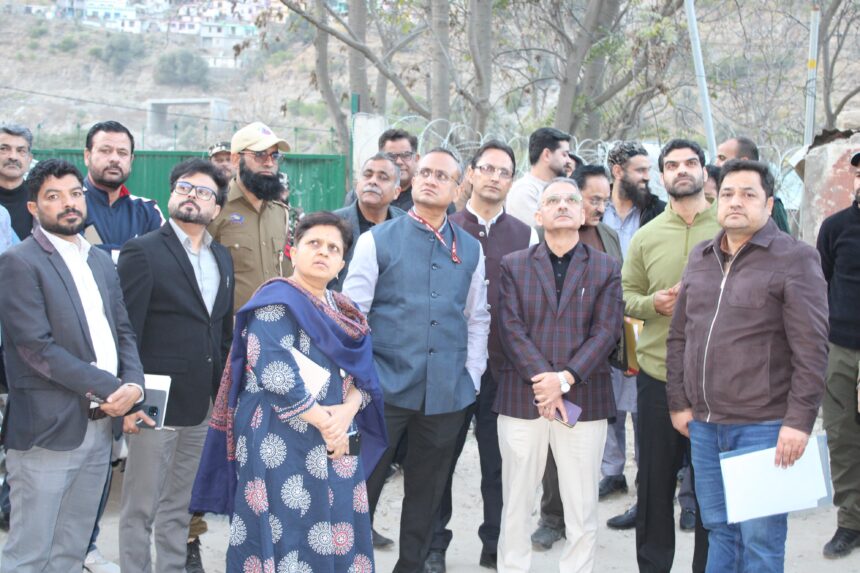
Jammu: A high-level Inter-Ministerial Central Team (IMCT) has undertaken an extensive assessment of damage caused by cloudbursts, flash floods, heavy rainfall and landslides during the Monsoon-2026 across Doda, Kishtwar and Poonch districts, inspecting damaged infrastructure and reviewing restoration requirements to assess the losses and ground-level needs.
The team, led by Gaya Prasad, Joint Secretary (F-II), Ministry of Home Affairs, visited several affected locations and held discussions with district administrations to assess the extent of devastation, the status of relief operations and the requirements for rehabilitation of damaged public infrastructure.
The assessment assumes significance as several parts of the Chenab region and Poonch suffered extensive damage to roads, bridges, protective embankments, power infrastructure and water supply schemes following intense monsoon activity, with difficult terrain adding to the challenges of restoring connectivity and essential services.
In Kishtwar, the team held a detailed meeting with Deputy Commissioner Pankaj Kumar Sharma, who presented a district-wide assessment of damage to public infrastructure and private property, besides briefing the members about relief, restoration and rehabilitation measures undertaken by the administration.
The team subsequently visited cloudburst-affected areas of Chatroo, inspecting three of the six identified affected sites. These included Dugga, which was hit by a cloudburst in August, Guzar-Gurinal Link Road, affected in July, and the Helipad Road-Guzar stretch via Tehsil Complex, which suffered damage in August.
The members assessed damage to roads, water supply schemes and other essential facilities and reviewed restoration work being undertaken by the concerned departments.
In Doda, the team visited landslide- and flash flood-affected areas of Thathri to undertake an on-the-spot assessment of the damage. It also held a detailed meeting with Deputy Commissioner Krishan Lal, who briefed the members about the impact of incessant rainfall, rising water levels in the Chenab, damage to roads and bridges, and difficulties in restoring infrastructure in remote and hilly areas.
The team reviewed the condition of critical infrastructure, including roads, bridges, electricity networks and water supply schemes, besides assessing relief and rehabilitation measures and the restoration of essential services.
The discussions also covered precautionary measures adopted by the district administration to minimise losses and strengthen disaster preparedness and response mechanisms.
In Poonch, the central team conducted an extensive field inspection of flood-damaged infrastructure, including protective bunds along the Poonch River, roads and water supply installations.
District Development Commissioner Ashok Kumar Sharma briefed the team about the damage caused by flash floods at different locations across the district.
The team inspected damaged protective bunds near SK Bridge along the Poonch River and at Kalai, particularly near the Power Grid Station on the river’s left bank. It also visited Dingla-Janeyar, where roads under the PMGSY and PWD (R&B) had been washed away.
The damaged Jal Shakti rising pipeline, which was washed away and broken at several locations, was also inspected as the team assessed the impact on water supply infrastructure and the requirements for restoration.
Technical officers from the concerned departments briefed the members about the nature and extent of damage and the restoration measures required to rebuild roads, strengthen river protection structures and restore water supply facilities.
The team also visited other flood-affected locations in Poonch to obtain first-hand information about the losses suffered by various departments.
The IMCT included Shyam Kejriwal, Chief Engineer (DP&M), Ministry of Power and Central Electricity Authority; Prabhat Kumar, Deputy Secretary, Ministry of Rural Development; and Shachi Jain, Director, Ministry of Jal Shakti and Central Water Commission.
The district-level inspections and deliberations are aimed at providing the central team with a comprehensive assessment of monsoon-related losses, the ground situation and the financial and technical requirements for restoration and rehabilitation across the affected districts.

