



By Bharat Nanda
Wars are eventually reduced to maps, ceasefire lines, captured territory and official communiqués. Yet some battles refuse to remain confined to military history. They become something larger — a measure of leadership, courage and the extraordinary things ordinary soldiers can accomplish when retreat ceases to be an option. The Battle of Dograi in September 1965 was one such moment.
Dograi stood barely 16 kilometres from Lahore, on the eastern bank of the formidable Ichhogil Canal. During the 1965 India-Pakistan War, the canal was far more than a water obstacle. Its steep banks, fortified approaches, minefields, concrete positions and defensive deployment made it one of the principal barriers protecting Lahore. For the Indian Army, breaking through this defence was strategically important. Pressure towards Lahore would compel Pakistan to divert troops and resources away from the Jammu and Kashmir theatre and force it to defend one of its most important cities.
The responsibility of carrying the fight into Dograi fell upon the 3rd Battalion of the JAT Regiment — 3 JAT — commanded by Lieutenant Colonel Desmond E. Hayde. What followed became one of the most remarkable infantry actions in the history of the Indian Army. The story of Dograi is extraordinary because 3 JAT effectively captured it twice.
On the morning of September 6, 1965, the battalion crossed the international border on foot at around 4:00 AM. There was no elaborate artillery preparation announcing their arrival. Speed, surprise and aggression were their weapons. The Pakistani forward positions around the Gosal-Dial village cluster were overwhelmed, and by morning the battalion had pushed towards Dograi, crossed the difficult approaches and reached the Ichhogil Canal. Indian troops seized the old village of Dograi, crossed the partially damaged canal bridge and established themselves beyond it.
By noon, 3 JAT had achieved something extraordinary. It had created a bridgehead on the western side of the canal and pushed into areas including the Batapore factory complex and Attoke Awan. But tactical brilliance at the front requires support from the rear. The battalion had advanced faster than the larger formation supporting it could consolidate. Reinforcements failed to link up, artillery support was inadequate, and Pakistani air attacks struck Indian supply lines and anti-tank resources. The men who had advanced deep towards Lahore found themselves dangerously isolated.
Eventually, orders came to withdraw. For soldiers who had fought their way through enemy positions and reached an objective others considered extremely difficult, the withdrawal must have been bitter. Ground taken through blood and courage had to be surrendered. For many military formations, such an experience could have left behind hesitation. For 3 JAT, it created unfinished business.
During the following two weeks, the battalion remained in the Santpura area under sustained Pakistani artillery fire. Dograi, meanwhile, was transformed into a fortress. Pakistan understood what the loss of Dograi could mean. The road beyond it led towards Lahore. The defence was strengthened with infantry, armour, minefields, barbed wire and concrete positions. The approaches were covered, machine guns were positioned to dominate likely assault routes, and Pakistani troops included 16 Punjab along with other elements, backed by Patton and Sherman tanks.
Everything about the battlefield favoured the defender. And yet Lieutenant Colonel Desmond Hayde was preparing to attack again. This is where Dograi becomes much more than the story of a military objective. It becomes a story of leadership.
Hayde had lived with his soldiers under bombardment. He had walked among them while artillery shells fell around their positions. His purpose was not theatrics. He was creating confidence. Fear is natural in war. Leadership does not eliminate fear; it creates something stronger than fear. Before the assault on Dograi, Hayde gave his men an instruction that has passed into regimental legend: “Dead or alive, we have to meet in Dograi.”
Few sentences better capture the spirit of infantry leadership. There was no elaborate speech and no complicated philosophy. There was an objective, there was a commander, and there was absolute clarity that no one would turn back.
On the night of September 21, approximately 550 men of 3 JAT moved towards Dograi. Opposing them was a larger Pakistani force occupying prepared defensive positions and backed by artillery and armour. Conventional military thinking normally favours the defender in such circumstances. An attacker attempting to storm fortified positions is generally expected to possess overwhelming numerical superiority. At Dograi, the equation was reversed.
The JATs moved through darkness, negotiating minefields and avoiding known killing zones. Men advanced in single file through terrain where one wrong step could destroy an assault group before the battle had even begun. Then they entered Dograi. What followed was not warfare as seen from command maps. It was warfare measured in metres — street by street, house by house, bunker by bunker.
The advantage of surprise quickly disappeared and the battle descended into violent close-quarter combat. Rifles were fired at short range. Grenades were thrown into fortified positions. Bayonets came into use. As ammunition ran low in places, men fought with whatever remained available to them. The darkness, smoke, explosions and confusion turned Dograi into a battlefield where individual courage repeatedly decided whether an Indian platoon moved forward or stopped.
There were extraordinary acts of bravery. Subedar Pale Ram, already an experienced soldier, was hit repeatedly but continued fighting. Despite serious wounds, he pressed forward with his bayonet and attacked machine-gun positions that were holding up the Indian advance. Major Asha Ram Tyagi displayed similar determination. He continued towards his objective despite receiving multiple gunshot wounds and played a crucial role in securing enemy armour before succumbing to his injuries. Captain Raghubir Singh Sandhu fought through some of the fiercest close combat of the night.
These men became symbols of Dograi, but the victory cannot be understood through individual heroism alone. A battalion does not capture a fortified town merely because a handful of men fight bravely. It succeeds when courage becomes collective; when a platoon continues after its officer falls, when a section advances towards a machine gun instead of seeking protection from it, and when soldiers who have watched their comrades fall still move forward because the objective has not yet been reached. That was the real strength of 3 JAT at Dograi.
By dawn on September 22, the supposedly formidable defensive position had been broken. Dograi was in Indian hands. But capturing the town was only half the battle. Pakistan immediately attempted to take it back. Repeated counterattacks followed. Pakistani artillery pounded the Indian positions, armour was committed, and infantry tried to force its way back into the town.
The men who had fought through the night now had to fight through the day. 3 JAT held. Supported by Indian armour, including elements of the Scinde Horse, Indian troops resisted repeated Pakistani attempts to recover Dograi. Anti-tank weapons and direct artillery fire struck Pakistani armour while infantry positions continued to hold. The men were exhausted, many were wounded and their numbers had been reduced, but the battalion did not give up the ground it had captured.
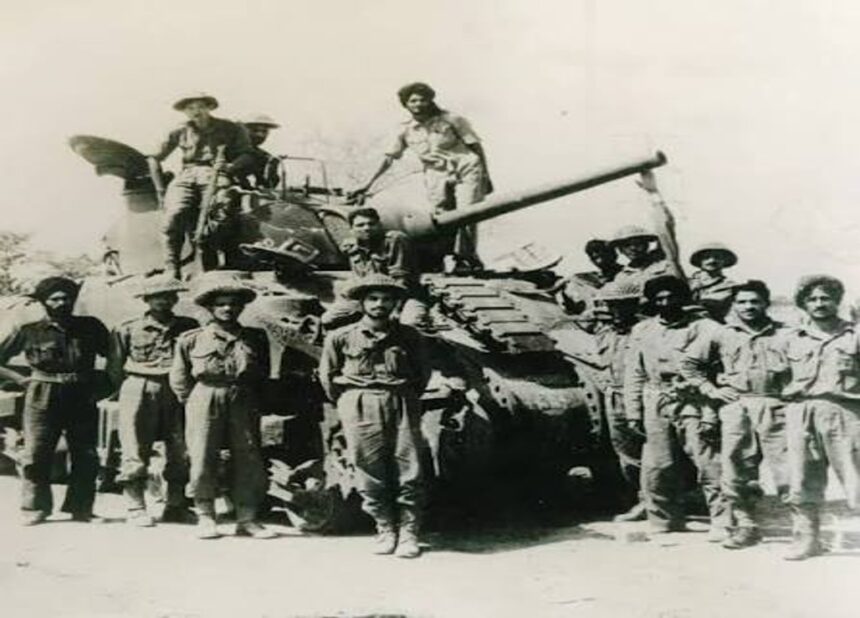
Among the most powerful images of the battle was the capture of Lieutenant Colonel J.F. Golwalla, commanding officer of Pakistan’s 16 Punjab, along with other Pakistani personnel. A fortified position intended to stop the Indian advance towards Lahore had fallen to a battalion that had attacked against formidable odds.
The cost was terrible. Eighty-six officers and soldiers of 3 JAT laid down their lives and more than 200 were wounded. Pakistani casualties were also severe, and more than a hundred Pakistani troops were taken prisoner. The scale of the sacrifice demonstrates an important truth about Dograi: victory in war is not a slogan. It is paid for.
It is paid for by soldiers who enter positions from which some know they may never return. It is paid for by families waiting hundreds of kilometres away. It is paid for in names engraved later on memorials, long after the noise of battle has disappeared. When the ceasefire came into effect on September 23, 3 JAT remained at Dograi. This time, there would be no withdrawal. The men who had been forced to relinquish the position earlier had returned and taken it again.
For its conduct in the battle, 3 JAT received an extraordinary number of gallantry awards, including three Maha Vir Chakras, four Vir Chakras and seven Sena Medals. But medals alone cannot explain Dograi. The real legacy of the battle lies in what it teaches about warfare.
Pakistan had concrete fortifications. Pakistan had minefields. Pakistan had armour. Pakistan had artillery. Pakistan had numerical strength. Yet none of these could guarantee victory once determined infantry penetrated the defensive system and refused to stop. Military technology has changed enormously since 1965. Today’s battlefield contains satellites, drones, precision-guided weapons, electronic warfare systems, artificial intelligence, real-time surveillance and networked command structures. The modern soldier may fight with equipment Hayde and his men could scarcely have imagined.
But one fundamental reality has not changed. Eventually, someone must hold the ground. A bunker may still have to be cleared, a ridge may still have to be occupied, a town may still have to be defended, and a soldier may still find himself isolated when communications fail, when the plan collapses and when the enemy remains directly ahead. Technology can make that soldier more effective. It cannot manufacture his courage.
Dograi also offers another lesson — one particularly relevant to every nation that believes imported military hardware alone can create battlefield superiority. Weapons matter. Technology matters. Fortifications matter. But military effectiveness is ultimately determined by the organisation, training, leadership and morale of the men who use them. A tank possesses firepower, but it does not possess resolve. Concrete can protect a position, but it cannot defend itself. A machine gun can dominate an approach, but someone must remain behind it when the enemy is coming closer. That is where battles are ultimately decided.
There is a story associated with the aftermath of Dograi that captures the respect earned by 3 JAT better than any official citation. After the ceasefire, a Pakistani soldier named Islamuddin, who had served with the JAT Regiment before Partition, reportedly came towards the canal and called across to the Indian side: “Only my old battalion could have done this.” An enemy soldier understood what had happened. Perhaps that is among the greatest compliments a fighting unit can receive.
Prime Minister Lal Bahadur Shastri later visited the battle-scarred area and met Hayde and his men. Dograi became part of the wider national memory of a war in which the Indian soldier demonstrated again that courage does not depend upon circumstances being favourable.
India must remember Dograi, not because war should be romanticised. Dograi itself destroys any romantic notion of war. Men were shot at close range. Families lost sons, husbands and fathers. Soldiers who had marched together only hours earlier were buried after the battle. There is nothing romantic about that. But there is something sacred about remembering it. A nation that forgets the price paid for its security eventually begins to take that security for granted.
Lieutenant Colonel Desmond Hayde and the men of 3 JAT did not know, as they moved through the darkness on September 21, 1965, how future generations would describe them. They were not thinking about history books. They were not fighting for anniversary tributes. They had been given an objective, they had their regiment beside them, and their commanding officer had told them where they would meet.
Dograi.
By dawn, they were there.
That is why the Battle of Dograi deserves to remain far more than another chapter of the 1965 India-Pakistan War. It represents something enduring in the Indian soldier. Strategy decides where armies fight. Weapons influence how armies fight. Numbers shape the odds. But there are moments in the history of nations when none of these fully explains what happens next.
Sometimes history is written by soldiers who simply decide that they will not turn back.
Dograi was one of those moments. That was 3 JAT. And that is a story India must never forget.
