



Arteev Sharma
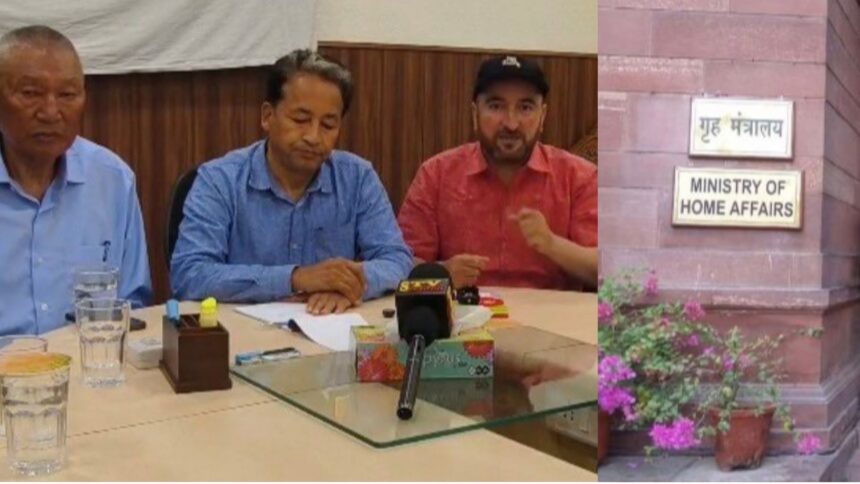
Jammu: The much-hyped Ministry of Home Affairs (MHA)-constituted sub-committee meeting in New Delhi remained inconclusive on Wednesday evening, with representatives from Ladakh describing the outcome as “unsatisfactory” and “falling short of expectations”, barring a few assurances.
The MHA, however, is learnt to have assured the Ladakh representatives that the next meeting of the sub-committee would be held in Ladakh in October, where the Centre is likely to place a detailed draft on the areas of consensus reached after further deliberations on the issues discussed during the previous meeting held on May 22
Though UT administration of Ladakh claimed that the meeting was held in a positive atmosphere, yet it confirmed that no major outcome was achieved during the meeting.
Chief Secretary of Ladakh Ashish Kundra, in a post on X, said, “Attended the sub-committee meeting with leaders of Ladakh at MHA in Delhi today. A general air of positivity prevailed as the broad contours of a Sui-generis model of governance under Article 371 of the Constitution were discussed. Deepening democracy is the goal”.
However, the LAB and KDA representatives remained dissatisfied with the outcome and held a joint meeting immediately after the talks to deliberate on their future course of action. The outcome of the meeting was not immediately known.
“We are not satisfied with the outcome of the meeting as no major headway was achieved. The MHA officials reiterated what was agreed upon in the sub-committee meeting held on May 22. They gave us no assurance on our major concerns regarding the implementation of the in-principle agreement for establishing a customised sui generis governance model for Ladakh under Article 371,” LAB chairman Chering Dorjay Lakrook told The News Now from New Delhi.
“We wanted to have a concrete assurance on the implementation of the agreement on the elected Union Territory-level body with executive, financial and legislative powers for Ladakh. We also sought that the UT administration should refrain from taking any major policy decisions concerning land, jobs and other such matters until the constitution of the elected UT-level body. We have no objection to the UT administration continuing to deal with routine day-to-day administrative affairs,” he said.
He further said, “Secondly, we sought an assurance from MHA that Home Affair must be placed substantially under the democratic control of the agreed upon elected Government (UT level body) on the pattern of Pondicherry but we did not get any satisfactory response from them in this context. They wanted to discuss the matter with the government and come back to us in the next meeting in October”.
It may be placed here that the LAB and KDA, in a joint memorandum to MHA, had submitted that “Home Affair must be placed substantially under the democratic control of the elected Government and Ladakh Legislative Assembly, drawing upon the constitutional principles reflected in Articles 162, 163 and 166(3) and the extension of the List II of the Seventh Schedule for Ladakh, with arrangements applicable to UT of Puducheny and the erstwhile UT of Mizoram serving as relevant constitutional reference points”.
In an official handout, LAB and KDA informed that the MHA stated that the intended UT-level body would be elected through direct elections and would have legislative powers with respect to land, culture and language, forests, environment, natural resources and any other subject matter reserved for the UT under Article 240.
“The elected body at the UT level would also have executive, budgetary, planning and financial powers. However, LAB and KDA observed that there is no clarity on the overall areas, including law and order, as seen in the UT of Puducherry, which is necessary for proper governance,” the handout stated.
The MHA also assured the representatives that a compensation package for those who lost their lives and those injured during the September 2025 agitation would be provided.
LAB and KDA, however, sought the immediate withdrawal of all cases registered against persons in connection with the September 2025 incident, instead of withdrawing them in phases. The MHA assured them that the matter was being looked into.
According to LAB and KDA, the MHA has assured that further talks would be held in the first week of October, during which a draft Article would be discussed.
The MHA is also expected to seek further comments from LAB and KDA shortly on some broader issues.
LAB and KDA unanimously stated that no major irreversible restructuring should be undertaken in the governance mechanisms of Ladakh, including land transfers and other related matters, before an elected body at the Union Territory level is put in place.
The two bodies further declared that if any such irreversible changes are made to the administrative and political setup of Ladakh before constitution of the UT-level democratic body, they would be compelled to call for public protests against such moves.
The meeting was attended by senior KDA leaders, including Asgar Ali Karbalai, Sajjad Kargili and Ghulam Rasool, while the LAB delegation included its chairman Chering Dorjay Lakruk, climate activist Sonam Wangchuk and Ladakh Lok Sabha member Haji Hanifa Jan besides Chief Executive Councillor Kargil Dr. Mohd Jaffer Akhoon and former CEC Leh Counci Tashi Gyalson.
The LAB and KDA had deferred their proposed Padyatra from Kargil scheduled to begin on September 10, citing the government’s decision to hold sub-committee talks in New Delhi. The LAB had warned that the agitation for constitutional safeguards and other demands would be intensified if the talks failed to yield concrete and satisfactory results.
On September 1, KDA announced a peaceful ‘Padyatra’ from Kargil to Leh from September 11 to September 24 to mount pressure on the MHA for early resolution of the region’s four-point agenda, including statehood and inclusion under the Sixth Schedule of the Constitution and justice for the victim of the last year’s violence on September 24.
Today’s meeting was held against the backdrop of two informal rounds of discussions between representatives of Ladakh and the Home Ministry on July 2-3 and August 19.
During the July meeting, the leaders of the Leh Apex Body (LAB) and KDA, and the MHA had reached an in-principle agreement to establish a customized elected Union Territory-level body with executive, financial and legislative powers for Ladakh. The consensus followed detailed deliberations between the two sides, with representatives signing the minutes of the previous meeting of the MHA-constituted sub-committee held on May 22.
On August 19, two sides had failed to make any major breakthrough over the implementation of the in-principle agreement for establishing a customised sui generis governance model for Ladakh under Article 371. The MHA officials had assured for fresh talks in September.
Pertinently, the MHA and the leaders from Ladakh on July 3 had reached an in-principle agreement on restoring democracy in Ladakh and providing Constitutional safeguards on the lines of Article 371 A, F, and G (as applied to Nagaland, Sikkim and Mizoram) in May 22 meeting in New Delhi. The consensus reached after extensive deliberations between the two sides, wherein they signed the minutes of the previous meeting of the MHA-constituted sub-committee held on May 22.

