



SRINAGAR: Chief Minister Omar Abdullah on Tuesday said the presence of leading artistes and filmmakers in Jammu & Kashmir would further strengthen the region’s longstanding association with cinema and help build a vibrant film ecosystem.
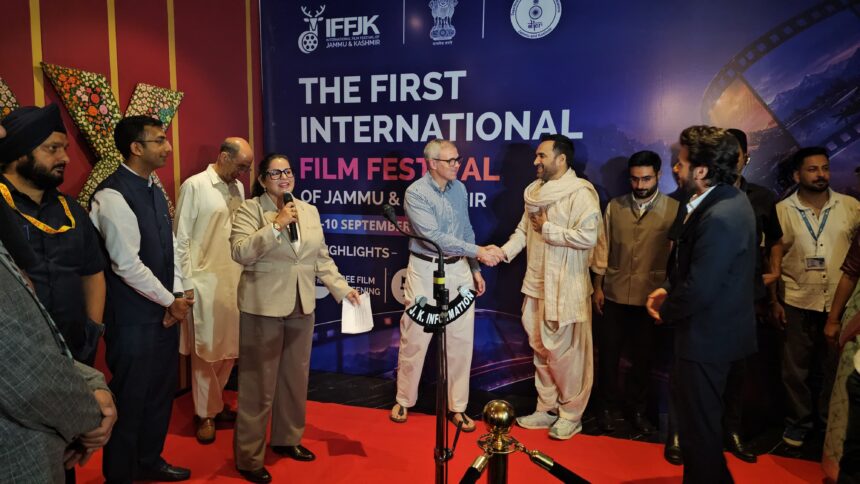
The Chief Minister made the remarks while attending a screening of Mirzapur: The Movie at INOX Multiplex, Shivpora, Srinagar, as part of the ongoing first International Film Festival Jammu & Kashmir (IFFJK).
During his visit, Omar Abdullah interacted with the film’s lead actors, including Pankaj Tripathi, who reprises his popular role of Kaleen Bhaiya, and Divyenndu, known for his portrayal of Munna Bhaiya in the Mirzapur series.
The Chief Minister felicitated the actors and welcomed their participation in the maiden edition of IFFJK. He said the participation of prominent names from the film industry would help renew Jammu & Kashmir’s connection with cinema and encourage greater interest in filmmaking in the region.
The four-day festival, being held under the theme ‘Rang-e-Cinema’, was inaugurated by Omar Abdullah at the Sher-i-Kashmir International Convention Centre (SKICC) on September 7.
The festival has brought together filmmakers, artists, delegates and cinema enthusiasts from India and abroad. More than 130 films are being showcased during the festival, with participation from over 30 countries.
The Chief Minister said the festival would provide a platform for filmmakers and audiences to engage with different cinematic traditions while also highlighting Jammu & Kashmir’s landscapes, cultural heritage and storytelling traditions.
The government has been seeking to promote J&K as a destination for film production through its film policy, incentives and single-window clearance mechanism, with the focus also extending to developing local talent and employment opportunities in the sector.
The second day of IFFJK featured discussions on building a sustainable cinematic ecosystem in the Union Territory. Chief Secretary Atal Dulloo, while participating in a panel discussion, stressed the need to nurture local talent, strengthen film education and create an environment conducive to filmmaking and investment.
Dulloo said the government was exploring scholarships for students interested in filmmaking and allied disciplines at reputed institutions outside J&K, besides facilitating specialised training and partnerships within the Union Territory.
He also called for further strengthening and simplifying the Single Window Clearance System to reduce procedural hurdles faced by filmmakers and production houses.
Commissioner Secretary, Information, R. Alice Vaz highlighted the incentives available under the J&K Film Policy for film productions and local filmmakers. She said the policy was aimed not only at attracting outside productions but also at creating opportunities for artists, technicians and other professionals from Jammu & Kashmir.
The festival also featured a competitive J&K Select Section comprising five films by filmmakers from the Union Territory. The selected films are Searching for the Grandpa by Mohammad Wali, Arifa by Rohin Ravendran Nair, Batt Koch (The Lost Lane) by Siddarth Koul and Ankit Wali, Tasrufdaar (Djinns of Kashmir) by Kapil Mattoo, and Naqsh-e-Daur (The Story of Ghulam Nabi Dhar) by Baba Tassaduq Hussain.
The films explore themes including childhood, family, memory, displacement, identity, heritage and resilience, offering stories rooted in the social and cultural experiences of Jammu & Kashmir.
Meanwhile, IFFJK activities were also held in Jammu, where Divisional Commissioner Ramesh Kumar felicitated filmmakers, producers and artists during events organised at Wave Mall.
A special screening of Ikkis was held, while the programme also highlighted the legacy of Dogri cinema and the contribution of local filmmakers and artists in preserving the region’s language, culture and storytelling traditions.
The festival’s Jammu programme also featured screenings of films from India and abroad and a cultural programme featuring Dogri singer Bishan Das, Romalo Ram and Party and other artists.
The IFFJK is being organised to revive and strengthen Jammu & Kashmir’s association with cinema while creating opportunities for local filmmakers, artists and technical professionals and promoting the Union Territory as a destination for national and international productions.
Kashmir has many untold Stories, says Imtiaz Ali
Srinagar: Kashmir has many untold stories, and there is no place as cinematic in the entire world as the Valley, Filmmaker Imtiaz Ali said on Tuesday.
Interacting with the reporters on the sidelines of the first International Film Festival of Jammu and Kashmir (IFFJK) at the SKICC here, Ali admitted to being fascinated by many characters from Kashmir, including the mystic Lal Ded.
“However, making a film on her is quite difficult because of her stature and what she represents — she was almost like the mother of the culture. And she is a saint revered equally by people of every religion. That is the best and greatest thing about her,” he said, adding to his objects of fascination the poetess Habba Khatoon.
The director, whose filmography includes Jab We Met, Rockstar, Love Aaj Kal and Amar Singh Chamkila, said if he ever finds courage and capability and intellect, he would “definitely want to make something” on these figures.
“Also, about the common people of Kashmir. There are a lot of stories in Kashmir that have not surfaced. Usually, Kashmir has been viewed from just one or two angles: either it is heaven and the most beautiful place, or something else entirely is happening here. But the normal Kashmir is very interesting,” he said.
Ali asserted that a comedy movie in Kashmir would be wonderful “because I feel Kashmiri humour is also very interesting.”
On Laila Majnu, extensively shot in Kashmir, Ali said he has always been fascinated by returning to Kashmir and shooting in the valley.
“There is no place as cinematic as Kashmir in the whole world. You people must know, since you have come here carrying cameras. And whenever we have shot in Kashmir, the films have turned out very well, and we have had a wonderful experience,” he said.
The filmmaker said the biggest merit of having such a film festival is the people thronging it.
“And they won’t view it through any set narrative; they will see Kashmir with their own eyes. They will see the Kashmiri people with their own eyes. Whatever new insights they gain, they will make films on that,” he said.
Ali said there could be fewer bigger occasions than the festival, where so many filmmakers and artists would come to Kashmir from different fields.
“They don’t need to be told anything; they themselves are creative. When they meet you, they will understand. When they see things here, they will form their own impressions,” he said.
Ali also tipped his hat to the “talented and sensitive” Kashmiris, who, he said, take a little time to open up, but show their true craft when they do.
“I feel Kashmiri artists haven’t broken through in mainstream acting, direction, or singing as much as they deserve to, but the talent is abundant. Boys and girls are eager to perform, direct, and sing,” he said.
The director said that everyone wants to come to Kashmir, even Steven Spielberg, and the mass arrival leads to the creation of an ecosystem.
“I feel this is a very wonderful initiative. Along with international voices, local voices will also emerge, because this is an era where, thanks to social media, everybody is listening to each other,” he said.
Ali urged the locals to understand that cinema is not a bad thing, and they must allow children to be involved in it because “Why not? Where else will I get better-looking people than Kashmiris?”
He said that over the last 60 years, filmmakers have not gotten over just the landscape of Kashmir and are still “reeling” under its spell.
“So far, cinema has mostly explored familiar spots like Pahalgam, Aru, and Chandanwari. When I visited Gurez, I wanted to shoot there. Many places have barely been captured,” he said.
All the same, Kashmiri culture and Kashmiri music are also coming through, he said.
“Whether it is ‘Bumbro’ or, in my own film, portraying a Kashmiri Pandit wedding and traditions — Things that are genuinely Kashmiri. Slowly, that cultural aspect is coming in. Earlier, only the body of Kashmir was seen; now, gradually, the soul of Kashmir will also be seen,” the auteur added.
Ali said that anyone who has shot a film in Kashmir has rarely complained, yet urged for streamlining, a single-window clearance, and government support as naturally essential to smoother filmmaking.
On the role of AI in films, the director said it will remain just another tool for filmmakers, not more.
“It will hone and slightly change how films are made, but at the end of the day, it is machine learning … I would never want AI involved in scriptwriting or creative breakdowns. That must remain human,” Ali said.
Sunidhi Chauhan wish to hold concert
Srinagar: Mesmerised by Kashmir’s beauty and hospitality, Bollywood playback singer Sunidhi Chauhan on Tuesday said it was her childhood dream to visit the valley and hoped to organise a concert here.
“I cannot express how happy I am because it was my childhood dream to come to Kashmir. Over the years, I have travelled to so many places, but I never had the opportunity to visit Kashmir. Finally, I am here, and it feels like I am in heaven,” Chauhan told reporters on the sidelines of the first International Film Festival of Jammu and Kashmir (IFFJK).
Wondering whether a place as beautiful as Kashmir can even exist, the singer said her eyes “are just left wide open in awe”.
“The people here meet you with so much affection. The food, the peace, I just do not feel like leaving. I really hope I get the chance to bring my concert here because I have fallen in love once again. First, I fell in love with Kashmir just by seeing it on screen, and now being here, I want to do my bit for all the people of Kashmir,” she said.
Referring to the festival, Chauhan said it is a very, very good initiative.
“It showcases films that don’t always receive much appreciation or those made with immense hard work where the makers don’t know what their fate will be. People with open minds and true film lovers are coming to watch the movies, and I think it is a great start,” she said.
She said such events provide a platform for the people.
“When festivals like this happen, the youth who are interested in direction, acting, or singing get a platform to learn a lot. If they have any confusion about these fields, it gets cleared up by coming here because there is so much to explore. I am very happy for the youth of Kashmir that they are attending, and I hope they have a great time,” she said.
She said the festival will also give a huge boost to the valley’s tourism sector.
“Whether it is tourism or filmmaking, it has been happening in Kashmir for many years; people yearn to come here. Any frame you shoot in Kashmir looks like something you have never seen anywhere else. The film festival will give this an even bigger boost. It is a great opportunity for our new generation, if they do not know what a treasure exists here, to discover Kashmir and spend time in these beautiful valleys,” she asserted.

