



Avinav Verma
Jammu:Union Home Minister Amit Shah on Sunday said the security situation in Jammu and Kashmir had changed significantly since the abrogation of Article 370, with separatist sentiment reduced considerably, terrorism figures gradually moving towards zero and the Union Territory progressing on the path of development.
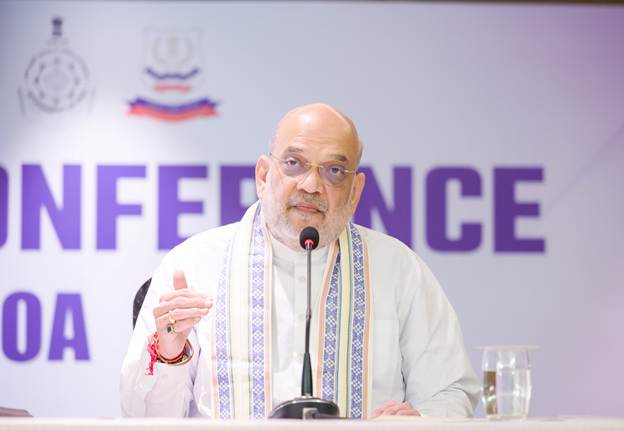
Addressing reporters after chairing a high-level meeting on narcotics in Panaji, Shah said the Narendra Modi government had taken several steps to strengthen internal security and address the country’s three major long-standing challenges—terrorism in Jammu and Kashmir, Left-Wing Extremism and insurgency in the Northeast.
“After the abrogation of Article 370 in Jammu and Kashmir, the feeling of separatism has reduced considerably. The figures of terrorism are gradually shrinking and moving towards zero. Jammu and Kashmir has progressed on the path of development,” Shah said.
He added that successful efforts had also been made to bridge the mental distance between Jammu and Kashmir and the rest of the country.
Shah’s remarks came while outlining the broader internal security record of the Modi government and its campaign against narcotics. He said the Centre had adopted a coordinated approach to tackling terrorism, Left-Wing Extremism and armed insurgency, combining security measures with development and efforts to bring affected sections of society into the mainstream.
Referring to the campaign against Left-Wing Extremism, Shah said the five-decade-old problem of Naxalism had almost become a thing of the past, with several armed cadres surrendering and joining the mainstream.
“The five-decade-old problem of Naxalism has today almost become a thing of the past. Most of the people who imagined the Red Corridor have today surrendered by laying down arms and are joining the mainstream,” he said.
He said the government had declared the country Naxalism-free on March 31 this year after a sustained campaign against Left-Wing Extremism.
“The way Naxalism was eliminated from the country, the Union government will similarly eliminate the menace of drugs,” Shah asserted.
Shah said Prime Minister Narendra Modi’s objective was that drug-free youth power should lead India towards Viksit Bharat by 2047. He said the government had prepared a three-year roadmap to make India drug-free by 2029, with a coordinated national strategy covering the entire narcotics network—from drug trafficking and financing to prevention, treatment and rehabilitation.
“Before 2014, the fight against narcotics was largely conducted in small units and isolation. Agencies were often satisfied catching small-time accused. Our government is making the fight a national security priority,” Shah said.
He said the Centre had created a four-tier National Coordination Committee for Countering Drug Trafficking (NCORD) mechanism in 2019 at the executive, state and district levels to ensure coordinated action against the drug menace. Dedicated Anti-Narcotics Task Forces had been constituted in all states and Union Territories, while local police had been linked with the national strategy.
A Joint Coordination Committee was also formed in 2019 to enable central agencies and state governments to take joint decisions against major drug networks, their international connections and operational gaps, he said.
The Narcotics Control Bureau has been strengthened through reorganisation of its cadre, enhanced manpower, greater zonal presence and improved operational capabilities, Shah said.
He said the government’s three-year roadmap was based on a four-pillared approach comprising intelligence- and operation-based enforcement, control of synthetic drugs, demand reduction and harm reduction, and capacity building and coordination.
Shah said the government had set a target of demolishing 100 national and international drug networks by March 2029 and bringing back 100 fugitives to India. By March 2027, there would be clear end-to-end visibility of the drug supply chain, while at least 75 clandestine laboratories would be destroyed during 2026, he said.
He added that the government had adopted a mission-mode approach to bring back fugitives hiding abroad. Between July 2019 and July 2026, 274 wanted or absconding criminals were brought back to India from 36 countries, Shah said. These included people involved in economic offences, terrorism, narcotics and gang wars.
He also said that over the past three years, 401 Red Corner Notices had been issued, including 182 up to July 2026.
The Home Minister said the fight against drugs was not limited to enforcement. He said the government had linked awareness, treatment, counselling, rehabilitation and livelihood opportunities with the anti-narcotics campaign. The 1933 MANAS helpline has been introduced to support people affected by drug addiction, he said, adding that the government’s objective was to prevent addiction and rehabilitate victims.
On the Northeast, Shah said around 11,000 armed youths had laid down their weapons and joined the mainstream. He said the Government of India had signed more than 14 peace agreements with armed groups in the region since 2019.
“The government of India has signed more than 14 agreements with them, and today the Northeast is also progressing on the path of development,” he said.
Shah said the government had also taken action against fugitives who fled the country after committing crimes. Between 2019 and 2026, assets worth ₹17,874 crore belonging to fugitives were attached, while ₹18,762 crore was recovered or restored, he said.
He also highlighted the government’s efforts against cybercrime, saying the cyber system had helped save more than ₹11,158 crore across 32.8 lakh complaints as of June 30, 2026.
Shah said strengthening border and coastal security, implementation of the three new criminal laws and the Vibrant Villages Programme were among the measures taken to strengthen internal security.
He said the government had adopted a zero-tolerance policy towards terrorism and a first-responder approach to disaster management.
The Home Minister also praised the Goa Police for effective implementation of the three new criminal laws, saying the conviction rate had increased from 22 per cent to 53.2 per cent.
Shah said the government would continue to pursue its internal security agenda through coordinated enforcement, development and rehabilitation measures.

