



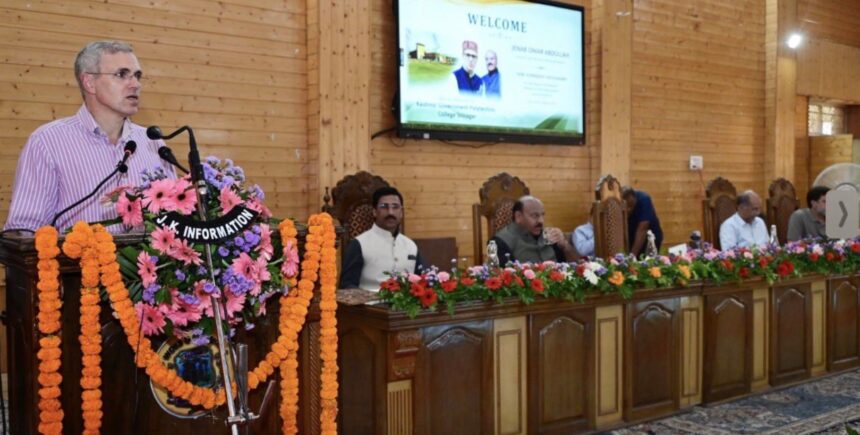
Srinagar: Jammu and Kashmir Chief Minister Omar Abdullah on Thursday called for greater focus on skill development and vocational education to help young people compete for employment opportunities in Jammu and Kashmir, across India and abroad.
He made the statement as he laid the foundation stone for developmental works at Kashmir Government Polytechnic in Srinagar and e-inaugurated infrastructure upgrades worth Rs 4.20 crore across government polytechnics in Kishtwar, Ramban, Kulgam and Kupwara.
Speaking on the occasion, the chief minister stressed that preparing youth for the future job market must go hand in hand with formal education.
“We cannot give government jobs to everyone. If we have to prepare our children for the future, we have to give them the skills to compete in the job market, whether in Jammu and Kashmir, elsewhere in the country or abroad,” the chief minister said.
He emphasised that skill development programmes must be aligned with emerging market requirements and the employment opportunities being created in sectors such as tourism, agriculture, horticulture, manufacturing, construction, healthcare and technology.
Abdullah called for regular review of courses and training programmes in ITIs and polytechnics so that outdated skills and equipment are replaced with training relevant to contemporary industry requirements.
He noted that the level of attention given to universities should also be extended to the skill-development network of ITIs and polytechnics, including the improvement of infrastructure, training quality and modern equipment.
Highlighting the employment potential emerging from major projects in JK, he said the skill-development ecosystem must be designed around the requirements of upcoming investments and industries.
The chief minister assured that the government would work to strengthen the network of skill-development institutions over the next three years and improve their infrastructure and quality.
He stressed the need to ensure greater employment opportunities for local youth in industries and projects coming to JK, saying companies should be encouraged to employ trained local youth before looking outside the region for skilled manpower.
Abdullah said JK’s objective should not be merely to send labour outside but to prepare skilled professionals capable of securing better-paying employment and competing in international markets.
He also felicitated students who secured overseas placements, underscoring the government’s commitment to strengthening technical education and creating meaningful employment opportunities for JK’s youth.
Seeks balance between urban growth, environment
Srinagar: Chief Minister Omar Abdullah on Thursday emphasised the importance of balancing planned urban growth, reforms for ease of doing business, and environmental safeguards while finalising the Master Plans for the twin capital cities of Jammu and Kashmir.
The chief minister chaired the 91st Board of Directors meeting of Jammu Development Authority (JDA) and the 85th Board of Directors meeting of Srinagar Development Authority (SDA) to discuss proposed amendments to the Master Plans for Jammu and Srinagar, an official spokesperson said.
He said Abdullah stressed the need to balance planned urban growth, reforms for ease of doing business, addressing public concerns and ensuring environmental protection while finalising the proposed Master Plans.
Chairman SDA Shabir Hussain Bhat and Chairman JDA Rupesh Kumar made separate presentations on the proposed plans.
Discussions covered proposed amendments, public feedback, regulatory requirements, and strategies for planned and sustainable urban development.
For Srinagar, the meeting discussed town planning schemes, safeguards for Dal, Nigeen and other water bodies, alignment with JK Unified Building Bye-Laws-2021, and reforms to simplify land-use zoning and building permissions, the spokesperson said.
The Revised Jammu Master Plan-2032 was also reviewed, focusing on 15 planning zones, rationalisation of land-use categories, geo-referenced mapping, and alignment of major infrastructure projects within the planning document.
Environmental and heritage safeguards, including the protection of the Tawi riverbed and watercourses, were also discussed, he added.

