



Avinav Verma
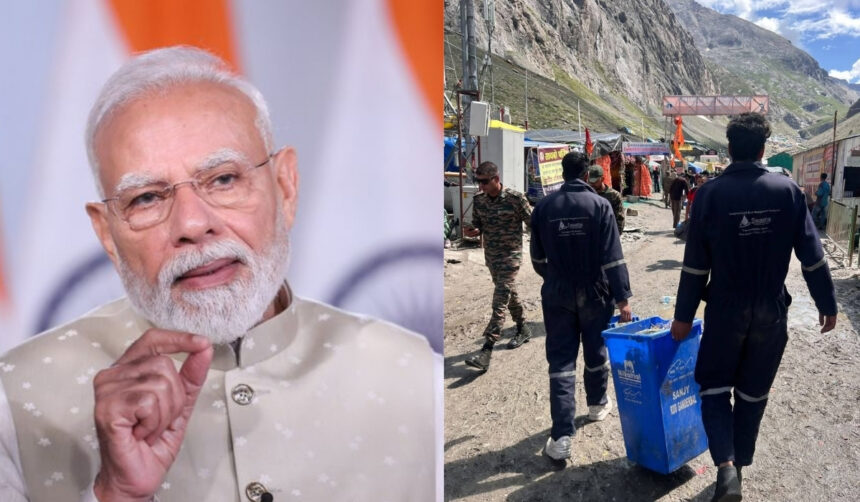
Jammu: Prime Minister Narendra Modi on Sunday lauded the sanitation and scientific waste management initiatives undertaken during the Shri Amarnath Ji Yatra 2026, while Lieutenant Governor Manoj Sinha felicitated officers, security personnel, sanitation workers, medical professionals, service providers and other stakeholders for the successful conduct of the 57-day pilgrimage.
In the 137th episode of Mann Ki Baat, Modi highlighted the efforts of thousands of sanitation workers who worked day and night to serve pilgrims along the arduous Himalayan route. He said more than 400 metric tonnes of waste was collected and processed during this year’s Yatra.
The Prime Minister said over 16,000 pilgrims took a cleanliness pledge, while more than 10,000 were awarded the ‘Responsible Yatri’ certificate for their participation in the cleanliness drive.
Highlighting an innovative waste-to-energy initiative, Modi said dung generated by horses and mules used during the pilgrimage was converted into biogas, with the clean energy subsequently used to illuminate the ‘Swachh Jyot’.
“Cleanliness became a form of service and faith during this holy pilgrimage to Baba Barfani,” the Prime Minister said.
The Yatra concluded on August 28 after being conducted for 57 days from July 3, with approximately 4.80 lakh devotees having darshan of Baba Barfani.
Despite adverse weather conditions for more than 10 days, 82 per cent of pilgrims completed darshan within the first 20 days, while 95 per cent completed it within the first month.
According to the Directorate of Rural Sanitation, Department of Rural Development and Panchayati Raj, J&K, more than 8,000 sanitation facilities and supporting infrastructure were deployed across the Yatra ecosystem.
The arrangements included prefabricated sanitation structures, toilets, bathing facilities and pucca bases. As part of the zero-waste initiative, 7,900 toilets were installed and maintained by 7,900 sanitation workers along the Yatra route.
A scientific solid waste management system was operationalised, covering segregation at source, collection, transportation, processing and scientific disposal. Under the Zero Waste to Landfill approach, 414.46 metric tonnes of waste generated during the Yatra was collected and scientifically processed.
The administration also undertook Information, Education and Communication (IEC) activities to encourage pilgrims to use designated sanitation facilities and adopt responsible waste disposal practices, promoting a ‘Swachh Yatra’ culture involving pilgrims, sanitation workers, service providers and other stakeholders.
The sanitation and waste management measures assumed particular significance given the fragile Himalayan ecosystem through which the pilgrimage passes, with the system aimed at reducing the environmental footprint of the massive Yatra while maintaining public health and hygiene standards.
Meanwhile, Lieutenant Governor Manoj Sinha felicitated officers and personnel of the Shri Amarnath Ji Shrine Board, civil administration, Army, CAPFs, J&K Police, BRO, medical teams, sanitation workers, pony operators, pithu bearers, palanquin carriers, langar volunteers, service providers and other stakeholders for ensuring a smooth, secure and dignified pilgrimage.
Addressing the gathering, Sinha said the successful Yatra was not the achievement of any single institution or department but the collective effort of “Team Jammu Kashmir”, which transformed hardships into duty, challenges into opportunities and service into a form of spiritual practice.
A total of 54,000 service providers were registered for the pilgrimage, including 31,000 pony operators, pithu bearers and palanquin carriers; 6,400 tent and shop operators; and 7,700 langar volunteers. Around 1.87 lakh pilgrims availed pony and palanquin services.
The administration established 93 medical facilities along the route, with 595 clinical beds and 26 oxygen booths. As many as 1,430 doctors and nursing personnel remained on round-the-clock duty, supported by 48 ambulances.
The holding capacity was increased to 63,000 within the Yatra area and 54,000 across Jammu and Kashmir divisions. Aadhaar-based registration was introduced to address the challenge of duplicate registrations.
Real-time monitoring was ensured through twice-daily coordination meetings at 3 am and 8 pm, led by Dr Mandeep K. Bhandari, CEO of the Shri Amarnath Ji Shrine Board and Principal Secretary to the Lieutenant Governor, along with nodal officers, police, divisional commissioners and camp officers.
Sinha expressed gratitude to security personnel, sanitation workers, pony operators, pithu bearers, palanquin carriers, langar volunteers and medical staff for their dedication despite difficult terrain and adverse weather.
He said the sacred Yatra reflected India’s Sanatan tradition and its ethos of humanity, coexistence and collective service. Pilgrims, he said, returned home not only with a religious experience but also carrying the message of Jammu Kashmir’s culture and hospitality.
The Lieutenant Governor also thanked civil society groups, political parties and religious leaders for extending support to the Yatra and said the discipline, energy and coordination demonstrated during the pilgrimage should become an enduring part of Jammu Kashmir’s development ethos.
“I am confident that every citizen of Jammu Kashmir fulfilled their moral responsibility towards this yatra, directly or indirectly, and elevated the rich cultural tradition of UT before the entire country,” Sinha said.
He added that the successful Yatra demonstrated that “when resolve is collective, leadership is clear, arrangements are robust, and the spirit of service is paramount, no goal remains impossible.”
Director General Rural Sanitation, J&K, Anoo Malhotra, said the Yatra demonstrated how infrastructure, manpower, technology and behavioural change could collectively create a cleaner and more environmentally responsible pilgrimage experience.
“With over 8,000 sanitation facilities deployed and 414.46 MT of waste collected and processed, the Yatra has demonstrated how infrastructure, manpower, technology and behavioural change can work together to create a cleaner and more environmentally responsible pilgrimage experience,” she said.
Appeals to citizens to make India drug-free
Jammu: Prime Minister Narendra Modi on Sunday appealed to citizens to unite against drug abuse and build a stronger future for the youth, noting that addiction engulfs not just an individual but impacts the entire society.
In his monthly radio address ‘Mann Ki Baat’, he noted that the ‘Drug-Free Youth for a Developed India’ campaign is rapidly gaining momentum across the country and stressed that its objective is clear: ‘Drug-free youth, drug-free India’.
The prime minister said he was happy that this campaign has not remained merely a formality as many people, especially the youth, are becoming a part of it in large numbers.
“After all, this is our collective resolve for the health, happiness, and bright future of India’s youth. Let us all play our part in this noble mission to keep India’s youth away from drugs and free from addiction,” he said.
Modi said drug addiction does not just engulf a single individual as the entire family and society have to bear the consequences.
“I would like to commend those who raise awareness against drugs and step forward to help individuals struggling with addiction,” he said.
The Drug-Free India through the ‘Nasha Mukt Bharat Abhiyaan’ (NMBA) is a flagship initiative of the government. The campaign seeks to prevent substance abuse through awareness generation, community participation, treatment, rehabilitation, aftercare and social reintegration.
The prime minister also highlighted the PM SVANidhi Yojana welfare scheme for street vendors, noting that lakhs of women are gaining strength from it.
Lakhs of women across the streets of cities and towns are engaged in selling vegetables or fruits, running tea stalls, while some are selling flowers, earthen lamps, and ‘pooja’ material, he noted.
“Often, a mere lack of capital prevents their businesses from growing further. But now, lakhs of such mothers and sisters are gaining new strength through the ‘PM SVANidhi Yojana’,” he said.
Modi said this aspect of ‘women empowerment’ is not discussed as much as it should be since women account for approximately 46 percent of the beneficiaries of the ‘PM SVANidhi Yojana’.
“This means that around 35 lakh women across the country are expanding their businesses by connecting with this scheme,” he asserted.
Referring to two women — one from Ghaziabad and the other from Bengaluru —who have benefitted from the ‘PM SVANidhi Yojana’, the prime minister said when a woman’s business grows, the future of her entire family advances along with it. “Children receive better education, household needs are met, and the woman’s self-confidence is strengthened. This is, indeed, a living example of ‘women’s empowerment’,” he said.
Modi said the month of August brings with it myriad hues of patriotism all around as during this time, the spirit of love for the nation intensifies in everyone’s heart.
He said the ‘National Handloom Day’, the anniversary of the ‘Quit India Movement’, the ‘Partition Horrors Remembrance Day’ make this month special and the ‘Independence Day’ and ‘National Space Day’ fill every countryman with pride.
The prime minister said the ‘Har Ghar Tiranga’ campaign further strengthens this sentiment and this year has become even more special as it marks the 150th anniversary of ‘Vande Mataram’.
He said this celebration of the tricolour was not limited to India alone; this year, through the ‘SuryapathTiranga’ initiative, the national flag embarked on a unique journey across the globe.
“The tricolour was hoisted in Suva, Fiji, at the first light of dawn. Subsequently, it was unfurled at Indian Missions and Posts across Asia, Africa, Europe, and eventually San Francisco in America. You can imagine how magnificent those scenes must have been; as the Sun traversed across the world, the Indian tricolour was hoisted in its wake,” he said.
Referring to the ‘Mission ShaktiSAT’, Modi said today the dreams of the country’s daughters are soaring from the earth to outer space.
“And you will be proud to know that India is bringing together thousands of daughters who are nurturing such dreams, from across the globe. This initiative is named ‘Mission ShaktiSAT,” he said.
The prime minister said through it, 12,000 girl students from 108 countries are getting the opportunity to learn satellite technology and to advance in the field of innovation.
“The goal of this entire initiative is truly special: preparations are underway to send a satellite – developed entirely through the participation of female students – into lunar orbit,” he said.
In his radio address, Modi also referred to the rising demand for avocados.
Hardly anyone knew about this fruit in the past and both its value and demand were low. However, today it is frequently seen on dining tables, he said.
“It has become a preferred choice in the health and premium markets. This is also very helpful for our farmer brothers and sisters,” he said.
The prime minister said many farmers, who were earlier cultivating other crops, are now engaged in avocado farming, which is allowing them to earn additional income.
During the radio address, Modi also shared the inspirational stories of Mumbai resident Krishna Seshadri, who has started a website called www.bharatrajya.com which shares information about little-know erstwhile kingdoms of India.
He also spoke about Nagaland’s Phek district resident Vesalu Puro, who has benefitted from flower cultivation, and Odisha’s Maithili Bhue, who is now involved in forest conservation, among others.
The prime minister is currently on a state visit to Uzbekistan and the radio broadcast is usually recorded a few days in advance and played on the last Sunday of every month.

