



Avinav Verma
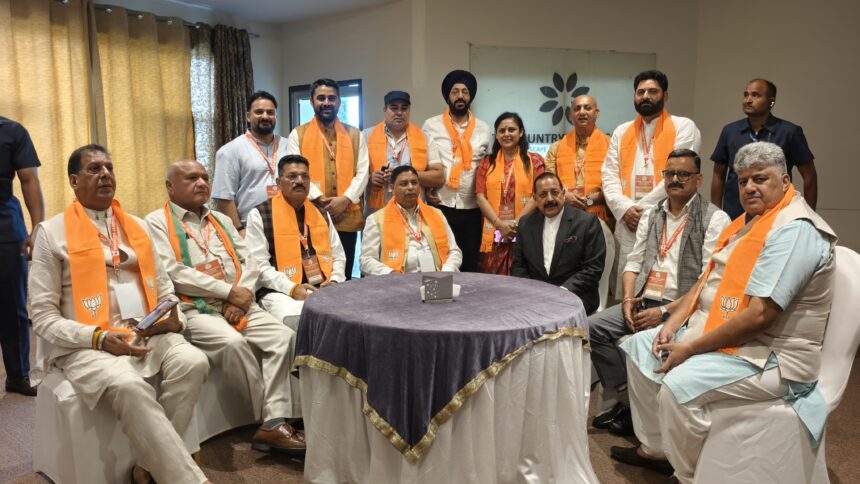
Srinagar: The Jammu and Kashmir unit of the Bharatiya Janata Party (BJP) on Sunday held its first-ever state-level organisational meeting in Srinagar, signalling a fresh push by the party to expand its political and organisational footprint in the Kashmir Valley and strengthen its direct connect with the people.
The two-day meeting, being held on August 23 and 24, brought together senior party leaders, MPs, MLAs, office-bearers, district presidents and other functionaries from across Jammu and Kashmir.
The deliberations focused on strengthening the organisation, expanding grassroots outreach, reviewing the party’s functioning and chalking out its future political roadmap.
The meeting assumes significance as the BJP has traditionally conducted its major organisational activities from Jammu, where it has a strong electoral base.
The party won 29 seats in the 2024 Assembly elections, all from Jammu, but is yet to win an Assembly seat in the Kashmir Valley.
The Srinagar meeting is being seen as an effort to change that equation by taking the organisation closer to the people and building a stronger constituency-level presence in Kashmir.
BJP J&K president Sat Sharma, who chaired the meeting, called for sustained engagement with the people and greater “pravaas” by senior leaders and office-bearers so that the party’s leadership remains directly connected with people across the Union Territory.
“BJP is not merely a political organisation but a movement rooted in nationalist ideology and dedicated to public service,” Sharma said.
He stressed the need for stronger booth-level organisation and continuous public outreach, while party leaders also underlined the growing importance of social media and other platforms in communicating the party’s programmes, policies and initiatives.
The organisational exercise comes ahead of the forthcoming Assembly session, with the BJP preparing to raise a range of issues concerning the people.
Leader of Opposition in the J&K Assembly Sunil Sharma said the party would use the Assembly to highlight public concerns and seek accountability from the Omar Abdullah-led government.
He said BJP MLAs and office-bearers discussed issues related to development, employment, local body elections, electricity tariffs and governance during the meetings.
“The voice of the people will remain our priority,” Sharma said, stressing that BJP legislators must remain closely connected with the public and raise their genuine concerns in the Assembly.
Sharpening its attack on the ruling National Conference government, the BJP announced that it would hold a protest and “gherao” the Assembly on September 2.
Sharma accused the government of failing to address several public concerns, including the delay in panchayat and urban local body elections, alleged outsourcing of government jobs, rising electricity tariffs and what he described as growing corruption.
He also alleged that the government was weakening grassroots democracy by delaying panchayat elections, which have been pending since 2023 after the expiry of the elected bodies’ terms.
The government has maintained that local body elections will be held at an appropriate time. Deputy Chief Minister Surinder Choudhary has argued that elected panchayat representatives would have limited powers without restoration of statehood and greater control over the bureaucracy and police.
The BJP, however, has made the issue a key part of its political campaign and is expected to press the matter during the upcoming Assembly session.
Union Minister of State in the PMO Dr Jitendra Singh, who attended the meeting, said Jammu and Kashmir had witnessed a major transformation since the Narendra Modi government came to power in 2014.
“Since Prime Minister Modi’s tenure began, the atmosphere here has changed. There is peace, and normalcy is returning. Development works are going at a good pace,” Singh told reporters on the sidelines of the meeting.
He said the mindset of the people, particularly the youth, had changed after decades of violence, with young people becoming increasingly aspirational and looking towards education, employment and new economic opportunities.
Singh cited the growth of lavender cultivation and the region’s “Purple Revolution”, along with new infrastructure projects, as examples of the changing economic landscape.
He said Jammu and Kashmir could play an important role in Prime Minister Modi’s vision of Viksit Bharat 2047.
Singh also referred to India’s achievements in the space sector, noting that Chandrayaan-3 successfully landed near the Moon’s south pole on August 23, 2023, and said the opening of the space sector to private participation had accelerated India’s space economy.
The Srinagar meeting also reflects the BJP’s larger effort to establish a sustainable political organisation in the Valley.
While the party has yet to win an Assembly seat in Kashmir, its performance in the 2024 elections offered some indications of its potential to compete in select constituencies.
In Gurez, BJP candidate and former MLA Faqir Mohammad Khan polled 7,246 votes against National Conference candidate Nazir Ahmad Khan’s 8,378 votes, losing by only 1,132 votes. Khan secured more than 40 per cent of the vote.
Faqir Mohammad Khan died in March 2025, but the Gurez result remains significant for the BJP as one of its closest contests in the Valley.
The party also finished runner-up in two other Kashmir constituencies in the 2024 Assembly elections.
The challenge before the BJP now is to convert such electoral performances into a broader grassroots organisation by identifying credible political faces, strengthening booth-level networks and maintaining continuous engagement with voters.
The party’s Kashmir expansion also comes amid scrutiny over recent cases involving some of its functionaries in Pulwama.
Police registered an FIR against BJP Pulwama district president Showkat Gayoor following allegations of extortion and criminal intimidation. The party subsequently suspended him from organisational posts.
Another BJP functionary, Aijaz Ahmad Shah, vice-president of the party’s Kisan Morcha in Pulwama, was also booked in a separate case involving allegations of cheating and criminal intimidation.
The allegations are under investigation and have not resulted in convictions.
For the BJP, maintaining organisational discipline and credibility will be important as it seeks to bring more political workers and leaders from different backgrounds into its fold.
The two-day Srinagar meeting is thus not merely an organisational review but an attempt to give greater political momentum to the BJP’s Kashmir outreach.
Alongside strengthening its organisational structure, the party is preparing to sharpen its opposition to the NC government and position itself as an alternative voice on issues affecting the people.
The discussions also include the party’s strategy for the 2029 Lok Sabha elections and the Jammu and Kashmir Assembly polls due the same year, according to party leaders.
For the BJP, the immediate focus is on building a stronger public connect, strengthening its presence at the grassroots and taking the concerns of people into the Assembly.
The September 2 protest will provide the first major test of that strategy.

