



Avinav Verma
Jammu: In a major decision aimed at strengthening access to justice in the Union Territory of Ladakh, the Union Cabinet, under the leadership of Prime Minister Narendra Modi, has approved the establishment of a bench of the High Court of Jammu & Kashmir and Ladakh in Ladakh.
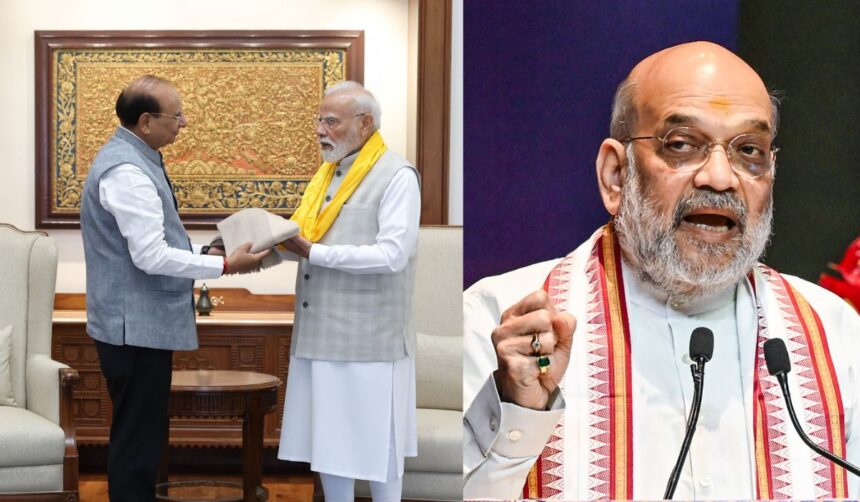
The decision was announced by Union Home Minister Amit Shah, who said the move would significantly improve access to legal services for people living in the remote and geographically challenging region.
“This will significantly enhance access to justice for citizens living in remote areas of Ladakh by reducing the time required to avail themselves of the legal services they are entitled to,” Shah said, adding that the government remained committed to the all-round development of Ladakh and ensuring constitutional safeguards for its people.
The decision is being seen as a significant relief for litigants from Ladakh, who have long faced geographical and logistical challenges in accessing High Court-level judicial services.
Until now, the High Court’s principal functioning has been centred around its Jammu and Srinagar wings, requiring litigants and lawyers from Ladakh to undertake long and often difficult journeys for matters requiring physical access to the High Court.
The announcement assumes particular significance in the context of the constitutional and administrative changes that followed the abrogation of Article 370 on August 5, 2019, and the subsequent bifurcation of the erstwhile State of Jammu and Kashmir into the Union Territories of Jammu and Kashmir and Ladakh.
Despite becoming a separate Union Territory, Ladakh continued to remain under the jurisdiction of the common High Court serving both Jammu and Kashmir and Ladakh.
However, unlike Jammu and Srinagar, Ladakh did not have a High Court bench of its own.
The establishment of a bench is therefore expected to address a long-standing gap in judicial accessibility while preserving the institutional connection of Ladakh with the High Court of Jammu & Kashmir and Ladakh.
The High Court currently functions under the name High Court of Jammu & Kashmir and Ladakh, with its existing Jammu and Srinagar wings continuing to serve the wider jurisdiction.
The judicial relationship between Jammu and Kashmir and Ladakh underwent an important nomenclature change in 2021.
Following the reorganisation of the erstwhile State, the court was initially referred to as the “Common High Court of the Union Territory of Jammu and Kashmir and Union Territory of Ladakh.”
However, an order notified in July 2021 changed the lengthy nomenclature to the “High Court of Jammu and Kashmir and Ladakh.”
While Ladakh thus became formally reflected in the name and jurisdiction of the High Court, the absence of a physical bench in the Union Territory remained a major practical concern for many litigants, particularly those residing in remote areas.
The Cabinet’s latest decision is expected to bridge that gap by bringing High Court services closer to the people of Ladakh.
The Cabinet decision comes on the day Lieutenant Governor of Ladakh Vinai Kumar Saxena met Prime Minister Narendra Modi in New Delhi, adding significance to the Centre’s latest move on judicial access in the Union Territory.
The meeting took place shortly before Union Home Minister Amit Shah announced the Cabinet’s decision to establish a bench of the High Court of Jammu & Kashmir and Ladakh in Ladakh.
The development is being viewed as a significant step towards strengthening institutional access and delivering justice closer to the people of the remote Himalayan region.
For Ladakh, geography has always been a major challenge in the delivery of public services, including access to the justice system.
The region’s vast distances, difficult terrain and harsh weather conditions can make travel to Jammu or Srinagar expensive, time-consuming and, during certain periods, difficult.
A High Court bench within Ladakh is therefore expected to make the justice delivery system more accessible to litigants, lawyers and other stakeholders.
The move could particularly benefit residents of far-flung areas of Leh and Kargil, where pursuing litigation at the High Court level has often involved considerable travel and logistical arrangements.
Legal observers believe that the presence of a bench could also strengthen the local legal ecosystem by providing greater opportunities for lawyers and litigants to engage directly with High Court proceedings.
The decision comes at a time when a substantial number of cases remain pending across the judicial system.
According to data tabled in Parliament by the Union Government, 44,551 cases were pending before the High Court of Jammu & Kashmir and Ladakh as on July 28, 2026.
The pendency in the High Court had stood at 47,371 cases in 2021, before declining to 43,575 in 2022 and 42,934 in 2023. It stood at 43,296 in 2024 and 43,039 in 2025, before rising to 44,551 as of July 28 this year.
In the subordinate courts of Jammu and Kashmir, pendency stood at 3,65,191 cases, while the subordinate courts of Ladakh had 1,748 pending cases as on July 28, 2026, according to the parliamentary data provided by the Ministry of Law and Justice.
The figures underline the continuing pressure on the judicial system and the importance of improving institutional capacity and accessibility.
However, while Ladakh’s subordinate court pendency is comparatively small, the establishment of a High Court bench is significant primarily because of the region’s unique geographical conditions and the practical difficulties faced by litigants in accessing higher judicial forums.
This distinction is important because the decision strengthens access to justice without altering the existing judicial structure linking Jammu, Kashmir and Ladakh.
The move could also help ensure that cases involving Ladakh are heard with greater physical accessibility for litigants and lawyers from the region.
The High Court has already embraced digital and virtual hearing mechanisms, but physical access to a constitutional court remains important, particularly in matters where litigants or lawyers need to appear personally.
The court’s official platform continues to provide separate cause lists and virtual hearing facilities for its Jammu and Srinagar wings.
For the people of Ladakh, the Union Cabinet decision is likely to be viewed as a major institutional achievement.
Beyond the legal implications, the decision carries wider significance for a Union Territory that has been seeking stronger institutions and improved safeguards following its separation from the erstwhile State of Jammu and Kashmir.
By bringing a bench of the High Court closer to Ladakh, the government has addressed a key concern related to access to justice in one of India’s most geographically challenging regions.

