



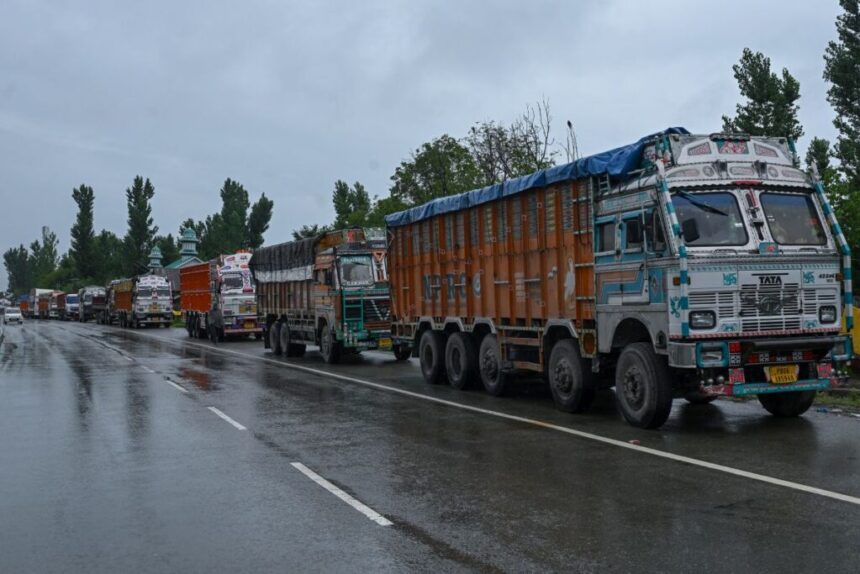
Jammu: The Jammu-Srinagar National Highway remained closed for the third consecutive day on Friday following multiple landslides, shooting stones and road erosion triggered by incessant rainfall, disrupting traffic on the only all-weather road connecting Kashmir with the rest of the country.
The prolonged spell of heavy rains, cloudbursts and flash floods over the past six days has claimed 26 lives in the Jammu region, while six persons are still missing, officials said.
Rescue teams have intensified searches in the worst-affected districts of Poonch and Rajouri, deploying additional personnel to scan flood channels and vulnerable areas.
The 250-km NH-44 remained blocked at several locations, including Deohal bridge, Samroli and Jakhani in Udhampur district and Banihal in Ramban district.
The Traffic Police, in an advisory, said the highway was still closed for vehicular movement due to landslides and shooting stones at multiple locations.
Officials said restoration work was underway, but continuous rainfall was hampering debris clearance and repair operations.
More than 1,000 vehicles remained stranded at Ramban, Nagrota, Jammu, Udhampur, Lakhanpur and Samba due to the highway closure. Commuters have been advised to avoid travel until the road is declared safe.
Besides NH-44, several inter-district roads remained closed due to landslides, mudslides and road erosion. The Doda-Kishtwar road was among the affected routes, while the Mughal Road and Srinagar-Sonamarg-Gumri (SSG) road remained open despite heavy rainfall.
To facilitate the movement of stranded passengers, Northern Railway operated a special train from Budgam and Banihal to Katra. Officials said more than 600 stranded tourists were shifted from Srinagar to Jammu.
Meanwhile, flash floods hit the Barkuanda area of Udhampur district early Friday, damaging several houses and forcing the administration to evacuate affected families. Three families were shifted to the Government Middle School at Barkuanda as a precautionary measure. No casualties were reported in the incident.
Another flash flood was reported from Kadwah village in Basantgarh tehsil, where overflowing water damaged houses and standing maize crops. Officials said floodwater was diverted through an alternative channel to prevent further damage to residential areas and agricultural land.
The Tawi River at Udhampur remained below the alert level, flowing at 12.655 feet against the alert mark of 15 feet. However, the Chenab River at Akhnoor crossed the flood alert level again.
In Kashmir, intermittent rains continued for the fourth consecutive day on Friday, keeping water levels in rivers and streams high and triggering a flood scare in several areas. The water level of the Jhelum River, which had crossed the flood declaration mark in Anantnag and Srinagar on Thursday night, started receding but remained above danger levels at some locations.
At Sangam in south Kashmir’s Anantnag district, the Jhelum level stood at 18.90 feet, below the flood declaration mark of 21 feet. At Pampore, near Srinagar, the water level was recorded at 5.09 metres against the flood declaration mark of 4.5 metres, while at Munshi Bagh in Srinagar it stood at 18.99 feet, above the flood declaration mark of 18 feet.
The Irrigation and Flood Control Department continued monitoring the situation and advised people to avoid moving near rivers, streams and other water bodies.
Weather conditions improved across most parts of Jammu and Kashmir on Friday after a prolonged spell of heavy rainfall triggered flash floods, landslides, highway closures and widespread disruption. The Meteorological Department said brief spells of rain and thundershowers are likely over the next few days, while another wet spell is expected from July 28 to July 31.
The cumulative rainfall data from July 19 to July 24 showed that Reasi received the highest rainfall in Jammu and Kashmir at 473.2 mm, followed by Udhampur with 417.5 mm, Rajouri 349.9 mm, Ramban 293.4 mm, Poonch 290 mm, Kathua 270.4 mm, Jammu 262.6 mm, Samba 213 mm, Doda 120.1 mm and Kishtwar 77 mm.
In Kashmir division, Kulgam recorded the highest rainfall at 201.1 mm, followed by Shopian at 145.2 mm, Srinagar 144.7 mm, Pulwama 136.8 mm and Anantnag 130.8 mm.
The administration continued the suspension of major pilgrimages, including Shri Amarnath Ji Yatra, Mata Vaishno Devi Yatra, Shiv Khori and Machail Yatra, due to adverse weather conditions.
The Shri Amarnath Ji Yatra remained suspended until further orders, and no pilgrim vehicles were allowed to proceed from Jammu, Udhampur or Ramban towards Srinagar. More than 15,000 pilgrims remained stranded at base camps and lodging centres across Jammu, Kathua, Samba, Udhampur, Ramban and Banihal.
Heavy rainfall was recorded across several districts during the past 24 hours, with Udhampur receiving the highest precipitation of 96.5 mm till 8:30 am on Friday, followed by Batote at 84.2 mm, Ramban 69.5 mm and Bhaderwah 65.7 mm. Katra recorded 45.1 mm, Kathua 44.8 mm, Banihal 38.3 mm, Doda 35 mm, Reasi 27.5 mm, Kishtwar 27 mm, Jammu Airport 26 mm, Jammu city 25.2 mm and Poonch 7.5 mm.
Officials said rescue and relief operations involving the civil administration, police, SDRF, NDRF and other agencies were continuing across the affected districts, while the situation remained under close watch.
The latest disruption came after the Meteorological Department had issued an advisory predicting widespread moderate to heavy rainfall, isolated extremely heavy rainfall in Reasi and Udhampur, flash floods, landslides, mudslides, shooting stones, waterlogging and a significant rise in river levels due to moisture incursion from the Arabian Sea and Bay of Bengal along with the northward shift of the monsoon trough. The forecast largely materialised, causing widespread damage across Jammu and Kashmir over the past week.

