



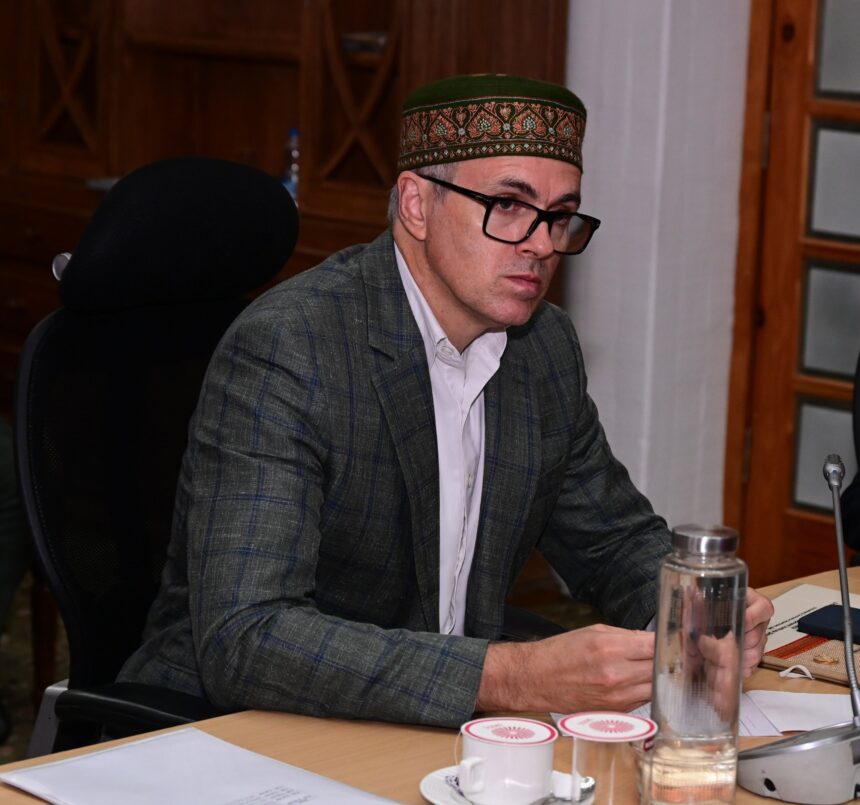
SRINAGAR: Chief Minister Omar Abdullah on Thursday said that while he understood the anger within the police following the recent terror attack in Anantnag, “there is also a Supreme Court observation that summary action of this nature should not be taken.”
Referring to the crackdown after the attack in Anantnag wherein a policeman was killed by terrorists, Abdullah said demolishing houses or carrying out mass arrests would not help restore normalcy and could instead aggravate the situation.
“We witnessed similar circumstances after the Pahalgam terror attack, when some people’s homes were demolished. At that time, I had to speak with the Central Government to get that process stopped. When the investigation was completed, it became clear that not a single local resident was involved in the attack—the attackers had all come from across the border,” he said.
Abdullah said that reports suggesting around 2,500 detentions were a matter of concern.
“So, demolishing homes or carrying out arrests in the thousands will not improve the situation. On the contrary, it could make matters worse. Security forces, including the police, Army and CRPF, can contain the situation to an extent, but lasting success will come only when ordinary people stand with us, reject terrorism and raise their voices against it,” he said.
He said people were angry over the killing of police head constable Ashiq but warned that excessive crackdowns could shift public resentment away from terrorists and towards the authorities.
“My hope is that in this fight, we carry our own people with us. Only then can we achieve real and lasting success,” he added.
Turning to the recent spell of heavy rainfall and cloudbursts, the Chief Minister said the government would have to prepare a comprehensive strategy to deal with recurring weather-related disasters.
“Fortunately, the water levels in the rivers did not rise as much as we had feared. However, some areas did suffer damage. For instance, in Berwah, around 37 shops collapsed into the river. The Deputy Commissioner has been instructed to initiate the necessary process for providing compensation to those affected,” he said.
Abdullah said Jammu and Kashmir had witnessed increasing incidents of cloudbursts in recent years.
“We cannot stop the rain, but we must be better prepared to mitigate its impact. During my childhood, cloudbursts would occur perhaps once or twice a year, usually in places like Pahalgam or other mountainous areas. Now, we hear reports of cloudbursts almost every month somewhere in the region. We need a comprehensive long-term strategy to protect infrastructure and save precious lives,” he said.
Commenting on the ongoing students’ protest, Abdullah opposed any punitive action against the protesting students and called for dialogue.
“Even if someone wants to take action, there should not be any retaliatory action against children. These students are staging a peaceful protest. If, after this assurance, they are willing to withdraw their hunger strike, that is a positive development. I believe no action should be taken against them. Instead, they should be engaged in dialogue, and their legitimate demands should be addressed,” he said.
On another issue concerning youth protests elsewhere in the country, Abdullah said governments could not afford to ignore young people.
“At some point, the government will have to sit down and engage with them. You cannot ignore such a large number of young people,” he said.
Referring to recent developments in Delhi, he said, “A significant part of New Delhi has remained disrupted, and even last night, tear gas had to be used around Jantar Mantar. Clearly, there is growing resentment among the youth—a resentment that has so far been ignored.”
Welcoming the Prime Minister’s remarks on youth, Abdullah said, “It is encouraging that the Prime Minister, through his post, acknowledged that young people are important. The right approach now would be to engage with them and address their concerns through dialogue.”
Highlighting entrepreneurship, Abdullah said the Startup Policy, in effect since 2024, had led to the establishment of a large number of new startup units across Jammu and Kashmir.
“Our continuous effort is to support these ventures through various capital assistance schemes, by leveraging incubation centres, and by organising mentoring and support programmes. The objective is to bring together our existing entrepreneurs, as well as aspiring entrepreneurs who have promising ideas but lack the resources to take them forward, with experienced individuals who understand the startup ecosystem and can guide them,” he said.
Abdullah said Jammu and Kashmir currently had around 1,460 startups, with the government’s aim being to double that number every year.
“If you visit the exhibition, you will get an idea of the diversity of our startups. They belong to various sectors, including agriculture, horticulture, energy usage and many other fields. There are several innovative ideas, and we are making every effort to support and nurture them,” he said.
Concluding with Ganderbal, Abdullah said the district had emerged as a success story under the One District One Product (ODOP) initiative.
“Under the One District One Product initiative, Ganderbal has achieved considerable success. Its cane and wickerwork has been identified as the district’s flagship product. The Industries and Commerce Department is making every effort to support artisans through marketing, innovation, product design and overall promotion. Our effort is to ensure that artisans across all districts—and in Ganderbal in particular—receive the support they need to grow and succeed,” he said.

