



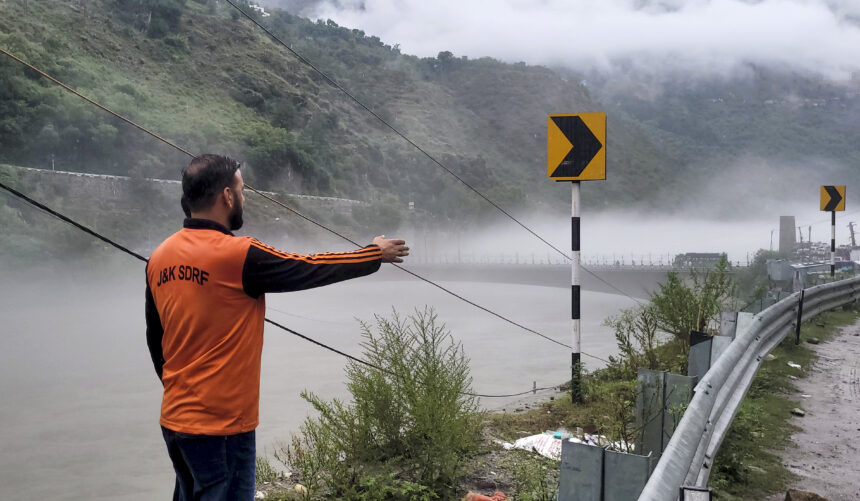
Jammu: Jammu and Kashmir remained in the grip of an unrelenting spell of rain for the fifth consecutive day on Thursday, with a devastating cloudburst in Baramulla’s Boniyar area, flash floods, rising river levels and landslides disrupting normal life across the Union Territory.
The strategic Jammu-Srinagar National Highway (NH-44) remained closed for the second straight day, while the death toll from the ongoing rain-related disasters rose to 26 after the body of a woman was recovered in Poonch.
The India Meteorological Department (IMD) has warned that another spell of rain and thundershowers is likely on Friday, with a fresh wet spell expected to affect Jammu and Kashmir from July 28 onwards, raising fears of further flooding and landslides.
The worst-hit area on Thursday was Mayan village in Boniyar tehsil of north Kashmir’s Baramulla district, where a cloudburst struck the upper reaches in the afternoon, sending a torrent of water, mud and boulders crashing downstream.
The flash floods washed away four culverts, snapped electricity and drinking water supply lines and cut off road connectivity to several villages.
Officials said the cloudburst severely damaged the Neela Nag water source and raw water transmission pipelines, disrupting drinking water supply to nearly a dozen villages, including Mayan, Kathal, Muqam Peeran, Braripora, Bijhama, Niloosa, Noorkhah, Gingle, Lachipora-A, Lachipora-B and Chandanwari.
Authorities appealed to residents to use water judiciously, boil drinking water before consumption and cooperate with restoration teams working in the affected areas.
Tehsildar Boniyar Najbullah Shah said restoration work had been launched on a war footing and electricity and water supply were expected to be restored by Friday, subject to improvement in weather conditions.
The cloudburst also triggered flash flooding that inundated residential areas, trapping a woman inside her house in Lachipora-Bijhama.
Police, in coordination with the civil administration, launched a swift rescue operation. Teams led by the Tehsildar Boniyar, SDPO Uri and SHO Bijhama successfully evacuated the woman to safety.
Police said the sudden surge of water and debris had created panic among local residents, but timely intervention prevented any loss of life.
Authorities continue to monitor the area closely amid fears of further rainfall.
Meanwhile, the overall death toll from rain-related incidents across Jammu and Kashmir climbed to 28 after the body of a woman was recovered from a flood channel in Poonch district.
Search operations are continuing for seven persons who remain missing in the flood and landslide-hit districts of Rajouri and Poonch, where additional rescue personnel have been deployed to comb vulnerable areas and flood channels.
The 250-km Jammu-Srinagar National Highway, the Union Territory’s only all-weather road linking Kashmir with the rest of the country, remained shut for the second consecutive day following fresh landslides, shooting stones and road erosion at multiple locations in Ramban district.
Traffic authorities said the highway remained blocked at five locations between Jakhani in Udhampur and Banihal in Ramban.
Although road clearance operations continued throughout the day, incessant rainfall hampered restoration efforts.
More than 600 vehicles remained stranded at different locations, including Jammu, Nagrota, Udhampur, Ramban, Lakhanpur, Samba and Banihal.
Authorities advised commuters not to undertake travel on NH-44 until the road is declared safe.
Officials said while only stranded and local vehicles were allowed limited movement wherever possible, restoration teams continued to clear debris and repair damaged stretches.
Besides NH-44, more than a dozen inter-district roads remained blocked due to landslides, mudslides and road erosion. The Doda-Kishtwar road also remained closed.
However, the Mughal Road connecting Kashmir with Poonch and the Srinagar-Sonamarg-Gumri (SSG) Road linking Kashmir with Ladakh remained open despite heavy rainfall.
Authorities intensified monitoring after the Chenab River at Akhnoor crossed the flood alert mark once again during the evening.
Officials said the river touched 33 feet, exceeding the flood alert level of 32 feet, while the danger mark has been fixed at 35 feet.
Emergency teams remained on high alert as river levels continued to fluctuate.
Rescue agencies remained engaged in multiple operations across the Union Territory as swollen rivers and streams threatened vulnerable areas.
In Jammu district, the State Disaster Response Force (SDRF) and police rescued two men trapped in the swollen River Tawi at Phallian Mandal. Both were shifted to safety and reported to be stable.
In Anantnag district, SDRF personnel rescued a tribal family stranded in the River Lidder near Aang Matipora after water levels rose suddenly.
In Doda, SDRF teams were deployed along the banks of the Chenab River at Pul Doda, while authorities advised people to stay away from rivers, nallahs and vulnerable locations.
In Rajouri, SDRF personnel helped officials of the Power Development Department (PDD) safely cross a swollen river to restore electricity supply in affected areas.
Another SDRF team removed a fallen tree near Manda on the Jammu National Highway, restoring traffic movement on the stretch.
Additional rescue teams were stationed in Pragwal, Akhnoor, to monitor the Chenab River, spread public awareness and respond swiftly to any flood-like emergency.
In Kathua, Deputy Commissioner Rajesh Sharma visited flood-hit areas along with officials of the Flood Control Department and directed officers to take all necessary measures to safeguard lives and property.
In Kishtwar district, heavy rainfall caused a mud house to collapse in the ChatrooFamber area.
Although all family members escaped unharmed, 25 sheep were killed in the incident.
Elsewhere, prolonged rainfall damaged roads, bridges, power infrastructure and drinking water supply systems in several districts.
The ongoing adverse weather also forced the continued suspension of pilgrimages to the holy shrines of Amarnath, Mata Vaishno Devi and Shiv Khori for the fifth consecutive day.
More than 6,000 pilgrims remained stranded at various base camps and lodging centres across Jammu, Kathua, Samba, Udhampur, Ramban and Banihal, while security agencies prevented further movement towards Kashmir.
According to the Meteorological Department, Reasi recorded the highest rainfall in the Jammu region with 119.5 mm, followed by Katra (97.4 mm), Ramban (71.5 mm), Jammu (60.6 mm), Batote (60.4 mm), Udhampur (53.2 mm), Banihal (53 mm), Jammu Airport (42.6 mm), Rajouri (32.6 mm), Kathua (22.2 mm), Doda (15 mm), Bhaderwah (14 mm), Kishtwar (12 mm) and Poonch (11 mm).
In Kashmir, Qazigund recorded the highest rainfall at 73.3 mm, followed by Pahalgam (60.2 mm), Kokernag (47.9 mm), Gulmarg (39 mm), Sangam (37 mm), Verinag (35.3 mm), Awantipora (31.2 mm), Baramulla (30.5 mm), Kulgam (24.2 mm), Tangmarg (22.2 mm), Pampore (20 mm), Handwara (18.6 mm), Ganderbal (18 mm), Shopian (17 mm), Lolab (16.4 mm), Srinagar (15.6 mm), Pulwama (14.2 mm), Wular (14 mm), Sonamarg (13 mm), Sopore (12 mm), Kupwara (6.9 mm) and Charar-e-Sharief (6.6 mm).
In Ladakh, Leh recorded 0.6 mm rainfall.
The Meteorological Department has forecast rain and thundershowers at many places on Friday, with scattered showers expected between July 25 and 27.
Forecasters have also predicted a fresh wet spell from July 28, prompting authorities to remain on alert as the prolonged monsoon continues to batter Jammu and Kashmir.

