



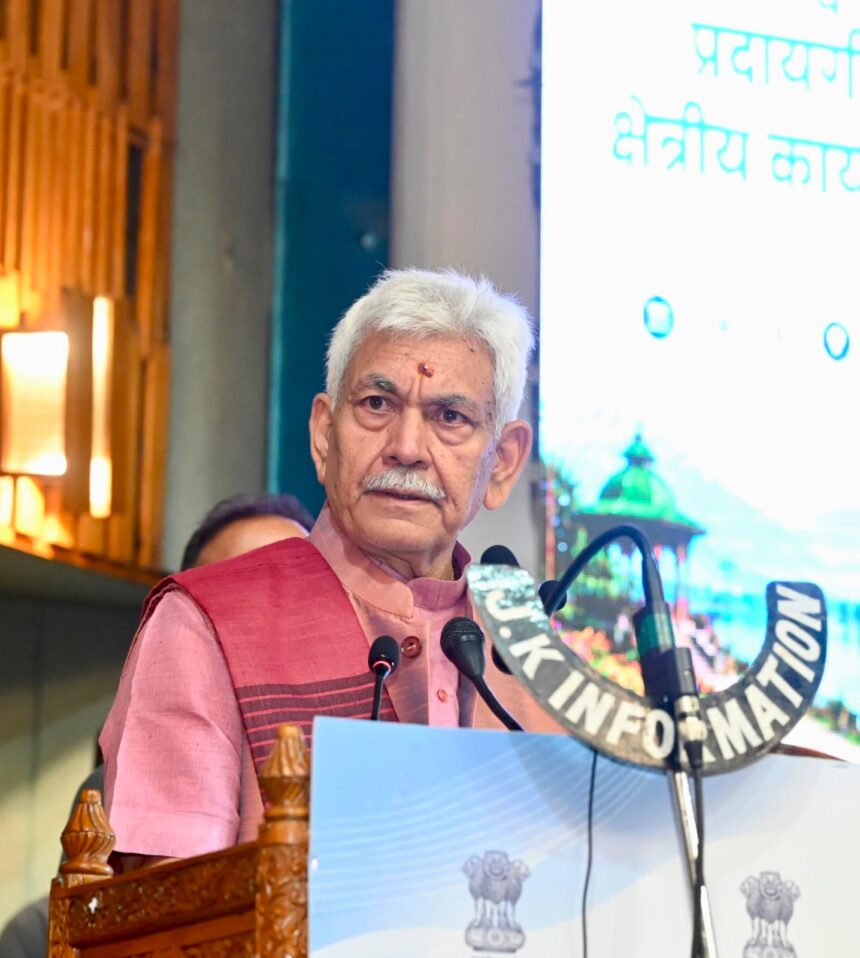
Srinagar: Jammu and Kashmir Lieutenant Governor Manoj Sinha on Tuesday said the Union Territory has transformed public service delivery through a “people first” governance approach, expanding digital access to government services and strengthening grassroots institutions to improve last-mile delivery.
Addressing the regional workshop titled “Seva Se Samriddhi – Panchayat-led Service Delivery”, organised by the Union Ministry of Panchayati Raj in collaboration with the J&K Administration, the Lieutenant Governor said the reforms undertaken since 2020 were aimed at ensuring that governance reaches citizens at their doorstep.
Sinha said Jammu and Kashmir expanded online public services from only 35 in 2020 to more than 1,100 by 2023, enabling the Union Territory to secure the top position in national e-service delivery rankings.
Highlighting the role of local governance institutions, he said the administration strengthened the three-tier Panchayati Raj system and positioned Panchayati Raj Institutions as key participants in governance. Initiatives such as Block Diwas and Back to Village were introduced to improve doorstep delivery of services, align infrastructure with local needs and promote policy-making from the grassroots level.
The Lieutenant Governor said the administration placed citizens’ aspirations at the centre of governance and sought to improve accountability and public participation, which helped build trust between institutions and people.
Calling for wider adoption of successful governance practices, Sinha urged delegates from Haryana, Jharkhand, Karnataka, Himachal Pradesh, Uttar Pradesh and Uttarakhand to study Jammu and Kashmir’s grassroots service delivery models including BEAMS-EMPOWERMENT, Aapki Zameen-Aapki Nigrani, and Your Mobile–Our Office, which he said had improved service delivery and programme implementation in villages.
Referring to digital adoption, Sinha cited a Government of India assessment which recorded around 20 million digital transactions in Jammu and Kashmir between 2016 and 2018, while the UT registered nearly 50 crore digital transactions in the first six months of 2023 alone.
He said more than 15,000 Common Service Centre (CSC) outlets are currently operational across Jammu and Kashmir and that 4,211 out of 4,290 panchayats have been connected to the network, achieving 98.16 per cent coverage. The remaining panchayats, he said, are located in remote and border areas where connectivity continues to remain a challenge.
The Lieutenant Governor stressed the need for greater inter-state learning and exchange of successful governance models, saying innovations in one region could help improve service delivery elsewhere.
Describing the regional conference as a reflection of India’s values of unity in diversity, cooperation and service-led development, Sinha said the objective should be to build panchayats where citizens can access services digitally, grievances are resolved quickly, decisions are participatory and accountability becomes institutionalised.
He said panchayats of the future should evolve beyond administrative units and emerge as centres of innovation, equal opportunity, sustainable development and public trust.
Sharing recommendations for states and Union Territories, Sinha proposed establishment of Village Innovation Labs in every panchayat with participation from youth, Krishi Vigyan Kendras and social organisations to develop local solutions in areas such as solar energy and irrigation.
He also advocated modern capacity-building programmes for panchayat leaders, institutionalisation of participatory budgeting, expansion of sustainability campaigns such as Green Jammu Kashmir, Ek Ped Maa Ke Naam and Ek Ped Beti Ke Naam, and greater leadership roles for women across governance initiatives.
During the workshop, Panditpora Gram Panchayat in Kupwara and Syed Waris Hafiz, a CSC Village Level Entrepreneur from Budgam, along with outstanding Gram Panchayats and CSCs from participating states, were felicitated.
The workshop was organised in collaboration with CSC-SPV, the Ministry of Electronics and Information Technology, and the Department of Rural Development and Panchayati Raj, J&K. Representatives from civil society organisations, academic institutions and rural technology organisations participated in discussions focused on digital transformation, citizen participation, innovation and improving accessibility of public services at the grassroots level.
J&K Minister for Rural Development and Panchayati Raj Javid Ahmad Dar, Secretary Ministry of Panchayati Raj Vivek Bharadwaj, Commissioner Secretary IT Saurabh Bhagat and other senior officials attended the inaugural session.

