



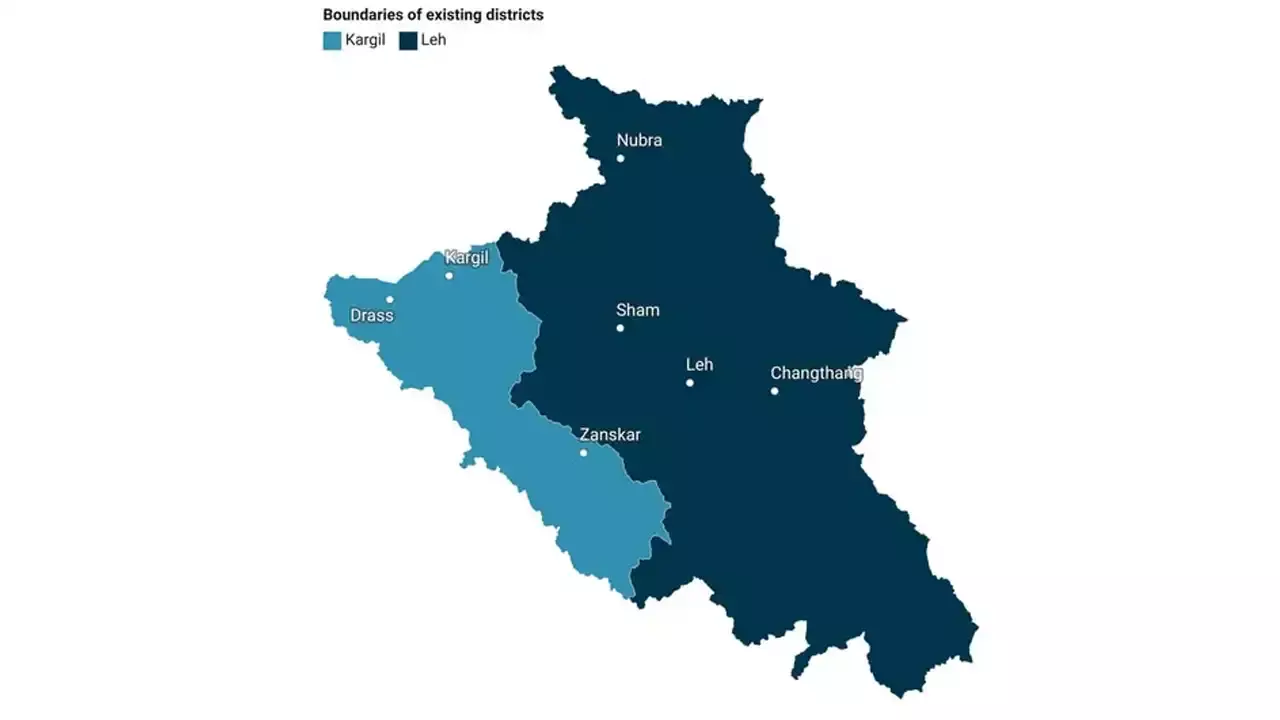
Jammu: The creation of five new districts in Ladakh has triggered a political storm in the otherwise peaceful region, with several political parties and regional leaders alleging that the move is aimed at “dividing the unified democratic and statehood movement” of the people while introducing a “regional and sectarian imbalance”.
Critics have termed the decision as “gerrymandering in the erstwhile state of Jammu and Kashmir,” warning that it could deepen existing regional fault lines and carry “dangerous consequences that history has already witnessed.” Leaders asserted that any attempt to divide people along sectarian or regional lines would be “firmly resisted”.
They pointed out that the reorganization has resulted in five Buddhist-majority districts and only two Muslim-majority ones, calling it a “skewed distribution” that could aggravate divisions in the Union Territory.
The statements assume significance as the Union Home Minister Amit Shah is set to arrive in Ladakh on a two-day visit to the Union Territory beginning tomorrow.
Senior leader of the Kargil Democratic Alliance (KDA), Sajjad Kargili, alleged that the move appeared “less like an administrative reform and more like a calculated move aimed at dividing the unified democratic and statehood movement of Ladakh’s people—particularly to weaken the collective voice of the Buddhist and Muslim communities,” Sajjad Kargili, senior leader of Kargil Democratic Alliance (KDA) tweeted.
He further said, “While we acknowledge the longstanding demands of regions like Dras and Zanskar and welcome their elevation to district status, the overall approach raises serious questions. The entire process has overlooked regional sensitivities, demographic realities, and principles of fair representation”.
Citing the 2011 Census, Kargili said Ladakh’s population comprises around 46.40 per cent Muslims and 39.65 per cent Buddhists, but the new district arrangement does not reflect this balance. “This disproportionate division reflects a biased and discriminatory mindset, contrary to the principles of justice, equality and harmony,” he said, cautioning that such decisions could deepen divisions in the region.
He said they strongly oppose this “arbitrary and insensitive decision” and added, “In particular, we reiterate the legitimate and longstanding demand to grant district status to Sankoo-Suru, Barsoo, and Shakarkatna. The people of these areas have repeatedly submitted memorandums to the government and presented their demands with strong arguments, yet they have been consistently ignored”.
“We express complete solidarity with the people of Sankoo, Suru, Barsoo, and Shakarkatna and will continue to fully support their rightful demands. Ladakh’s true strength lies in its unity and diversity; therefore, every attempt to divide its people on sectarian or regional lines will be firmly resisted”, he said.
The issue also drew sharp reaction from Hyderabad MP Asaduddin Owaisi, who alleged that the government’s decision was aimed at dividing the unified statehood movement of Buddhists and Muslims in Ladakh. Referring to census figures, he also questioned the reorganization phenomenon, stating that five districts have been created for a smaller percentage of the population, while only two cater to a larger segment.
“There are now 7 instead of 2 districts. The govt wants to divide the unified statehood movement of Buddhists and Muslims. This is another gerrymandering in the erstwhile state of Jammu and Kashmir. As per the 2011 Census, Ladakh has 46.40% Muslims and 39.65% Buddhist population out of the total population of 274289. Out of the 7 districts, 5 are Buddhist majority, only 2 are Muslim. Basically 5 districts for 39.65% population and only 2 districts for 46.40% population,” he had said.
Ladakh Lok Sabha MP Mohmad Haneefa Jan welcomed the creation of new districts, calling it a significant step towards strengthening grassroots governance and accelerating development. He congratulated residents of Nubra, Zanskar, Drass, Sham and Changthang on achieving long-pending administrative recognition.
However, he also strongly pressed for district status for Sankoo–Suru and Shakar–Chiktan–Shargole, noting that these are among the most populous and geographically vast areas of Ladakh. He said carving out separate districts for these regions is both justified and urgently required to ensure better governance and service delivery.
Pertinently, the Prime Minister Narendra Modi has congratulated the people of Ladakh, saying the new districts would bring government services and development closer to residents living up to 300 km away from Leh and Kargil. The Lieutenant Governor of Ladakh has called the notification of new districts as a “historic day for Ladakh.”

