



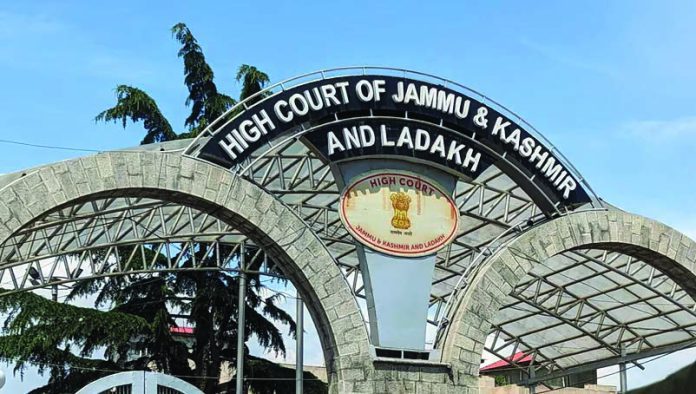
Jammu: The Jammu & Kashmir and Ladakh High Court has held that the Shri Mata Vaishno Devi Shrine Board, despite being a statutory body, does not qualify as “State” under Article 12 of the Constitution due to the absence of government control.
In a detailed judgment, Justice Sanjay Dhar observed that the determining factor for bringing an संस्था within the ambit of Article 12 is not merely its statutory origin but the extent of control exercised by the government. The Court noted that in the absence of financial, functional or administrative control, the Shrine Board cannot be treated as “State.”
The ruling came in a petition filed by a Pujari who had challenged his disengagement in 1988, alleging that the termination was arbitrary and violative of constitutional safeguards, including Articles 14, 16 and 311. The petitioner had also sought reinstatement and questioned provisions of the Shri Mata Vaishno Devi Shrine Act.
Opposing the plea, the Shrine Board contended that the petitioner’s appointment was purely on an adhoc basis and did not confer any right to continue in service. It was also argued that since the Board is not “State,” constitutional protections available to government employees are not applicable.
While examining the issue, the Court reaffirmed that although the Shrine Board is not “State” under Article 12, it can still be amenable to writ jurisdiction under Article 226 in cases involving a public law element. However, it clarified that writ jurisdiction cannot be invoked to enforce rights arising out of purely private contracts.
In the present case, the Court found that the dispute stemmed from a contract of service between the petitioner and the Shrine Board, which was purely private in nature and did not involve any public duty. On this ground, the writ petition was held to be not maintainable.
The Court further observed that the petitioner, being an adhoc employee, had no vested right to continue in service. It noted that the disengagement order was not punitive or stigmatic but based on the requirement of the Board, which had stated that the services were no longer needed.
Accordingly, the High Court dismissed the petition, holding that it lacked merit.

