



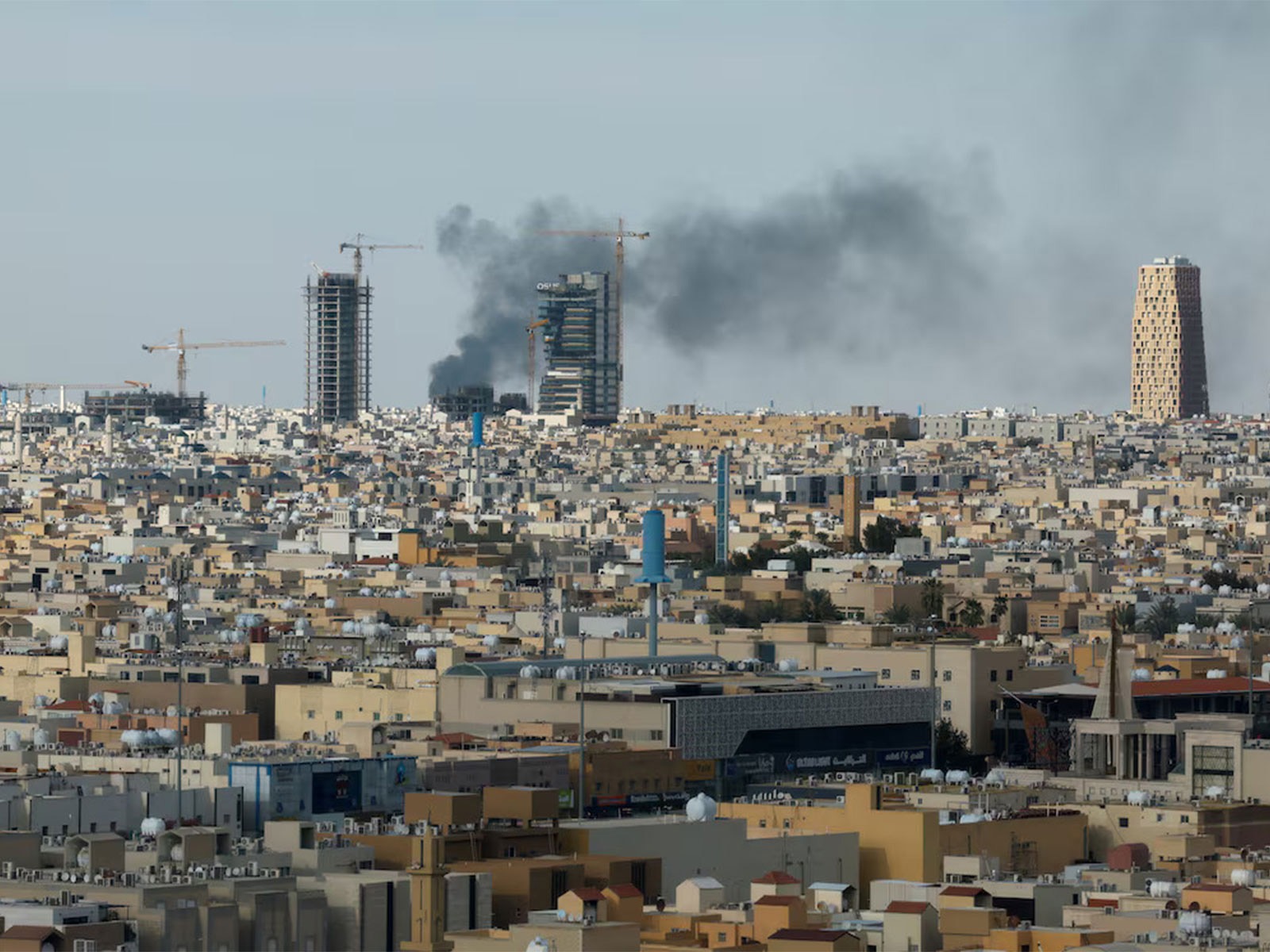
Washington, Mar 17: The US Embassy and a hotel in Baghdad were targeted by drones early Tuesday, with video appearing to show air defences engaging a projectile near the embassy, CNN reported.
The Majnoon oil field in southern Iraq also came under attack, the spokesperson for the Commander-in-Chief of Iraq’s armed forces said, according to the US broadcaster.
Meanwhile, a report in the Anadolu Agency cited an unnamed security source telling the Shafaq news agency that four drones attempted to target the US Embassy in Baghdad. The report added that Iraq’s air defences managed to intercept and shoot down all drones before they reached their targets, the source said, noting that one drone fell on Abu Nuwas Street, while another landed near the embassy inside the Green Zone.
A new wave of rockets has struck an American diplomatic facility near Baghdad airport, as per a report by Al Jazeera.
Iraq’s Ministry of Interior confirmed that a drone fell on the Al-Rasheed Hotel early Tuesday local time, according to CNN.
“The ministry wishes to clarify that, after specialized forensic teams conducted an on-site and technical inspection, it was found that a drone had struck the upper fence of the hotel, without resulting in any loss of life or significant material damage,” Iraq’s interior ministry said in a statement.
Videos, geolocated by CNN, shows an explosion close to the vicinity of the US Embassy in Baghdad. Other videos showed a projectile consistent with a drone impacting the area near the embassy, and air defence systems engaging a projectile over Baghdad around 600 meters away from the embassy compound.
Meanwhile, the United Arab Emirates temporarily closed its airspace after two separate fires broke out at the Fujairah oil zone and the Shah gas field after drone strikes at both locations, CNN reported.
Tensions seem to escalate further between the US-Israel and Iran as both sides continue with attacks.
Earlier, the Ministry of Defence in Saudi Arabia confirmed that several unmanned aerial vehicles were neutralised in the eastern portion of the kingdom. According to officials, the drones were “intercepted and destroyed” after being detected in the region.
This defensive action follows an earlier report from the ministry regarding a similar security operation in the same area. In that instance, Saudi forces engaged six drones, all of which were “successfully destroyed” to prevent any impact.
In the context of these heightening tensions, Mohamed bin Zayed Al Nahyan, President of the United Arab Emirates, held a telephone conversation yesterday with Prince Mohammed bin Salman bin Abdulaziz Al Saud, Crown Prince and Prime Minister of Saudi Arabia, to review regional developments, as reported by Gulf News.
During the call, the two leaders assessed the impact of escalating military actions, which they identified as presenting “grave threats to regional and global security and stability”.
The discussion, according to Gulf News, also addressed the ongoing and “blatant Iranian attacks” directed at nations throughout the region. Both parties noted that these actions constitute a “violation of sovereign rights” of the affected countries and contravene established international norms.
Before this, a tanker was hit by an “unknown projectile” approximately 23 nautical miles east of Fujairah in the United Arab Emirates, according to the United Kingdom Maritime Trade Operations (UKMTO).The agency noted in a post on X that the vessel was “at anchor” when the incident occurred. While the strike caused “minor structural damage” to the tanker, the vessel’s integrity remained stable.
There were “no injuries reported” to the crew following the impact, the maritime agency confirmed in its advisory. Furthermore, officials stated that “no environmental impact” was detected in the surrounding waters.
The UKMTO has confirmed that “authorities are investigating” the matter. In the meantime, all vessels operating in the region have been “advised to transit with caution” and to notify the agency of any “suspicious activity.”
This maritime incident coincides with reports of further instability on land. A fire has erupted within the Fujairah Oil Industry Zone following a drone strike at the facility, according to a report by Al Jazeera, citing the local government’s media office. (AGENCIES)News Bulletins Service
India Hits Out At Pak Over Ahmadiyyas Persecusion, Air-Bombings Against Afghan In UNGA
UNITED NATIONS, Mar 17: India called out Pakistan for its habit of “fabricating imaginative” tales of Islamophobia in neighbouring countries, questioning how Islamabad’s own brutal repression of Ahmadiyyas or air-bombing campaigns during Ramzan against Afghanistan can be characterised as.
“India’s western neighbour is an excellent example of fabricating imaginative tales of Islamophobia in their neighbourhood,” India’s Permanent Representative to the UN Ambassador Parvathaneni Harish said.
“One wonders what would brutal repression of Ahmadiyyas in this country be termed, or the large-scale refoulement of the helpless Afghans or air-bombing campaigns in this Holy Month of Ramadan?” Harish said.
Harish was addressing the UN General Assembly commemoration of the International Day to Combat Islamophobia on Monday.
In a strong retort, he also said that the Organisation of Islamic Cooperation, which “our western neighbour has systematically attempted to weaponise against India”, has repeatedly made false and baseless allegations against my country.
He stressed that it is important for the UN to take note of the rising trend and dangers of weaponising religious identity and instrumentalising it to serve narrow political ends by state and non-state actors alike.
Underlining that India is home to more than 200 million Muslims, one of the largest populations of the community in the world, he said Muslims in India, including those in Jammu and Kashmir, elect their own representatives to speak for them.
“The only ‘phobia’ evident here appears to be directed against the multicultural and peaceful coexistence that all communities in India enjoy, including Muslim communities,” he said.
“Such narratives run counter to India’s fundamental ethos and reflect instead the sectarianism and terrorist mentality that this country has perpetuated since its inception. That is the real issue at hand,” he said.
Harish said that history bears repeated witness to how the politicisation of religion does not solve and resolve grievances; however well-intentioned, they risk lending legitimacy to precisely this kind of selective, polarising narratives that breed further division.
“The United Nations was conceived as an institution that transcends religion, culture, and politics. Its credibility rests on universality and impartiality. We, therefore, urge caution against frameworks that exclusively focus on one faith, without addressing the broader phenomenon of religiophobia in all its manifestations,” he said.
India noted that the 1981 Declaration on the Elimination of All Forms of Intolerance and of Discrimination Based on Religion or Belief remains a very balanced and enduring instrument that enshrines the rights of all religious followers without privileging any.
India also strongly condemned violence and hatred in the name of religion, regardless of the religion in question. As a nation where followers of virtually every major world religion coexist peacefully and a nation that has given birth to four major world religions, namely Hinduism, Buddhism, Jainism and Sikhism, India, more than any other country, is acutely aware of the need for a world free from religious discrimination.
“The philosophy of ‘Sarva Dharma Sambhava’ implying equal respect for all religions has been the civilizational way of life for India and one that inspired the secular ethos of the Indian Constitution,” he said.
Harish noted that the United Nations’ greatest contribution to peace and human dignity lies in its efforts to maintain international peace and security, bringing everlasting peace in conflict situations, its development work and humanitarian action, and its promotion of universal human rights – work that is conducted without regard to the faith of those it serves.
“Global public goods, like sunshine, should be available to one and all, irrespective of affiliations. The UN has built its credibility through tireless work on conflict resolution, poverty alleviation, and protection of civilians. We urge the UN to remain anchored to this founding spirit,” he said.
India reaffirmed its commitment to a world free from religious hatred and violence in all its forms. “We urge the UN to channel its time and limited resources towards building inclusive societies grounded in equality, dignity, and the rule of law – for every individual of every faith,” Harish said. (Agencies)

