



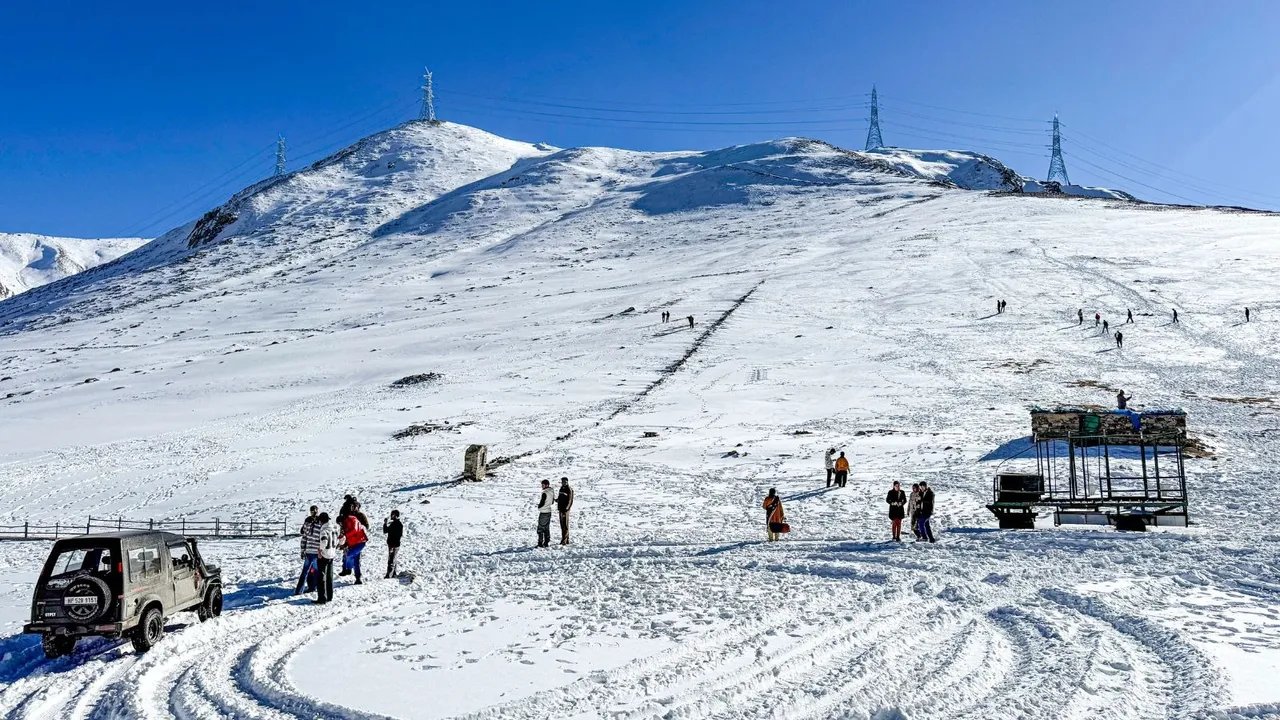
Jammu: A weak Western Disturbance continues to influence weather conditions across Jammu and Kashmir, bringing fresh snowfall to parts of the Kashmir Valley, sub-zero temperatures in higher reaches and prompting authorities to issue travel advisories even as key road links remain operational.
Several areas of north Kashmir received fresh snowfall on Tuesday afternoon.
Officials said places including Gurez in Bandipora district, Gulmarg in Baramulla and Macchil in Kupwara witnessed snowfall, while upper reaches such as Sadhna Top and the Tulail Valley received light to moderate snow. Most other parts of the Valley remained generally cloudy.
According to the India Meteorological Department (IMD), generally cloudy weather is expected across Jammu and Kashmir from December 30 to January 10, with intermittent rain or snowfall at many places. Light to moderate rain or snow is likely over most areas during the night of December 31 to January 1, while higher and extreme upper reaches of north and central Kashmir may receive moderate to heavy snowfall.
From January 2 onwards, weather is expected to remain partly to generally cloudy with isolated light rain or snowfall.
Partly cloudy conditions are forecast for January 3 to 5 and January 7 to 8, while January 6 may see light snowfall over isolated higher reaches. The IMD has also indicated partly to generally cloudy conditions from January 9 to 10, followed by partly cloudy weather till January 13.
Despite fresh snowfall, Kashmir is witnessing an unusually warm winter during the ongoing Chilla-e-Kalan, a 40-day period traditionally associated with severe cold. The Meteorological Department said temperatures across the Valley are hovering three to four degrees above the seasonal average.
On Monday night, Srinagar recorded a minimum temperature of 1.0 degree Celsius, which is 3.6 degrees above normal. Gulmarg, the coldest place in the Valley, recorded minus 1.6 degrees Celsius, while Pahalgam in south Kashmir recorded a low of minus 1.2 degrees. Qazigund, the gateway town of the Valley, saw the mercury dip to 1.4 degrees Celsius. All these locations remained around four degrees above their usual minimum temperatures.
In north Kashmir, Kupwara recorded a minimum of 2.0 degrees Celsius, while Awantipora in south Kashmir recorded 1.0 degree. In the Jammu region, Jammu city recorded a minimum temperature of 8.6 degrees Celsius, Katra 9.8 degrees, Bhaderwah 3.8 degrees and Kishtwar minus 1.5 degrees Celsius.
Ladakh continued to reel under intense cold conditions, with Leh recording a minimum of minus 8.4 degrees Celsius, Kargil minus 7.9 degrees and Nubra Valley minus 4.2 degrees, indicating the persistence of severe cold wave conditions in the region.
Meanwhile, traffic movement on the Mughal Road, connecting Rajouri and Poonch districts with south Kashmir, was resumed on Tuesday after remaining temporarily suspended due to adverse weather and foggy conditions. Officials said the road was reopened after an improvement in weather and clearance of the affected stretches, with necessary arrangements put in place to ensure safe movement of vehicles.
Traffic on the Jammu–Srinagar National Highway continued to ply normally. However, authorities advised motorists to remain cautious, particularly in fog-prone areas and high-altitude stretches where icy road conditions could pose risks.
Officials have urged travellers and tourists to exercise caution, carry adequate winter gear and stay updated with official weather and traffic advisories, especially as the region prepares for New Year celebrations amid cold and wet conditions.

