



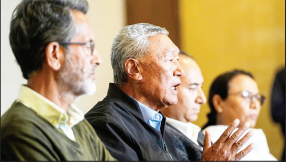
LAB, KDA seek ‘empowered’ Autonomous District Councils, amnesty for Sonam Wangchuk, all detainees
30-member Assembly with 28 seats reserved for STs of Ladakh proposed; 2 LS seats, separate PSC for Ladakh sought
Arteev Sharma
Jammu: : The Leh Apex Body (LAB) and the Kargil Democratic Alliance (KDA) on Monday formally submitted a comprehensive 29-page draft framework to the Ministry of Home Affairs (MHA), pressing for Ladakh’s inclusion under the Sixth Schedule powers along with a strong case for granting full-fledged Statehood with “protections under XXI and Article 371 of the Constitution of India”.
Describing their proposal as a “Sui Generis Model for Protected Statehood and Sixth Schedule,” the two influential groups recommended replacing the existing Autonomous Hill Development Councils of Leh and Kargil with more empowered Autonomous District Councils (ADCs) on the lines of ADCs under the Sixth Schedule, and extended to all existing and newly created districts, including the five new districts proposed for Ladakh.
The draft framework outlines sweeping legislative powers for the ADCs, ranging from the allotment, use, occupation, and conservation of land to the regulation of land alienation in order to safeguard tribal and permanent residents.
It also proposes Council authority over community land management—including kahcharai and shamilat—and regulation of mining, quarrying, natural resources, renewable and non-conventional energy, environmental protection, ecology, desert development, and agricultural water use.
The Councils, it states, must also have the mandate to preserve cultural heritage, promote local languages, scripts, dialects, music, and literature, and protect cultural monuments, monasteries, shrines, and archaeological sites. They would additionally regulate traditional institutions such as Tsogspa, Goba, Nambardar, and Anjuman/Majlis.
The draft further proposes that ADCs legislate on succession to property, district development programmes, budgeting, grassroots implementation guidelines, district planning, and the management of Council-vested assets, including roads excluding highways.
Their developmental jurisdiction would extend to employment generation, poverty alleviation, cooperatives, notified area committees, small-scale and cottage industries, tourism, transport, and vocational training.
The Public health, sanitation, hospitals, education, livestock protection, and recruitment to public posts up to Group B/Class II would also fall within their ambit. The framework adds that any additional matter under the State’s executive authority may be assigned through government notification.
The LAB and KDA leaders argued that bringing the Autonomous Hill Councils under the Sixth Schedule would give them legislative powers in order to frame laws in the specific context of Ladakh and also boost participatory democracy. “As of date, the councils are structurally very similar to the hill councils in the six schedule areas; however, their powers are very limited to only rule-making. The removal of the assembly and the council vis-à-vis Article 370 and 35A has further disempowered the councils,” they said.
The draft also proposes that the future State Government of Ladakh should frame rules for the constitution of ADCs, covering qualifications for members, election procedures, Council functioning, conduct of business, and staffing. Each ADC would have a five-year term.
Citing examples of Sikkim and Mizoram—both former Union Territories that were later granted statehood, the leaders asserted that Ladakh’s distinct cultural identity and administrative history merit similar treatment.
…There is already a case in favour of Ladakh that the elected representatives can run the government efficiently, honestly and within the spirit of the constitution of India. Granting statehood and an assembly shall strengthen democratic governance and encourage more local, inclusive participation. The formation of the new districts has also made it more imperative to have a legislative body that represents all the regions of Ladakh under one roof,” they have said in the draft.
In a key political demand, the LAB and KDA leaders have also sought general amnesty for climate activist Sonam Wangchuk and others detained following the September 24 protests in Leh. They urged the Centre to withdraw all cases unconditionally, describing the move as vital for sustaining the ongoing dialogue.
They have sought unconditional withdrawal of all the cases against Sonam Wangchuk and his immediate release claiming it would help in conducting ongoing dialogue process in a smooth manner. “The extension of such a general amnesty would serve as a huge confidence-building measure that would reinforce the spirit of dialogue and mutual trust between the people of Ladakh and the government of India,” the leaders said.
“Such a gesture would also be in keeping with India’s long democratic tradition of reconciliation and goodwill. The Government of India has, in the past, adopted similar approaches in the North east as well as in Jammu and Kashmir, where the withdrawal of cases and release of detainees played a pivotal role in restoring normalcy and strengthening public confidence in the Union’s intentions. Such a healing hand approach in the case of Ladakh shall ensure that Ladakh always remains the peaceful place it has been known for in the Country as well as the sub-continent,” they said.
The draft further proposes two parliamentary seats in Lok Sabha for Ladakh while it recommends a 30-member Legislative Assembly wherein all members to be chosen by direct election from the same number of assembly segments. Out of 30 seats, the draft proposes that 28 constituencies shall be reserved for the members of Scheduled Tribes (STs) of Ladakh.
The draft further recommends the creation of an exclusive Public Service Commission for Ladakh. It proposes that the rules and processes followed by the Jammu & Kashmir Public Service Commission prior to the 2019 Reorganisation Act be applied mutatis mutandis to the Ladakh PSC, ensuring a robust recruitment system tailored to local needs.

