



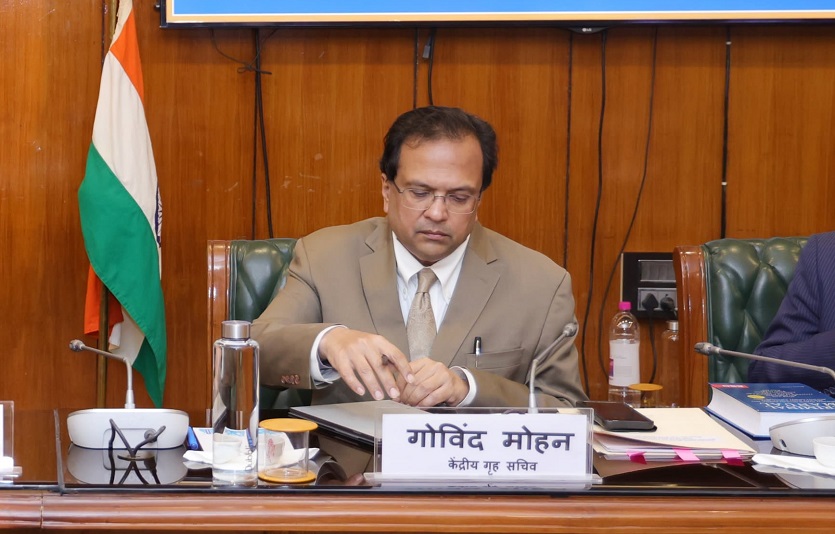
Union Home Secretary Govind Mohan is set to chair a high-level security review in Srinagar on November 5, focusing on the prevailing situation in Jammu and Kashmir. The meeting will bring together senior officials from the police, paramilitary forces, civil administration, intelligence agencies, and other key stakeholders. The primary agenda includes intensifying operations against militants in higher-altitude areas and implementing measures to prevent cross-border infiltration.
Although the Darbar Move was scheduled to conclude in Srinagar on October 31 and November 1, with offices reopening in Jammu on November 3, senior officials from the Home and Police Departments have been instructed to remain in Srinagar until after the Home Secretary’s visit, according to official sources.
This review follows an earlier security assessment led by Union Home Minister Amit Shah in New Delhi on October 9, during which he reiterated the Centre’s commitment to a terrorism-free Jammu and Kashmir.
The upcoming meeting will be attended by Chief Secretary Atal Dulloo, Home Secretary Chandraker Bharti, Director General of Police Nalin Prabhat, Intelligence Chief Nitish Kumar, and the Inspectors General of both Jammu and Kashmir divisions. Senior officers from the Central Armed Police Forces (CAPFs) based in New Delhi and J&K, along with other relevant officials, are also expected to participate. Officials from the Ministry of Home Affairs overseeing J&K affairs will be present as well.
Sources indicate that intelligence inputs suggest militants currently hiding in the upper reaches may descend to lower areas as snowfall begins in November and December, making them more vulnerable to detection and neutralization. A coordinated strategy is likely to be formulated to address this anticipated movement. Security forces—including the Army, paramilitary units, J&K Police, and Special Operations Group—are continuing their operations in these remote zones.
The meeting will also focus on a comprehensive winter security plan aimed at achieving zero infiltration along the Line of Control (LoC) and International Border (IB). Enhanced efforts to eliminate remaining militant elements within the hinterland are also on the agenda.
Reports have highlighted the presence of foreign militants in the higher terrains of Kishtwar, Udhampur, Rajouri, Poonch, and other districts in the Jammu region, as well as in the Kashmir Valley. In recent months, security forces have engaged in multiple encounters, resulting in the elimination of several militants, including top commanders, though some personnel have also made the ultimate sacrifice.
Additionally, the meeting will review the status of border infrastructure, particularly fencing along the IB in Jammu, Samba, and Kathua districts, which suffered significant damage during the August floods. The Border Security Force (BSF) has since undertaken repairs and reconstruction of damaged fencing and border outposts.
There were also earlier reports of infiltration through the IB in the Hiranagar sector of Kathua district. In one such incident at the end of March, four police personnel lost their lives and two militants were killed after a prolonged encounter. However, a few infiltrators reportedly managed to escape.
The Home Secretary’s review is also expected to cover the progress of post-flood rehabilitation and reconstruction efforts in the Jammu region. The J&K Government continues to await a special relief package from the Centre, similar to those extended to flood-affected states like Punjab, Himachal Pradesh, and Uttarakhand. During a recent visit to Jammu, Union Home Minister Amit Shah had announced a ₹209 crore relief package for the Union Territory under the State Disaster Response Fund (SDRF).

