



Deep. Sharma
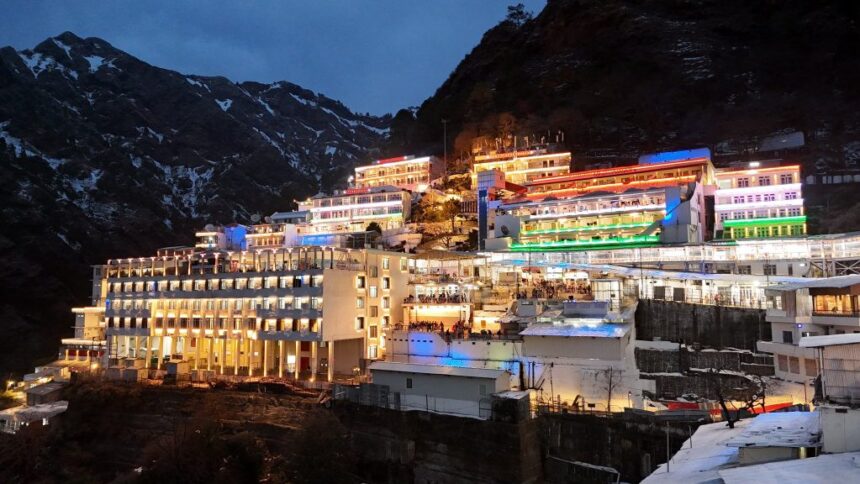
Jammu: With the nine-day Sharadiya Navratri festival beginning October 11, the Shri Mata Vaishno Devi Shrine Board and the Reasi district administration have stepped up preparations to manage the expected rush of pilgrims at Katra and along the pilgrimage route to the Mata Vaishno Devi Bhawan.
As part of the arrangements, elderly and specially-abled pilgrims will be provided free battery car, pony and palki services from Katra to Bhawan during Navratri, from October 11 to 19. Special darshan arrangements will also be made for them through Gate No. 2. Specially-abled pilgrims will be required to produce a valid disability certificate to avail the facility.
The Shrine Board is also preparing round-the-clock langar services at four major points along the pilgrimage route. Its food outlets will serve special Navratri vrat meals for devotees throughout the festival.
A senior Shrine Board official said arrangements were being strengthened across security and surveillance, sanitation and hygiene, medical and emergency services, uninterrupted water and power supply, and disaster preparedness. CCTV surveillance has been enhanced at key points in Katra and along the track to monitor crowd movement and security.
Eight dedicated help desks will operate at identified locations along the route to provide pilgrims with information, guidance and other assistance. The number of registration counters at Katra can also be increased if the rush warrants additional facilities.
The Mata Vaishno Devi Bhawan and other key locations will receive elaborate floral decorations during Navratri, with the overall decoration budget estimated at around ₹5 crore.
The main Bhawan, entrance to the ancient cave, Atka and routes around Katra will be decorated with flowers sourced from India as well as abroad. Lilies and tulips are brought from the Netherlands and Japan, orchids from Thailand and Malaysia, while gladiolus and gerbera are sourced from South Africa and Europe. Carnations are sourced from Colombia and Turkey, while anthuriums are brought from South America.
More than 500 professional artisans from different parts of the country are expected to work on the decorations. Traditional Indian flowers including marigold, rose, chrysanthemum, jasmine and champa will also form part of the arrangements.
Security arrangements have been strengthened from the Katra base camp to Bhawan, with re-verification measures being undertaken and the pilgrimage route kept under CCTV surveillance. The RFID-based tracking system will remain fully operational to monitor pilgrims along the route.
The security and traffic arrangements were reviewed by Reasi SSP Mukund Tibrewal during a comprehensive inspection of Katra town and the pilgrimage route. The review covered the track leading to Bhawan, parking areas, CCTV points, entry and exit locations, security checkpoints and the crowd-management plan.
Additional checkpoints and police deployment have been put in place at multiple locations in Katra ahead of the festival.
Tibrewal said traffic movement and parking would remain among the key challenges during Navratri. Authorities reviewed which vehicles would be permitted in designated parking areas and where movement would be restricted, besides security arrangements for parked vehicles and CCTV coverage.
The district administration is also working to expand parking capacity at the New Bus Stand to accommodate more vehicles during the festival.
The SSP appealed to local residents and parking operators to ensure functional CCTV surveillance at parking facilities, including private parking areas, and urged vehicle owners to avoid roadside parking during Navratri to prevent congestion.
He said the objective was to ensure that devotees face minimum inconvenience during the festival.
Authorities are also focusing on medical and emergency response arrangements, cleanliness, water and power supply and disaster preparedness along the pilgrimage route. A special cleanliness drive has been undertaken to keep the track clear and hygienic during the expected increase in footfall.
The Navratri period will also witness various religious and cultural programmes in Katra and at Bhawan, including Shobha Yatras, Prabhat Pheris, Kavi Sammelans and other events, requiring additional traffic and security arrangements.
The shrine witnessed significant pilgrim footfall during previous Navratri periods. Around 3.75 lakh pilgrims visited during Chaitra Navratri in 2025, while more than three lakh devotees visited during the March 19–27 Chaitra Navratri period in 2026. In 2024, 4,04,605 pilgrims visited during Navratri, including 1,61,699 during Sharadiya Navratri.
With a substantial pilgrim rush expected this year, authorities have placed crowd regulation, traffic management, security, pilgrim convenience and emergency preparedness at the centre of the Navratri arrangements.

